
Awlcraft SE is a fast-drying basecoat developed for metallic, pearlescent and special-effect colours. It is not a topcoat on its own: it provides the colour and effect, while the clearcoat applied over it provides gloss and protection. SE should therefore always be thought of as part of a basecoat/clearcoat system.
With effect colours, the key to success is even, uniform orientation of the aluminium or pearl pigments within the film. Even small changes in gun distance, speed and pressure show up as mottling and striping. That is why the application technique for Awlcraft SE differs from standard topcoats.
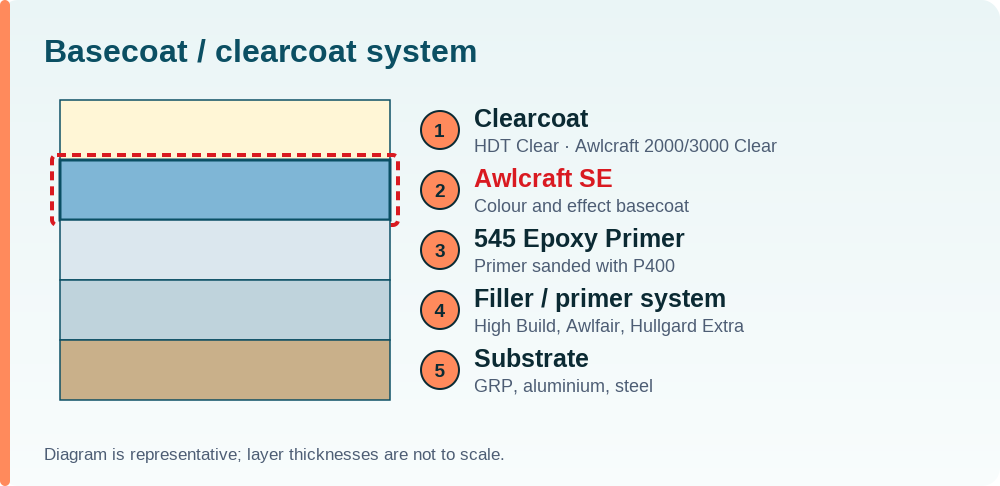
What does Awlcraft SE do and where does it sit in the paint system?#
SE is applied over a suitable Awlgrip primer (usually 545 Epoxy Primer) or over sanded old Awlgrip/Awlcraft topcoat. It must always be clearcoated. The data sheet gives Awlcraft 2000 Clear (2:1:1 with G3010) as an example. Awlgrip HDT Clear and Awlcraft 3000 Clear are also used as clearcoats over SE.
Which surfaces and where is it used?#
- Metallic (E code) and pearlescent (P code) hull colours
- Solid colour (L code) basecoat/clearcoat systems
- Stripes, logos and decorative details
- Repairable systems with HDT or Awlcraft clearcoat
Surface preparation: the stage that decides the outcome#
For maximum gloss and DOI the primer is sanded smooth with P400. Then the surface is wiped with T0170 in the US or T0340 in the EU using the two-cloth method. With effect colours, sanding scratches underneath are magnified by the metallic pigment and become visible, so a uniform sanding pattern matters even more than with standard colours.
Mix ratio, induction and pot life#
SE is mixed by volume 100 parts base + 15 parts hardener and reduced about 50% with T0001, T0003 or T0005. The target spray viscosity is 14–15 seconds in a DIN 4 cup. The data sheet gives no figure for pot life but states that it is noticeably shorter than that of normal topcoats. No accelerator is added.
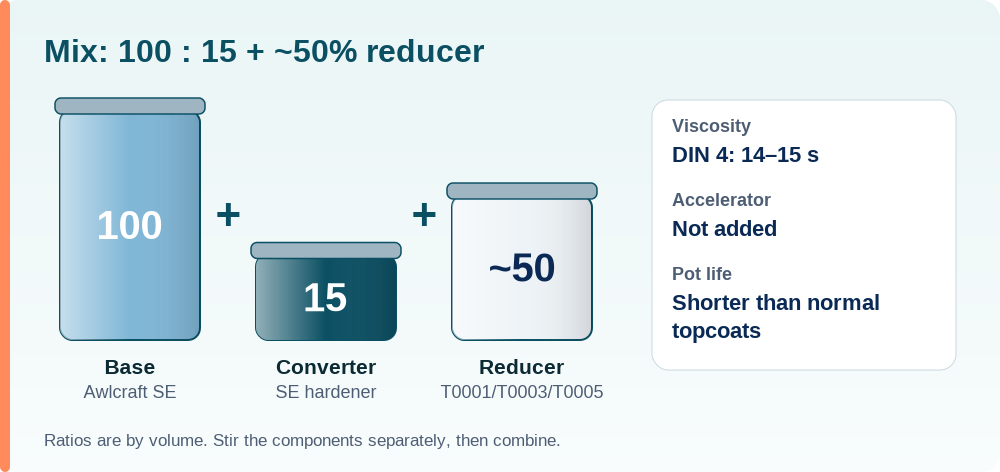
| Value | Data sheet value |
|---|---|
| Mix | 100 : 15 |
| Reducer | T0001 / T0003 / T0005 |
| Reduction | about 50% |
| Viscosity | DIN 4: 14–15 s |
| Accelerator | Not added |
Application: step by step#
SE is applied as two cross coats. Each coat is applied smooth, even and flowing, working in passes no wider than 25–35 cm at a time. Air pressure is kept constant. Between coats, wait until the film has flashed to matt; at 25 °C this takes about 10 minutes.
With solid colours, 1–2 wet coats until opaque are usually enough. On metallics and two-stage pearls, an optional drop coat (mist coat) can be applied before the clearcoat to even out pigment orientation. On three-stage pearls, opacity is first achieved with 2–3 solid coats, then 1–2 pearl mid-coats are applied evenly.
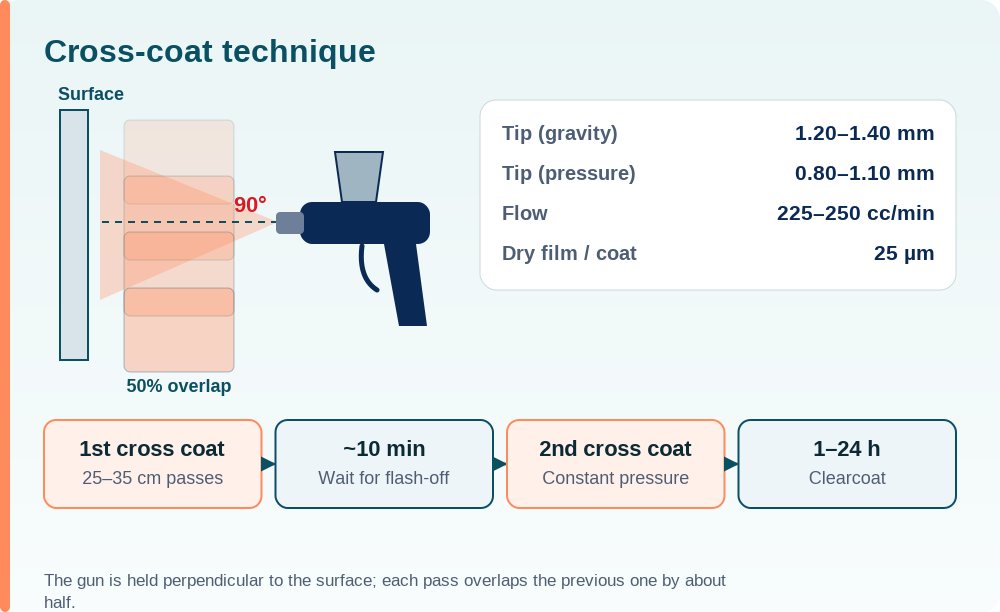
- 1st cross coat
Smooth, flowing coat; passes 25–35 cm wide.
- Wait for flash-off
About 10 minutes at 25 °C.
- 2nd cross coat
Same pressure and speed, in the opposite direction.
- Drop coat if needed
Evens out pigment orientation on metallics and two-stage pearls.
- Clearcoat
Two full clear coats within 1–24 hours, while the basecoat is fully matt.
| Spray setting | Gravity feed | Pressure feed |
|---|---|---|
| Tip size | 1.20–1.40 mm | 0.80–1.10 mm |
| Flow | 225–250 cc/min | 225–250 cc/min |
| Wet / dry film | 50 / 25 µm | 50 / 25 µm |
Drying and recoat times#
The basecoat must receive its clearcoat on time. At 25 °C the data sheet gives minimum 1, maximum 24 hours between basecoat and clearcoat. The basecoat itself is tape-free in 1 hour at 25 °C, ready for light use in 1 day and fully cured in 7 days.
| Condition (25 °C) | Value |
|---|---|
| Between coats | Until flashed to matt (~10 min) |
| Clearcoat minimum | 1 hour |
| Clearcoat maximum | 24 hours |
| Tape-free | 1 hour |
| Full cure | 7 days |
Application conditions: temperature, humidity and dew point#
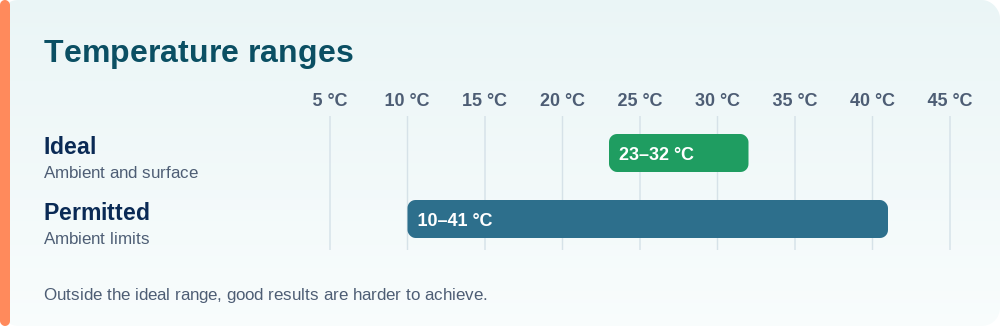
The ideal ambient and surface temperature for SE is 23–32 °C; outside this range good results are harder to achieve. The absolute limits are 10–41 °C. The surface must be at least 3 °C above the dew point.
Tips from the professionals#
- Keep gun distance and speed constant along the whole panel; in metallics the smallest variation causes mottling.
- Apply the drop coat from farther away and faster; the aim is not to cover but to orient the pigment.
- Do not touch the basecoat with bare hands; cleaning before the clearcoat is very limited.
- For three-stage pearls, use let-down panels to decide in advance how many pearl coats are needed.
Common mistakes#
- Two cross coats, constant pressure
- Flash-off to matt between coats
- Basecoat clearcoated within 1–24 hours
- Colour decision made on a clearcoated test panel
- SE left as a topcoat without clearcoat
- Heavy wet coats applied, metallic pigment floats
- Accelerator added
- Basecoat left for more than 24 hours
Health and safety#
Frequently asked questions#
What is the mix ratio of Awlcraft SE?
By volume 100 parts base + 15 parts hardener; about 50% reduction with T0001, T0003 or T0005.
Can Awlcraft SE be used without clearcoat?
No. According to the data sheet, SE must always be clearcoated.
When is the clearcoat applied over SE?
At 25 °C, after the basecoat has completely flashed to matt, within minimum 1 and maximum 24 hours.
Which clearcoats are used?
The data sheet gives Awlcraft 2000 Clear as an example; Awlgrip HDT Clear and Awlcraft 3000 Clear are also clearcoats designed for SE.
_Source: Awlgrip / AkzoNobel, Awlcraft SE product data sheet; Awlgrip HDT Clearcoat and Awlcraft 3000 Clearcoat technical data sheets; Awlgrip Application Guide (22nd edition). The values on this page are compiled from documents published by the manufacturer and may change as the product evolves. Always check the product label, the current technical data sheet (TDS) and the safety data sheet (SDS) before application._