
Awlgrip Topcoat is the classic polyurethane topcoat that gave the brand its name. It is known for its high gloss, distinctness of image (DOI) and chemical resistance; when yacht painters say "Awlgrip paint" they usually mean this product. It is used with two different converters, one for spray and one for brush and roller; choosing the right converter is the first condition for a good result.
Awlgrip Topcoat forms a hard, glossy, long-lasting film. That hardness is both its greatest advantage and its main limitation: the manufacturer's data sheet asks that classic Awlgrip surfaces not be waxed, compounded or polished. The product is designed as a low-maintenance topcoat that "stays as painted". For a topcoat that can be polished, Awlcraft 2000 and Awlgrip HDT are the options.
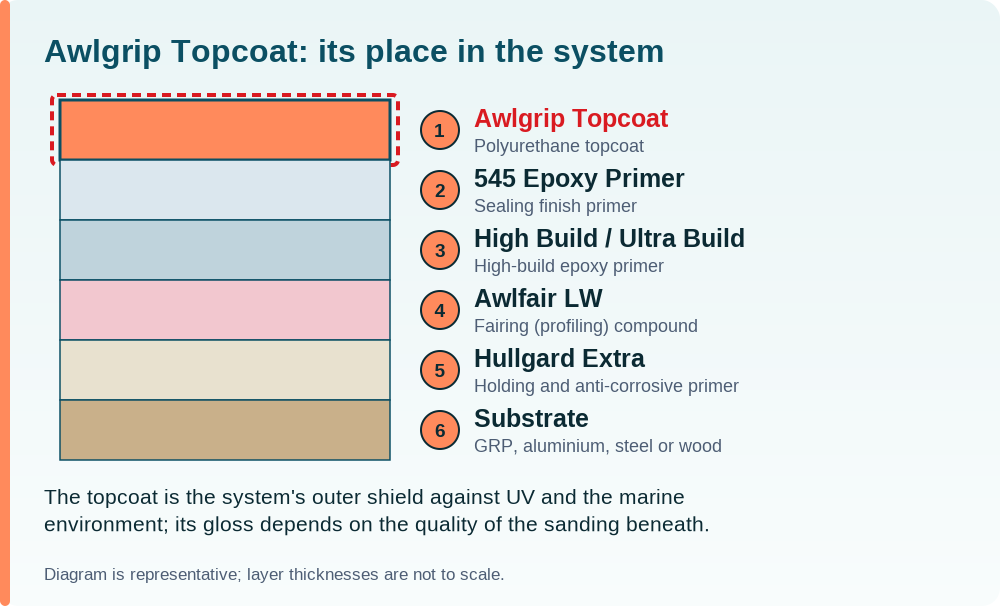
What does Awlgrip Topcoat do and where does it sit in the paint system?#
The topcoat is the visible, weather-exposed face of the paint system. UV light, salt water, fuel and cleaning chemicals attack this layer first. Thanks to its aliphatic polyurethane chemistry, Awlgrip Topcoat keeps its colour and gloss under UV for a long time.
But a topcoat is only as good as the system beneath it. The manufacturer states that the best results are obtained over properly prepared 545 Epoxy Primer. For brush and roller work the recommended primer is Awlquik. The sanding of the primer directly determines how smooth the topcoat will be.
Which surfaces and where is it used?#
- Topsides of fibreglass (GRP), aluminium, steel and wooden boats
- Superstructure, deck surfaces and flybridge
- Non-skid deck areas with Griptex additive
- Masts, booms and other hardware (with a suitable primer system)
Surface preparation: the stage that decides the outcome#
The most critical step before the topcoat is sanding the primer. Following the manufacturer's recommendation, 545 Epoxy Primer is sanded smooth with P280–P400. A very thin "guide coat" of lacquer primer in a contrasting colour is applied and sanded until it disappears completely, so no waves or low spots are missed.
Sanding dust is removed with clean compressed air and a vacuum, and the surface is wiped with Awlgrip surface cleaner (T0340 in Europe) using the two-cloth method. Immediately before application, the last dust is picked up with a tack rag.
Mix ratio, induction and pot life#
For spray application the base is mixed 1:1 by volume with G3010 (Awlcat #2) converter. The data sheet gives a reduction of 0–25%; the text also mentions "up to 33%" for standard air spray. The target is a spray viscosity of 11–14 seconds in a DIN 4 cup. The reducer is chosen by ambient temperature: T0002 is very fast, T0001 fast, T0003 standard and T0005 the hot-weather reducer.
For brush and roller application the converter is different: the base is mixed 2:1 by volume with H3002 (Awlcat #3) and reduced 10–33% with T0031. Never brush with the spray converter or spray with the brush converter.
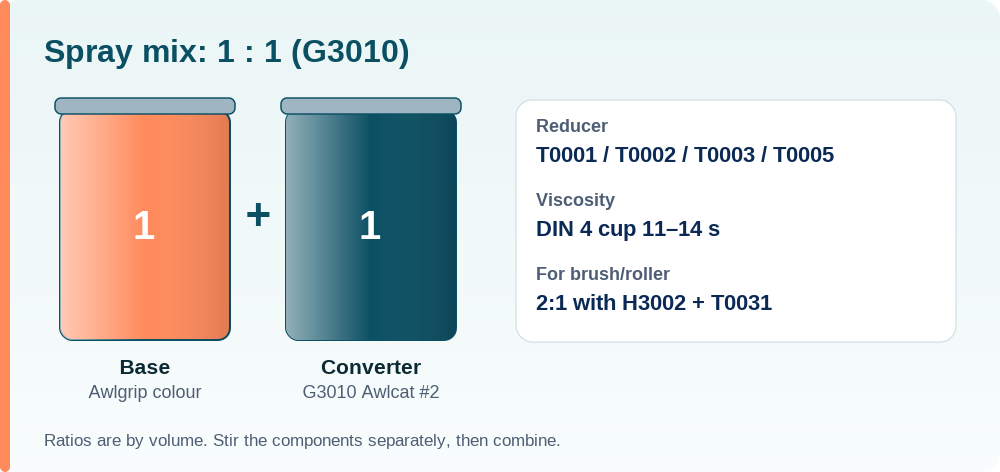
| Value | Spray | Brush / roller |
|---|---|---|
| Converter | G3010 (Awlcat #2) | H3002 (Awlcat #3) |
| Mix (base : converter) | 1 : 1 | 2 : 1 |
| Reducer | T0001 / T0002 / T0003 / T0005 | T0031 |
| Reduction | 0–25% (up to 33% in the data sheet text) | %10–33 |
| Pot life (25 °C) | 7 hours | Not stated in the data sheet |
Application: step by step#
By spray, Awlgrip Topcoat is usually applied in three coats; some colours need four or more for full hiding. The first coat is a light, "semi-wet" tack coat, followed by a 15–45 minute wait. The second coat is applied almost fully wet, then wait 30–45 minutes until the film is slightly tacky. The third coat is applied heavy enough for full hiding, but without sagging.
By brush and roller at least two coats are applied. On large areas, roll first, then lightly "tip" with a brush. With two people, one rolls and the other tips. Working alone, roll about 0.5 m² (6 ft²) and tip it immediately.
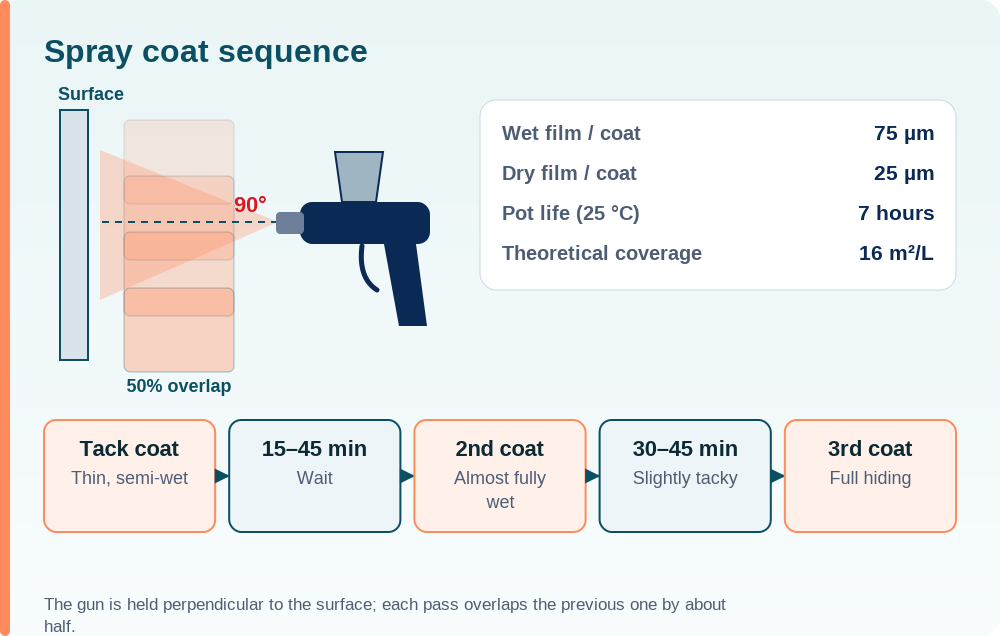
- Guide-coat sanding and cleaning
545 or Awlquik is sanded, dusted off and wiped with the two-cloth method.
- Tack coat
Apply a light, thin, semi-wet coat; wait 15–45 minutes.
- Second coat
Almost fully wet coat; wait 30–45 minutes until the film is slightly tacky.
- Hiding coat
Apply with enough build for full hiding, without sagging. A fourth coat if needed.
- Cure
No tape for 24 hours; light use after 3 days; full cure in 14 days.
| Value (spray) | Data sheet value |
|---|---|
| Wet film / coat | 75 µm |
| Dry film / coat | 25 µm |
| Theoretical coverage | 16 m²/L (100% transfer) |
| Volume solids | %40,2 |
| Value (brush/roller) | |
| Wet film / coat | 100–125 µm |
| Dry film / coat | 50–63 µm |
Drying and recoat times#
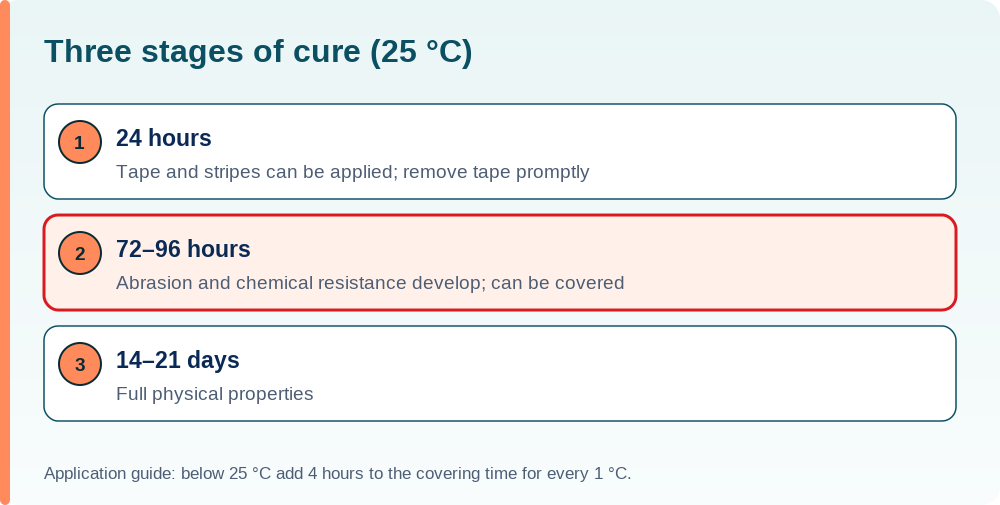
The cure of Awlgrip Topcoat is best thought of in three stages. In the first 24 hours the film becomes hard enough to take tape. At 72–96 hours abrasion and chemical resistance develop. Full physical properties are reached in 14–21 days. The application guide asks that fresh paint not be covered earlier than 72–96 hours at 25 °C, and recommends adding 4 hours for every 1 °C below 25 °C.
| Condition (25 °C) | Spray (G3010) | Brush/roller (H3002) |
|---|---|---|
| Recoat minimum | 30 minutes | 16 hours |
| Recoat maximum | 24 hours | 24 hours (then sand) |
| Tape-free | 24 hours | 24 hours |
| Light use | 3 days | 3 days |
| Full cure | 14 days | 14 days |
Application conditions: temperature, humidity and dew point#
Awlgrip Topcoat is applied at ambient temperatures of 13–41 °C. The surface must be at least 3 °C above the dew point and must not exceed 41 °C. Moisture is the polyurethane topcoat's greatest sensitivity: if condensation forms within 6–8 hours of application, loss of gloss, blistering, dull patches and water spots can appear.
Tips from the professionals#
- Choose the reducer by surface temperature and airflow, not the thermometer: on a hot, windy day T0003 or T0005 keeps the wet edges open.
- Keep the tack coat genuinely thin; its job is not to hide but to create a "tacky" base for the next coat to grip.
- When brushing, join edges while they are wet; an edge left half done will show a mark after 10 minutes.
- Dark colours heat up more and make touch-ups more visible; on dark hulls the quality of the fairing before painting matters even more.
- When covering a fresh surface, do not let plastic touch the paint directly; put paper in between and do not leave plastic on for more than two days.
Common mistakes#
- G3010 is used for spray, H3002 for brush
- The first coat is applied as a thin tack coat
- Recoat times and the 24-hour limit are respected
- The cured surface is cleaned only with water and Awlwash
- The converters are used interchangeably
- The first coat is applied heavy, causing sags and solvent entrapment
- The topcoat is applied in the evening and night condensation kills the gloss
- Classic Awlgrip is compounded and polished
Health and safety#
Frequently asked questions#
What is the mix ratio of Awlgrip paint?
For spray, base to G3010 (Awlcat #2) 1:1 by volume; for brush and roller, base to H3002 (Awlcat #3) 2:1 by volume.
Can Awlgrip be applied by brush and roller?
Yes; with H3002 converter and T0031 reducer, at least two coats, using the roll-and-tip technique. Some colours are not suitable for brushing.
How many coats of Awlgrip are applied?
By spray typically three coats; four or more for some colours. By brush and roller at least two coats.
Can a boat painted with Awlgrip be waxed?
For classic Awlgrip Topcoat the manufacturer says not to wax, compound or polish. If you want a topcoat that can be polished, consider Awlcraft 2000 or Awlgrip HDT.
How long does Awlgrip take to dry?
At 25 °C it is tape-free in 24 hours, ready for light use in 3 days and fully cured in 14 days.
_Source: Awlgrip / AkzoNobel, Awlgrip Topcoat (Spray) technical data sheet (20.09.2023); Awlgrip Topcoats G/H Line product data sheet (Rev 8); Awlgrip Application Guide (22nd edition). The values on this page are compiled from documents published by the manufacturer and may change as the product evolves. Always check the product label, the current technical data sheet (TDS) and the safety data sheet (SDS) before application._