
Awlgrip 545 Epoxy Primer is a two-component epoxy primer applied immediately before the topcoat in the Awlgrip paint system. Its job is to seal the fillers and high-build primers beneath it, provide a smooth substrate with no differences in absorbency for the topcoat, and give the whole system corrosion resistance and adhesion.
Known among applicators simply as "545", this product is the recommended primer for Awlgrip Topcoat, Awlgrip HDT and the Awlcraft family. The gloss and DOI of the topcoat depend largely on how well the 545 coat is applied and sanded. So 545 is not an "intermediate product" but a layer that determines the final appearance.
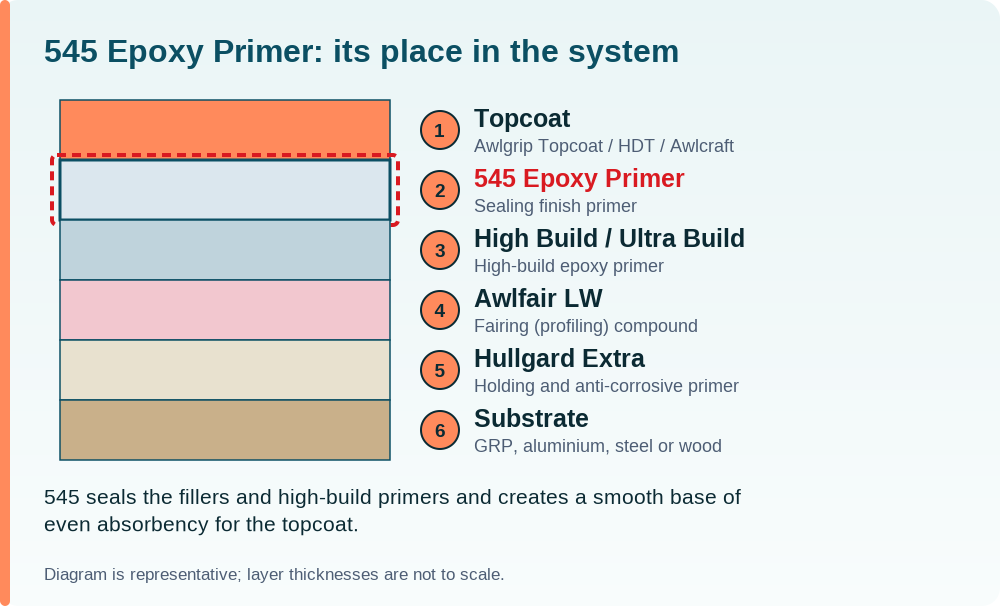
What does Awlgrip 545 Epoxy Primer do and where does it sit in the paint system?#
If we think of a yacht paint system layer by layer, the tie-coat primer at the bottom (Hullgard Extra) provides adhesion, the fairing compound (Awlfair) provides shape and the high-build primer (High Build, Ultra Build) provides surface smoothness. 545 is the sealing layer that goes over these layers and is in direct contact with the topcoat. It closes the porous structure of the filler and surfacing primers, so the topcoat does not soak into them and turn dull, and no "die-back" or blotches form on the surface.
The product's dual role is also emphasised in the data sheet: it seals both undercoats and surfacing primers in one product. Thanks to its epoxy chemistry it also provides corrosion protection, which is why it is part of the system on metal boats too.
Which surfaces and where is it used?#
545 is one of the few primers that can be used below and above the waterline on a range of substrates:
- Sealing primer before the topcoat: over High Build, Ultra Build, Awlquik and Epoxy Surfacing Primer
- Fibreglass (GRP) and gelcoat surfaces: directly after suitable sanding
- Steel and aluminium: as an anti-corrosive primer once a suitable profile has been created
- Wood: as a reduced sealer coat (details below)
- Below the waterline: as an adhesion and protective coat beneath the antifouling system
Surface preparation: the stage that decides the outcome#
The adhesion of 545 depends on the cleanliness and roughness of the surface beneath it. Each substrate is prepared differently. On GRP, sanding before mould release, wax and grease have been completely removed drives the contamination into the surface. So the order is always clean first, then sand, then clean again.
After sanding, dust is removed with clean compressed air and a vacuum. Then the "two-cloth method" is applied with Awlgrip surface cleaner (T0340 in Europe): one cloth wet with cleaner wipes the surface, a second dry cloth wipes it dry immediately. As the last step, a tack rag is passed lightly over the surface only immediately before application.
Mix ratio, induction and pot life#
545 is a two-component product and is mixed by volume 1 part base + 1 part converter (D3001). First the base is stirred in its own can until no settled pigment remains at the bottom, then the converter is added and the mix is stirred until homogeneous.
After mixing, allow a 15-minute induction time. This lets the epoxy resin and converter "warm up" to the reaction; if skipped, film properties can be weakened. Reducer is added after induction according to the application method: 0–25% T0006 for spray, 5–10% T0031 for brush and roller.
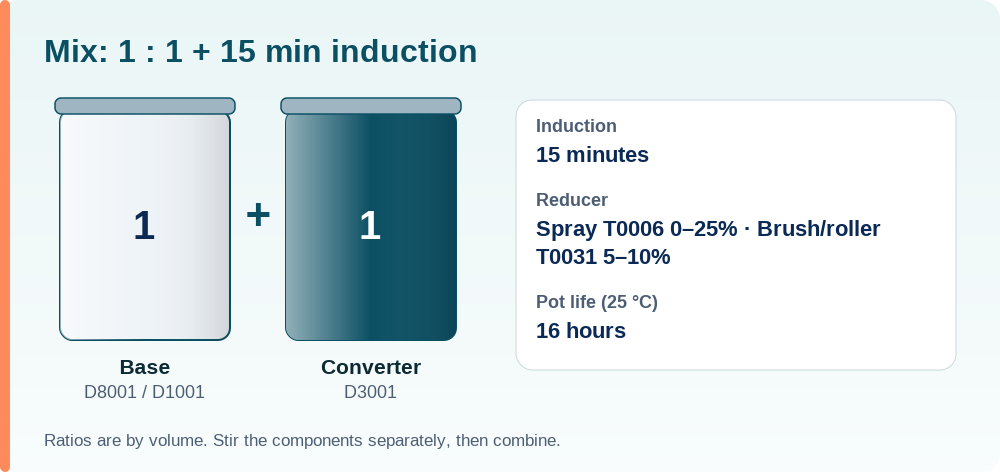
| Value | Spray | Brush / roller |
|---|---|---|
| Mix (base : converter) | 1 : 1 | 1 : 1 |
| Induction | 15 min | 15 min |
| Reducer | T0006, 0–25% | T0031, 5–10% |
| Pot life 15 / 25 / 35 °C | 16 h / 16 h / 8 h | 16 h / 16 h / 8 h |
Application: step by step#
545 can be applied by spray, brush or roller. The data sheet recommends 3 coats. The recommended dry film thickness is 35 µm per coat, maximum 45 µm. After sanding before the topcoat, the remaining total dry film must be at least 50–75 µm; so if sanding thins the film, an extra coat may be needed.
When spraying, the gun is held perpendicular to the surface and each pass overlaps the previous one by about half. With brush and roller, on large areas a thin, even coat is rolled on and lightly tipped off with the brush.
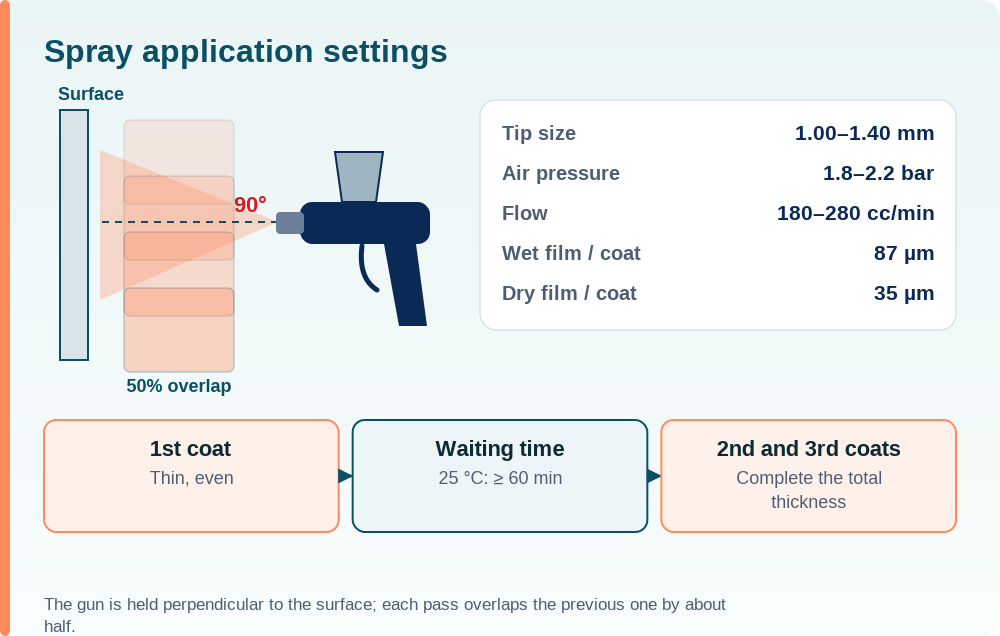
- Check the prepared surface one last time
Make sure no dust, fingerprints or moisture remain; pass the tack rag lightly just before application.
- Apply the first coat thin and even
For spray, aim for 87 µm wet film; cover corners and edges first, then flat areas.
- Respect the recoat time
For spray wait at least 60 minutes at 25 °C, for brush and roller at least 12 hours; the maximum is 24 hours.
- Complete the second and third coats
Complete the total thickness, allowing for what sanding will remove.
- Sand after cure
After 24 hours sanding is required; sand with P320–P400 for smoothness and adhesion before the topcoat.
| Spray setting (air) | Value |
|---|---|
| Tip size | 1.00–1.40 mm |
| Air pressure | 1.8–2.2 bar |
| Fluid pressure | 1.8–2.2 bar |
| Flow | 180–280 cc/min |
| Wet / dry film | 87 µm / 35 µm |
Drying and recoat times#
The recoat times of 545 vary greatly with the application method. Because a spray coat is a thin, fast-drying film, it can be recoated after 60 minutes at 25 °C. Brush and roller coats are thicker and need at least 12 hours at the same temperature. In both cases the maximum is 24 hours: 545 past 24 hours is not recoated without sanding.
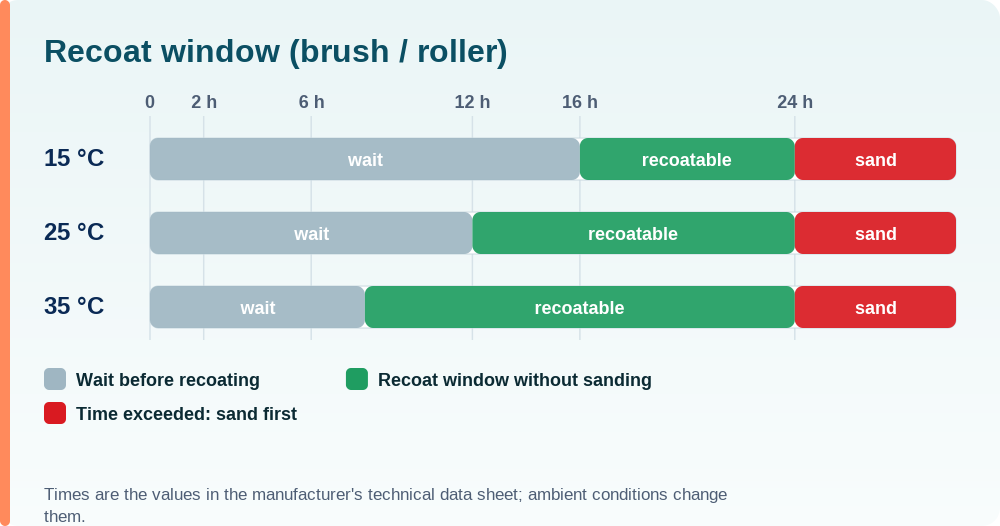
| Condition | 15 °C | 25 °C | 35 °C |
|---|---|---|---|
| Touch dry | 3 h | 2 h | 30 min |
| Hard dry | 10 h | 6 h | 3 h |
| Recoat (spray) minimum / maximum | 2 h / 24 h | 60 min / 24 h | 60 min / 24 h |
| Recoat (brush/roller) minimum / maximum | 16 h / 24 h | 12 h / 24 h | 8 h / 24 h |
Application conditions: temperature, humidity and dew point#
For 545 the ambient temperature must be in the 13–41 °C range. The surface temperature must be at least 3 °C above the dew point and must not exceed 41 °C. In cold weather the chemical reaction slows down: the Awlgrip application guide states that below 25 °C recoat times roughly double for every 3 °C drop.
Tips from the professionals#
- Choose the grey (D1001) or white (D8001) base according to the topcoat colour: a grey base makes hiding easier under dark topcoats, a white base under light ones.
- Keep spray coats thin: one heavy coat traps solvent, delays the cure and "gums up" when sanded.
- For brush application use no reducer other than T0031; fast-evaporating reducers leave brush marks open.
- Before the topcoat, make sure the film has not been sanded through; touch up with 545 wherever the surfacing primer shows.
- In the cold season, consider Cold Cure (M3066) for brush work, but mix small batches, allowing for the shorter pot life.
Common mistakes#
- Base and converter are stirred separately, measured 1:1 and left 15 min
- T0006 is used for spray, T0031 for brush
- The minimum recoat time is respected and the surface is sanded past 24 hours
- Sanded with P320–P400 before the topcoat, keeping 50–75 µm total film
- Induction is skipped and the mix is used immediately
- General-purpose thinner or cellulose thinner is added
- One heavy coat is applied; the film sags and dries slowly
- A surface past 24 hours is recoated without sanding and the coats delaminate
Health and safety#
Frequently asked questions#
What is the mix ratio of Awlgrip 545?
Mix 1 part base (D8001 or D1001) with 1 part D3001 converter by volume and allow 15 minutes induction.
Which reducer is used with 545?
T0006 (0–25%) for spray application, T0031 (5–10%) for brush and roller.
How many coats of 545 are applied and how thick should it be?
The manufacturer recommends 3 coats, targeting 35 µm dry film per coat. After sanding, at least 50–75 µm total dry film must remain.
Can 545 be used below the waterline?
Yes. According to the data sheet it can be used below and above the waterline. Below the waterline, refer to International system recommendations for the transition to the antifouling system.
When can the topcoat be applied over 545?
A spray coat after at least 60 minutes at 25 °C, a brush/roller coat after at least 12 hours; past 24 hours sanding is mandatory. In practice, since 545 is sanded before the topcoat anyway, this limit is met on most jobs.
_Source: Awlgrip / AkzoNobel, 545 Epoxy Primer technical data sheet (TDS, 05.04.2024); Cold Cure M3066 product data sheet; Awlgrip Application Guide (22nd edition). The values on this page are compiled from documents published by the manufacturer and may change as the product evolves. Always check the product label, the current technical data sheet (TDS) and the safety data sheet (SDS) before application._