
Awlfair LW is a lightweight epoxy fairing compound used on yacht hulls to correct the shape and fill waves, low spots, dents and weld seams. "Fairing" means bringing the hull to a smooth, flowing form that reflects light flawlessly. The secret of a mirror-like topcoat lies largely in this stage.
Awlfair LW comes in two versions. The Standard version (D7200) has a long pot life that allows comfortable work over large areas. The Fast version (D7222) can be sanded much sooner and suits quick repairs. Both are applied by trowel and sanded by hand or machine.
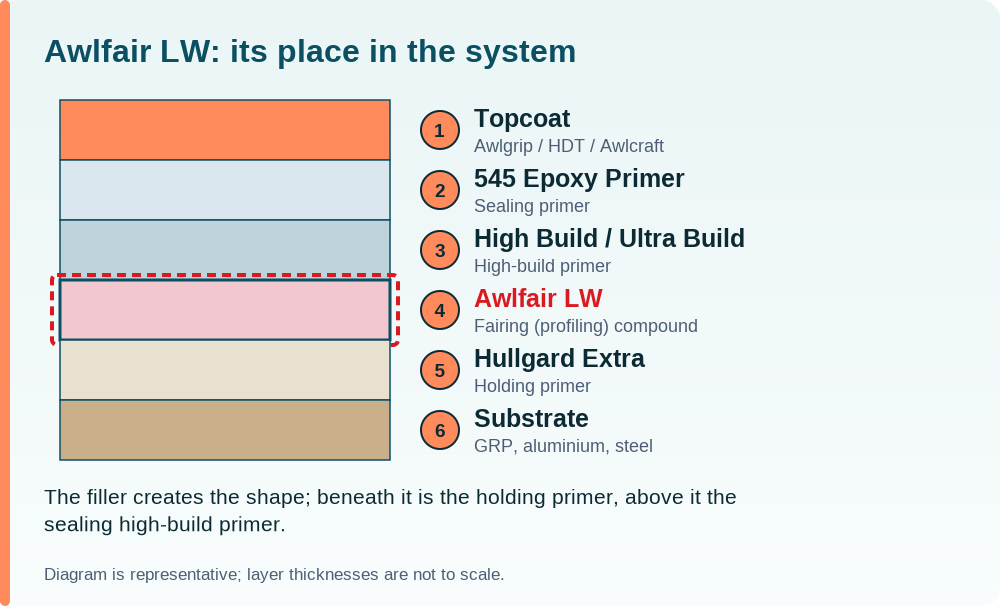
What does Awlfair LW do and where does it sit in the paint system?#
The filler is the "shaping" layer of the paint system and is not a structural material. The data sheet makes this explicit: Awlfair LW is a cosmetic material. The design of the structure beneath must be assessed separately, and independent expert advice should be sought to prevent cracking and detachment.
The filler is always applied over a suitable Awlgrip primer. The recommended underlying primers are Hullgard Extra and, for GRP only, High Build. After filling, the surface is sealed with an epoxy primer (High Build or Ultra Build above the waterline, Hullgard below).
Which surfaces and where is it used?#
- Hull fairing: correcting waves, low spots, dents and weld seams
- Correcting the shape after welding on aluminium and steel boats
- Surface correction on GRP boats (over High Build)
- Below the waterline (sealed with Hullgard) and above
Surface preparation: the stage that decides the outcome#
The filler is applied to primer, not to a bare surface. It can be applied directly over Hullgard Extra without sanding; Hullgard Extra's minimum wait before filler is 16 hours at 25 °C. If applying over High Build, High Build is sanded first. The surface must be free of dust and dirt.
Mix ratio, induction and pot life#
Base (D8200, white) and converter are mixed 1:1 by volume; for Standard the ratio by weight is 1.59:1. Mixing continues until the Standard version reaches a uniform pink with no streaks or lumps. This colour is the visual check that the two components are fully mixed.
No reducer, solvent or thinner of any kind is added to the filler. An automatic mixing machine may be used; however, the data sheet notes that this can increase density and change mechanical properties, and asks that the technical representative be consulted.
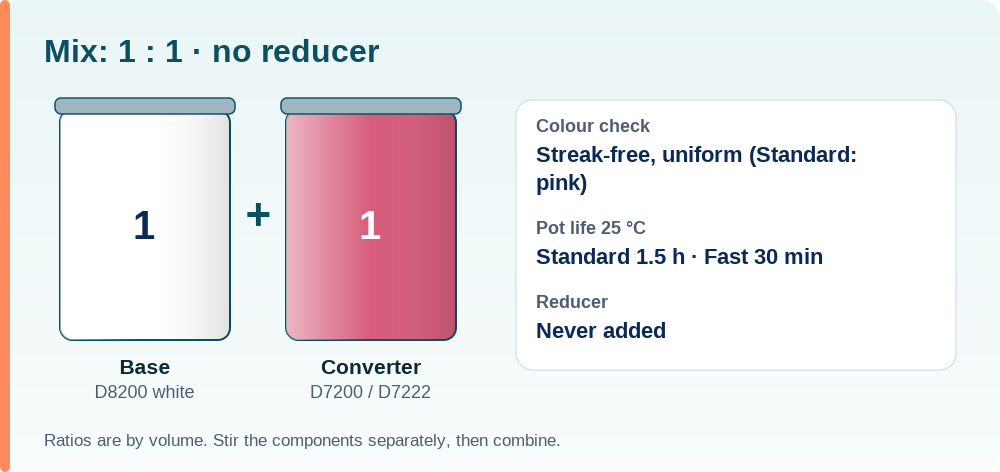
| Value | Standard (D7200) | Fast (D7222) |
|---|---|---|
| Mix (volume) | 1 : 1 | 1 : 1 |
| Pot life 15 °C | 2.5 h | 80 min |
| Pot life 25 °C | 1.5 h | 30 min |
| Pot life 35 °C | 45 min | 20 min |
| Working area | As much as can be worked in 15–20 min | As much as can be worked in 5–10 min |
Application: step by step#
The filler is applied by trowel, spreader or batten. To minimise air bubbles, the recommended maximum thickness per application is 5–6 mm. In deep areas, low spots are first filled with thin layers up to 6 mm, then work progresses towards the high areas. Large areas may need several applications. Air pockets must be kept below 4 mm and eliminated as far as possible.
Battens can cause excessive air pockets. If they are to be used, consult the Awlgrip technical representative first. The step left after removing the batten is ground back to a slope shallower than 7:1 and filled with 6 mm applications.
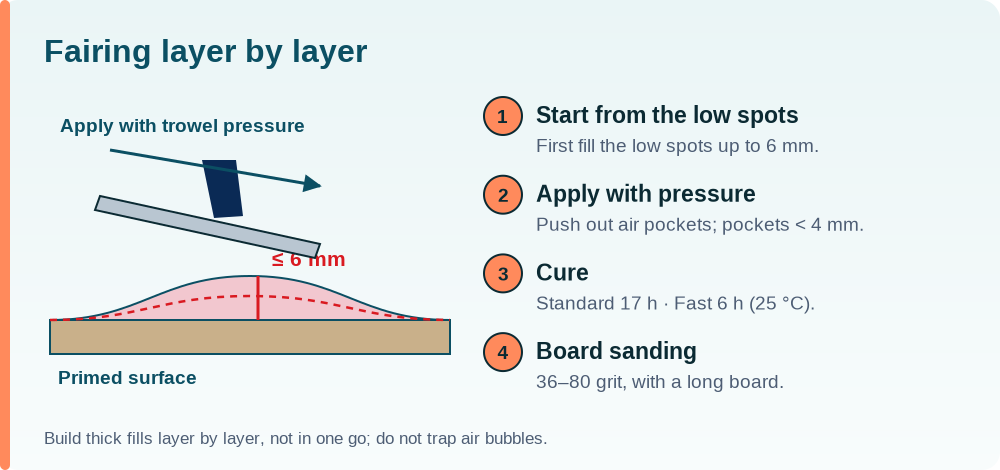
- Mix
1:1 by volume, to a uniform colour; do not add reducer.
- Fill the low areas
With thin layers of max. 6 mm, from low to high.
- Apply with trowel pressure
With enough pressure to push air pockets out; pockets < 4 mm.
- Wait for cure
Standard can be sanded after 17 h at 25 °C, Fast after 6 h.
- Sand with a board
36–80 grit (Fast 36–60); remove dust and move to the next layer.
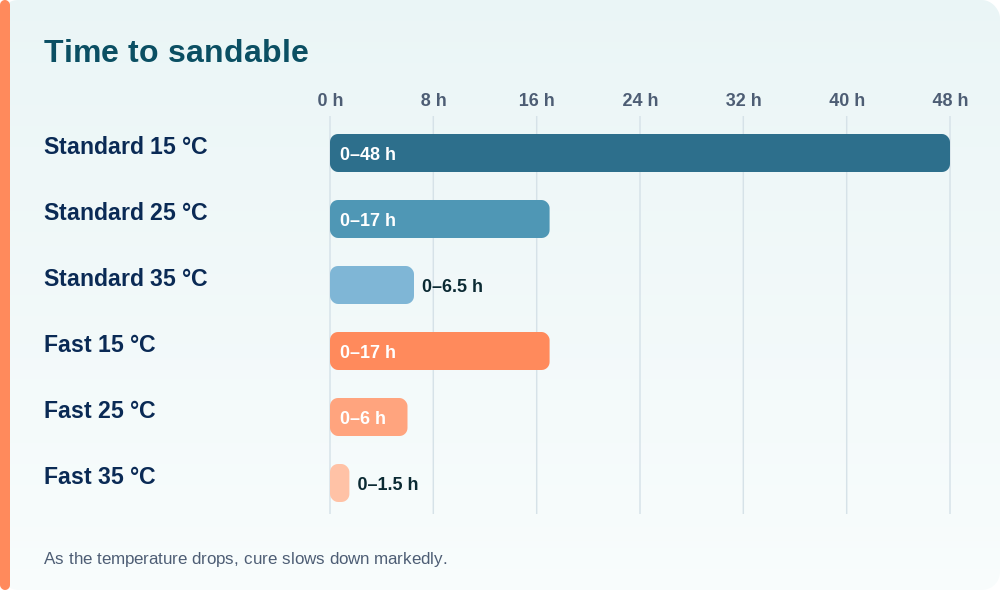
| Sandable | Standard | Fast |
|---|---|---|
| 15 °C | 48 h | 17 h |
| 25 °C | 17 h | 6 h |
| 35 °C | 6.5 h | 90 min |
| Grit | 36–80 | 36–60 |
Drying and recoat times#
Sanding is mandatory before applying new filler, Awlfair Surfacing Filler or a high-build primer over the filler. After sanding, the primer must be applied as soon as possible. To reduce print-through, the filler is coated with an approved high-build primer.
| Recoat (Standard) | Minimum | Maximum |
|---|---|---|
| 15 °C | 42 h | Long |
| 25 °C | 17 h | Long |
| 35 °C | 6.5 h | Long |
| Fast (all topcoats) | 24 h | Long |
Application conditions: temperature, humidity and dew point#
The filler is not applied below 13 °C or above 40 °C. A combination of low temperature and high humidity can form a by-product on the surface (amine blush). This layer must be removed by washing with detergent and fresh water, or by sanding; otherwise it prevents adhesion of the coats above.
Tips from the professionals#
- Spread the mix in a thin layer on a mixing board; a mass left standing in a pot heats up and the pot life shortens.
- On hot days choose the Standard version; Fast reaches the end of its pot life in 20 minutes at 35 °C.
- To see sanding waves, rub dry guide powder or a guide coat over the sanded surface.
- On weld seams, grind the height off first, then fill.
Common mistakes#
- 1:1 mix, uniform colour
- ≤ 6 mm per layer
- Primer immediately after sanding
- Sealed with Hullgard below the waterline
- Thinned with thinner
- 2–3 cm filled in one go, trapping air
- Primer over unsanded filler
- Applied in cold, damp weather and the blush is not removed
Health and safety#
Frequently asked questions#
What is the mix ratio of Awlfair LW?
1:1 by volume (1.59:1 by weight for Standard); mix until streak-free and uniform in colour.
What is the maximum thickness Awlfair can be applied at?
The recommended maximum thickness per application is 5–6 mm; deeper areas are filled layer by layer.
When can Awlfair be sanded?
Standard after 17 hours at 25 °C, Fast after 6 hours; with 36–80 (Fast 36–60) grit.
Can Awlfair be used below the waterline?
Yes; according to the data sheet it can also be used below the waterline, sealed with Hullgard Epoxy Primer.
Which primer goes over Awlfair?
High Build or Ultra Build above the waterline; Hullgard below.
_Source: Awlgrip / AkzoNobel, Awlfair LW (D8200/D7200) technical data sheet; Awlfair LW Fast technical data sheet (14.10.2022); Awlgrip Application Guide (22nd edition). The values on this page are compiled from documents published by the manufacturer and may change as the product evolves. Always check the product label, the current technical data sheet (TDS) and the safety data sheet (SDS) before application._