
Awlquik is a fast-drying, medium-build, easy-sanding two-component epoxy primer/surfacer. Because it can be applied by brush, roller and spray, it is indispensable for amateur and small-yard work, and before Awlgrip Topcoat applied by brush and roller.
Awlgrip's brush/roller data sheet gives Awlquik as the recommended primer under the topcoat. For maximum gloss, sealing Awlquik with 545 is recommended.
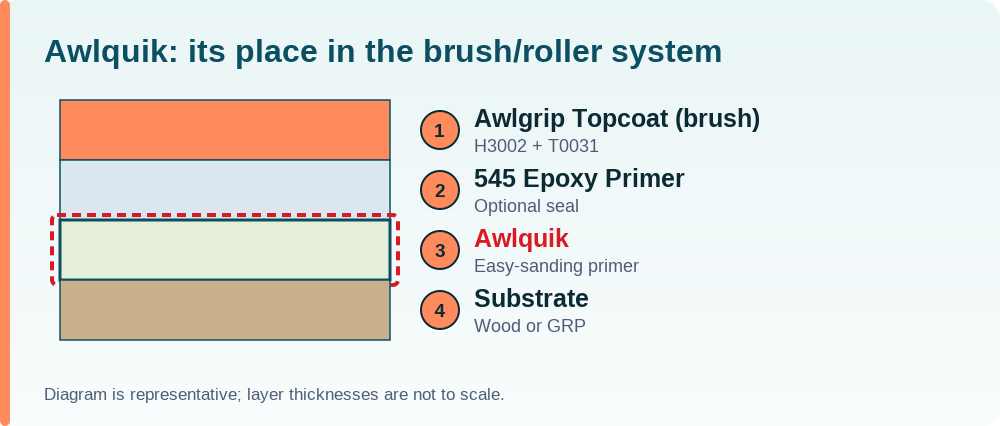
What does Awlgrip Awlquik do and where does it sit in the paint system?#
Awlquik works best as a surfacer over other Awlgrip primers. It can be brushed or rolled directly onto properly prepared wood and fibreglass, but results are better if the surface is sealed with 545 first. Awlgrip or Awlcraft 2000 topcoat and 545 Epoxy Primer can be applied over it.
Which surfaces and where is it used?#
- Primer before Awlgrip Topcoat applied by brush and roller
- Surfacer on wood and fibreglass surfaces
- Small repair and detail areas
Surface preparation: the stage that decides the outcome#
Wood and fibreglass are suitably sanded and cleaned. If Awlquik goes over another Awlgrip primer, follow the sanding and recoat times in that primer's data sheet. The surface is cleaned with the two-cloth method.
Mix ratio, induction and pot life#
D8003 and D9001 are mixed 1:1 by volume and allowed 15 minutes induction. Reduce up to 50% with T0006 for spray and T0031 for brush/roller. For brush/roller application on wood, reduction goes up to 50–70%. Example spray recipe: 8 + 8 + 8 parts. Pot life at 25 °C is 8 hours.
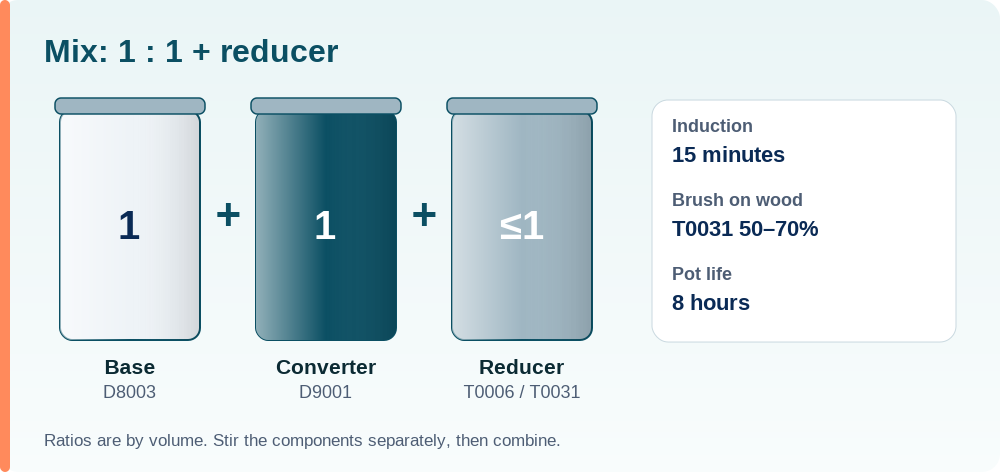
| Value | Spray | Brush / roller |
|---|---|---|
| Mix | 1 : 1 | 1 : 1 |
| Reducer | T0006 ≤ 50% | T0031 ≤ 50% (50–70% on wood) |
| Induction | 15 min | 15 min |
| Pot life | 8 h | 8 h |
Application: step by step#
For spray, wait 4 hours at 25 °C between smooth coats. Brush/roller needs two coats, and a light sanding between coats improves the appearance. On large areas, roll first and then tip with a brush. The recommended wet film is 125 µm, dry film 50–75 µm.
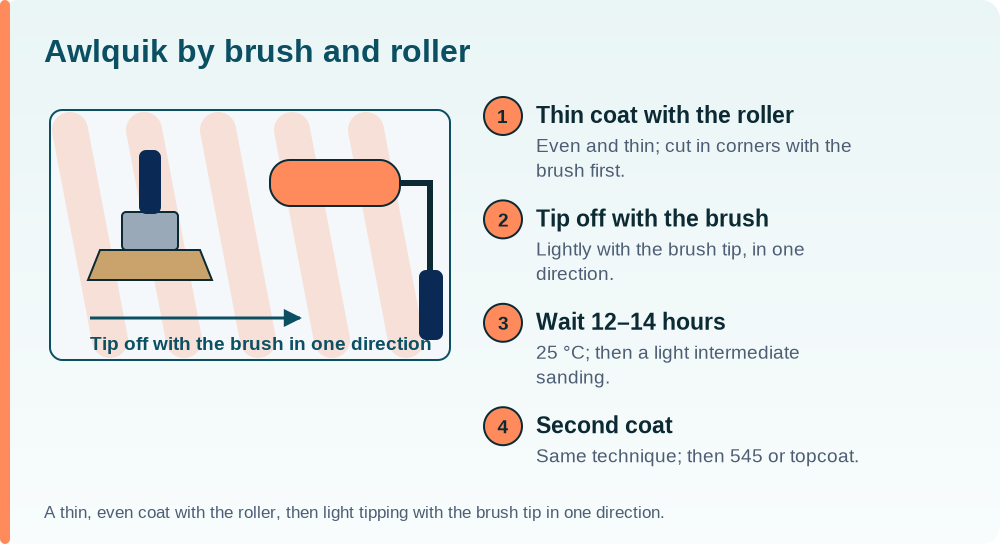
- Mix
1:1; 15 min; suitable reducer.
- 1st coat
Thin coat with the roller, tip off with the brush.
- Waiting time
12–14 hours for brush/roller; 4 hours for spray.
- Intermediate sanding
Light sanding improves the appearance.
- 2nd coat
With the same technique; then 545 or topcoat.
| Value | Data sheet |
|---|---|
| Wet film | 125 µm |
| Dry film | 50–75 µm |
| Brush/roller number of coats | 2 |
Drying and recoat times#
Awlquik's recoat times vary with the method. The maximum without sanding is 24 hours.
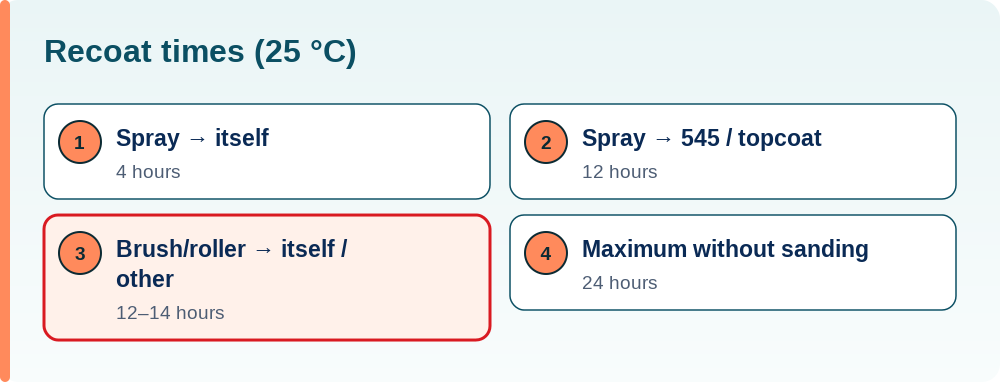
| Condition (25 °C, 50% humidity) | Value |
|---|---|
| Spray, with itself | 4 h |
| Spray, 545 or topcoat | 12 h |
| Brush/roller, with itself | 12–14 h |
| Brush/roller, other products | 12–14 h |
| Maximum without sanding | 24 h |
Application conditions: temperature, humidity and dew point#
Ambient 13–41 °C; the surface must not be below 13 °C or above 41 °C and must be at least 3 °C above the dew point. Do not attempt to cure below 13 °C.
Tips from the professionals#
- On wood, apply the first coat highly reduced (50–70%); it penetrates the grain.
- Working roller and brush at the same time with two people keeps a wet edge.
- If a brushed and rolled topcoat is planned, consider sealing Awlquik with 545.
Common mistakes#
- T0031 for brush, T0006 for spray
- Two coats, with light sanding in between
- Recoat or sand within 24 hours
- Use below the waterline
- Fast spray reducer used for brush work
- Recoated past 24 hours without sanding
Health and safety#
Frequently asked questions#
Can Awlquik be applied by brush?
Yes; reduced up to 50% with T0031, it is applied by brush and roller, and two coats are needed.
What is the mix ratio of Awlquik?
D8003 and D9001 1:1 by volume; 15 min induction.
Can Awlquik be used below the waterline?
No.
_Source: Awlgrip / AkzoNobel, Awlquik Epoxy Primer/Surfacer (D8003/D9001) technical data sheet (18.01.2019); Awlgrip Topcoats G/H Line product data sheet. The values on this page are compiled from documents published by the manufacturer and may change as the product evolves. Always check the product label, the current technical data sheet (TDS) and the safety data sheet (SDS) before application._