
Awlwood is a one-component varnish system that cures with moisture in the air, starting with Awlwood Primer and completed with Awlwood Clear Gloss or Satin Matt. Needing no mixing and allowing several coats in one day make it far more practical than two-component varnishes.
With coloured primers (yellow, red), the system also makes it possible to balance the tone of the wood and compensate for fading over time.
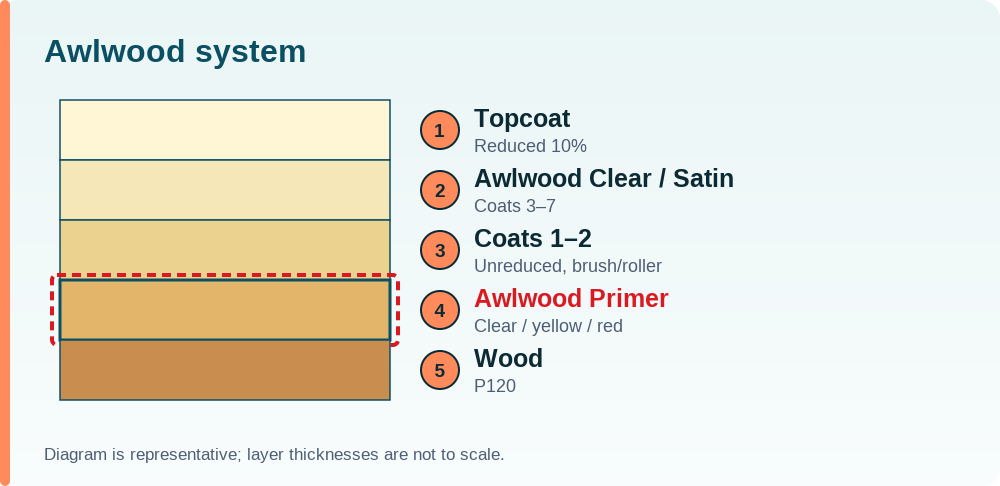
What does Awlwood do and where does it sit in the paint system?#
The primer penetrates and bonds with the wood; the Clear coats build film thickness and UV/water protection. Outdoors, aim for at least 8 coats and 250 µm total film.
Which surfaces and where is it used?#
- Exterior wooden brightwork
- Clear protection over epoxy-coated wood, GRP and carbon
- Satin look with Satin Matt
Surface preparation: the stage that decides the outcome#
The wood is sanded with P120, vacuumed and degreased. The primer is applied to clean, dry wood; when it is touch dry and fully absorbed, the first gloss coat is applied the same day. Epoxy, GRP or carbon surfaces are sanded with P180, making sure there is no epoxy blush.
Mix ratio, induction and pot life#
It is one-component; no mixing. For brush/roller, reduction is usually not needed; if required, max. 10% T0201. For spray, max. 10% T0202. The first 2–3 gloss coats and the first brush/roller coats are not reduced. The last coat is reduced 10%.
| Coat | Reduction |
|---|---|
| Primer | Not reduced (application guide) |
| Coats 1–2 | Not reduced |
| Coats 3–7 | ≤ 10% (T0201 / T0202) |
| Topcoat | %10 |
Application: step by step#
Coats 1 and 2 are applied by brush or roller, one day apart. On open-grained hardwoods, one coat a day until the grain is filled (usually 2–3 coats). From coat 3, by brush, roller or spray, several coats can be applied on the same day once the previous coat has cured enough (no fingerprint left). 80 µm wet, 36 µm dry film per coat; at least 8 coats and 250 µm in total.
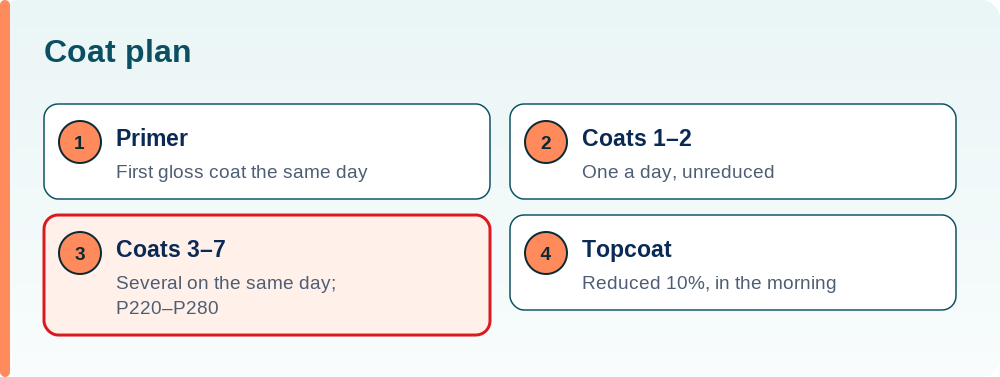
- Preparation
P120, vacuum, degrease.
- Primer
Until touch dry and absorbed.
- Coats 1–2
Brush/roller, unreduced, one day apart.
- Coats 3+
Several coats on the same day by fingerprint test; P220–P280 intermediate sanding.
- Topcoat
Reduced 10%, out of sun and wind, preferably in the morning.
Drying and recoat times#
Awlwood's times vary with temperature.
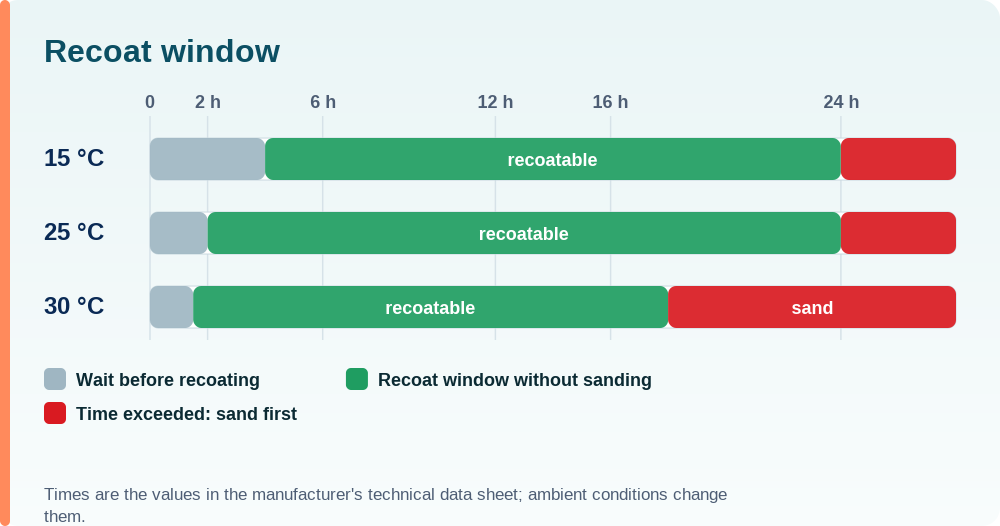
| Condition | 15 °C | 25 °C | 30 °C |
|---|---|---|---|
| Touch dry | 3 h | 2 h | 1.5 h |
| Sandable | 8 h | 4 h | 3 h |
| Recoat minimum | 4 h | 2 h | 1.5 h |
| Recoat maximum (no sanding) | 24 h | 24 h | 18 h |
Application conditions: temperature, humidity and dew point#
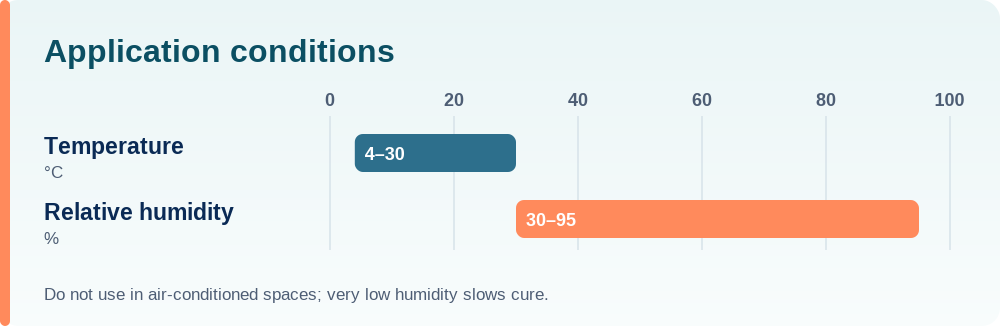
Ambient 4–30 °C and 30–95% relative humidity. Not used in air-conditioned spaces; very low humidity slows cure. Do not apply if condensation may form on an uncured coat.
Tips from the professionals#
- Do not touch the surface with hands covered in sunscreen; the data sheet notes that some creams containing nano titanium dioxide / zinc oxide can accelerate UV degradation.
- To compensate for fading, you can add up to 10% coloured primer to the first coats.
- Do not leave product in the spray cup between coats.
Common mistakes#
- First coats unreduced
- At least 8 coats, 250 µm
- Regular maintenance coats
- Alcohol-based thinner
- Application in an air-conditioned space
- Missing the primer window
Health and safety#
Frequently asked questions#
How many coats of Awlwood are applied?
Outdoors, at least 8 coats, at least 250 µm in total.
How is Awlwood maintained?
The surface is cleaned, sanded with P220 and at least 2 new coats of Awlwood are applied.
Does Awlwood need mixing?
No, it is one-component and cures with moisture in the air.
_Source: Awlgrip / AkzoNobel, Awlwood Clear Gloss (OJ3890) technical data sheet (19.02.2021); Awlgrip Application Guide (22nd edition). The values on this page are compiled from documents published by the manufacturer and may change as the product evolves. Always check the product label, the current technical data sheet (TDS) and the safety data sheet (SDS) before application._