
Awlgrip High Build is a two-component epoxy primer that fills and levels faired surfaces in thick single coats. It covers the sanding scratches, small waves and pinholes of Awlfair fairing compound and, once sanded, prepares a smooth base before the topcoat.
As its name suggests, High Build is a primer that builds "high thickness": 100–125 µm dry film per coat. Using the off-white (D8002) and yellow (D9002) bases in alternate coats lets you see where you are when sanding.
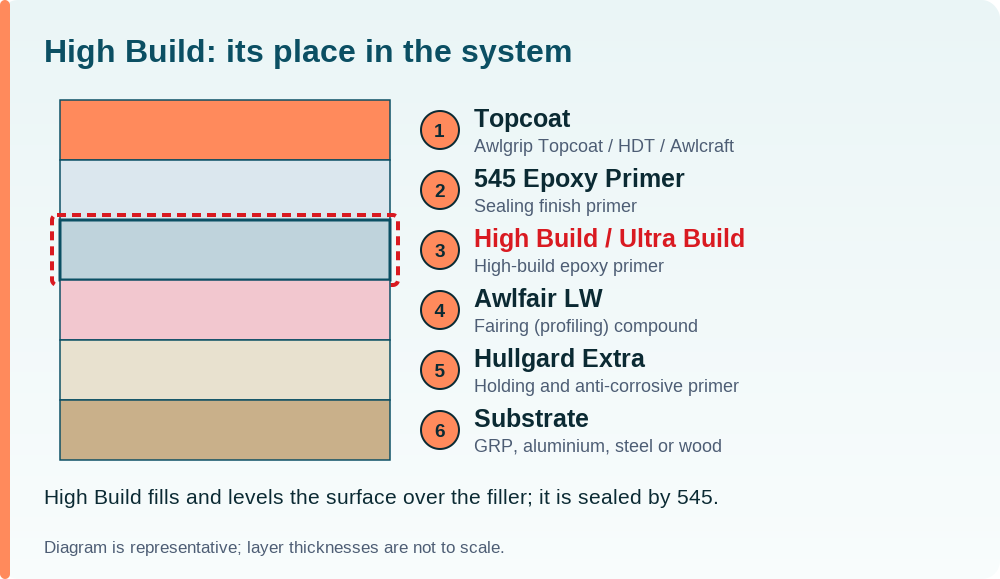
What does Awlgrip High Build do and where does it sit in the paint system?#
In the system it sits above Awlfair fairing compound and below 545 Epoxy Primer. The filler creates the shape, High Build levels the surface, 545 seals. The manufacturer describes High Build as working best as a surfacer over other Awlgrip primers and fairing compounds. It can also be applied directly to properly prepared wood and fibreglass, but sealing with 545 first gives better results.
Which surfaces and where is it used?#
- Filling and levelling over Awlfair LW and other fairing compounds
- Intermediate primer over Ultra Build and Hullgard Extra
- Prepared gelcoat and fibreglass (100–150 grit)
- Wood (80–100 grit)
Surface preparation: the stage that decides the outcome#
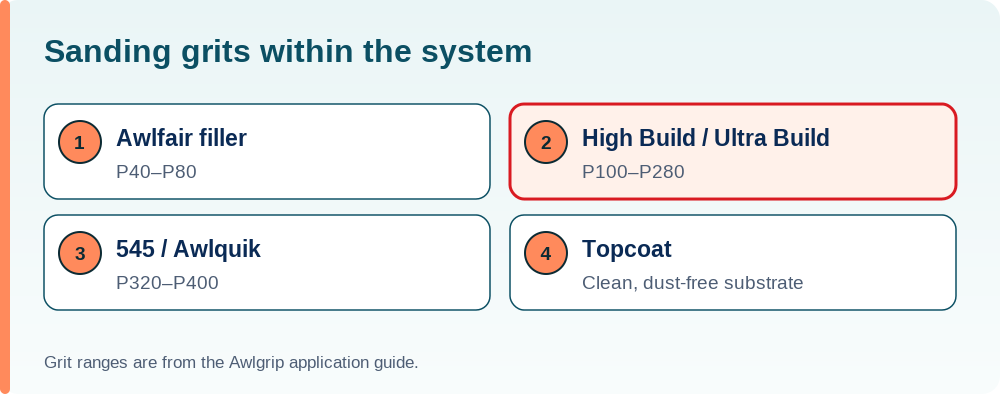
If applying over filler, Awlfair is first sanded according to its data sheet and dusted off. For direct application to gelcoat or fibreglass the surface is sanded with 100–150 grit, on wood with 80–100 grit. In all cases the surface is cleaned with the two-cloth method.
Mix ratio, induction and pot life#
Base and D3002 converter are mixed 1:1 by volume, allowed 15 minutes induction and reduced 10–20% with T0006. Example recipe: 8 parts base, 8 parts D3002, 3.2 parts reducer. Pot life at 25 °C and 50% humidity is 8 hours; high temperatures shorten it.
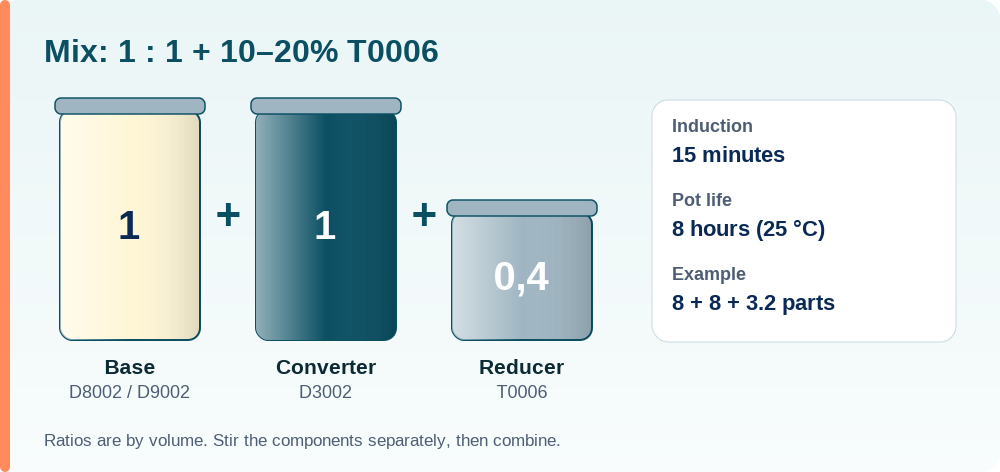
| Value | Data sheet value |
|---|---|
| Mix | 1 : 1 |
| Induction | 15 min |
| Reducer | T0006 10–20% (North America: T0176) |
| Pot life | 8 h (25 °C) |
Application: step by step#
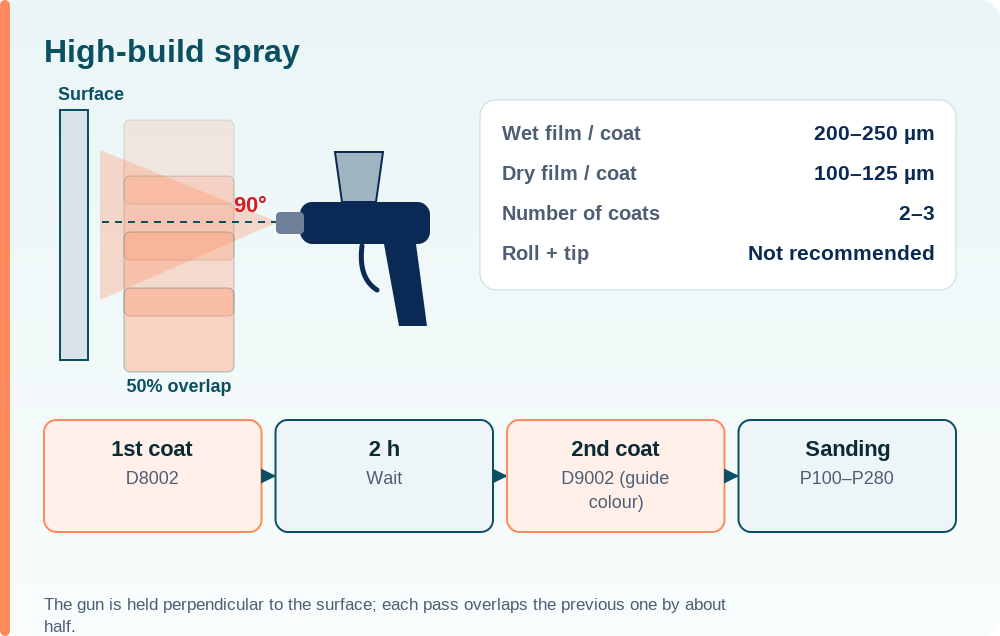
High Build is applied by pressure-fed conventional or airless spray. Aim for 200–250 µm wet, 100–125 µm dry film per coat; 2–3 even coats may be needed. It can be recoated with itself after 2 hours.
- Preparation
Filler sanding, cleaning.
- Mix
1:1, 15 min induction, 10–20% T0006.
- 1st coat
200–250 µm wet film, even coat.
- Subsequent coats
At 2-hour intervals; alternate colours (D8002/D9002) to create a sanding guide.
- Sanding
Sanding is recommended before other products; P100–P280 (application guide).
| Value | Data sheet |
|---|---|
| Wet film / coat | 200–250 µm |
| Dry film / coat | 100–125 µm |
| Coverage (2 coats, recommended DFT) | 10–15 m² / gallon |
| Airless tip | 0,028–0,043" |
Drying and recoat times#
High Build can be recoated with itself after 2 hours, and with other products after 12–24 hours. The maximum without sanding is 24 hours.
| Condition (25 °C) | Value |
|---|---|
| With itself | 2 h |
| Other products | 12–24 h |
| Maximum without sanding | 24 h |
| Compatible topcoats | 545, Ultra Build, Awlfair LW, Awlquik |
Application conditions: temperature, humidity and dew point#
Ambient 13–41 °C, the surface between 13–41 °C and at least 3 °C above the dew point. Do not attempt to cure below 13 °C.
Tips from the professionals#
- To avoid sags in a heavy coat, two thin coats are better than one thick coat on vertical surfaces.
- Sand with a long board in crossing directions.
- Choose within P100–P280 before 545 according to the precision of the job.
Common mistakes#
- As a surfacer over filler
- Guided sanding by alternating colours
- Recoat or sand within 24 hours
- Used below the waterline
- Applied by roll and tip
- Recoated after 24 hours without sanding
Health and safety#
Frequently asked questions#
What is the mix ratio of High Build?
Base and D3002 1:1 by volume; 15 min induction; 10–20% with T0006.
How many coats of High Build are applied?
2–3 coats; 100–125 µm dry film per coat.
Can High Build be used below the waterline?
No, it is for above the waterline only.
_Source: Awlgrip / AkzoNobel, High Build Epoxy Primer (D8002/D9002/D3002) product data sheet; Awlgrip Application Guide (22nd edition). The values on this page are compiled from documents published by the manufacturer and may change as the product evolves. Always check the product label, the current technical data sheet (TDS) and the safety data sheet (SDS) before application._