
Awlgrip Ultra Build is a sag-resistant epoxy primer that can build 375–500 µm dry film per coat. It was developed to reduce print-through, where fairing marks on large flat areas show through the topcoat as "shadows".
Ultra Build's high build creates a "buffer" layer between the filler and the thin primer. This reduces the risk of the fairing profile and batten marks showing in the topcoat.
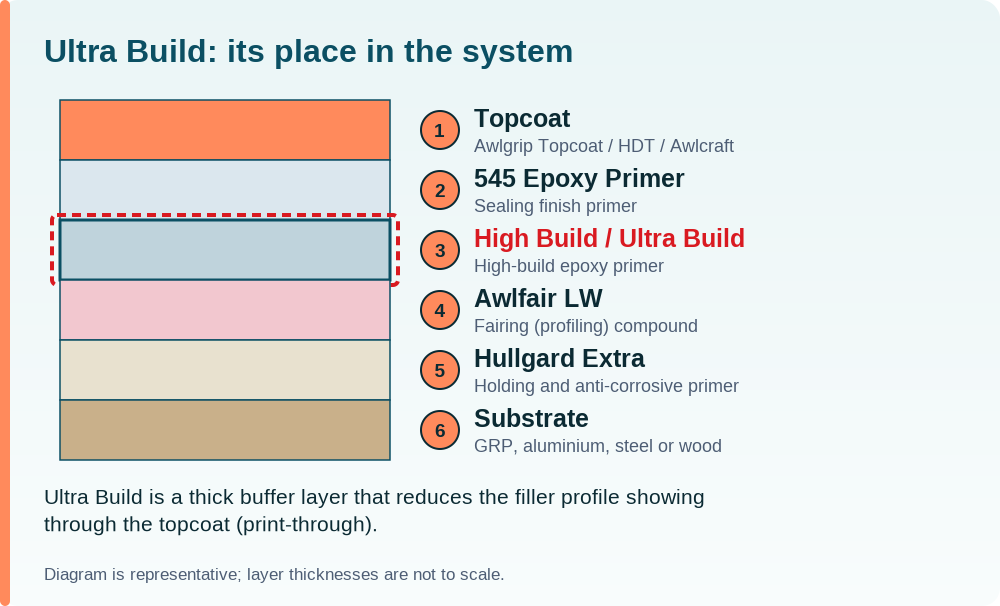
What does Awlgrip Ultra Build do and where does it sit in the paint system?#
In the system it sits between Awlfair fairing compound and 545 Epoxy Primer; it is used as an alternative to High Build or together with it. It can be applied over other properly prepared Awlgrip primers and fillers.
Which surfaces and where is it used?#
- Large hull surfaces faired with Awlfair LW
- Areas with a high print-through risk, such as dark-coloured hulls
- Aluminium and GRP fairing systems (above the waterline)
Surface preparation: the stage that decides the outcome#
Ultra Build is applied over sanded and dusted-off Awlfair or a suitable Awlgrip primer. The surface is cleaned with the two-cloth method.
Mix ratio, induction and pot life#
D8008 base and D3018 converter are mixed 1:1 by volume and allowed 15 minutes induction. For conventional spray it is reduced 5–25% with T0073; no reduction is needed for airless. Example: 10 parts base, 10 parts D3018, 2 parts T0073 (10%). Pot life at 25 °C is 8 hours.
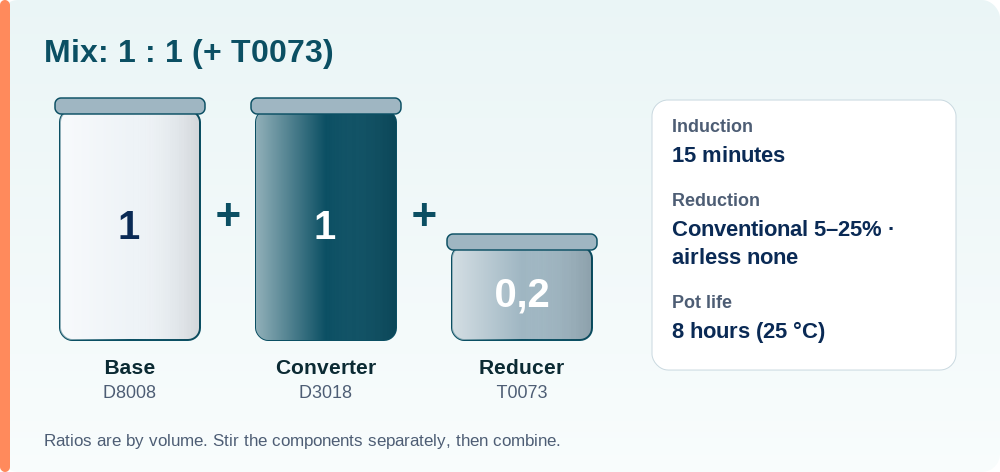
| Value | Data sheet value |
|---|---|
| Mix | 1 : 1 |
| Induction | 15 min |
| Reducer | T0073: conventional 5–25%, airless none |
| Pot life | 8 h (25 °C) |
Application: step by step#
Ultra Build is applied by conventional pressure-feed or airless spray in smooth, even coats. Aim for 625–750 µm wet, 375–500 µm dry film per coat. At 25 °C wait 1 hour between coats. No more than two coats are applied in succession: after two coats the film is left to hard-cure for 12–24 hours.
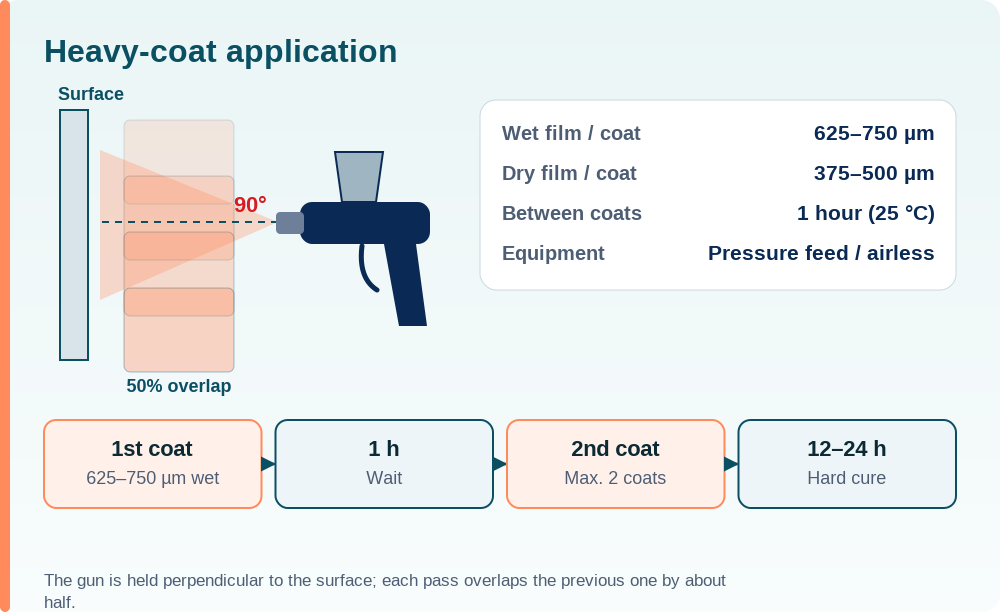
- Mix
1:1, 15 min induction; T0073 for conventional.
- 1st coat
625–750 µm wet film.
- 1-hour wait
25 °C, 50% humidity.
- 2nd coat
Maximum two coats; then 12–24 hours hard cure.
- Sanding
Before other products; P100–P280.
| Value | Data sheet |
|---|---|
| Wet film / coat | 625–750 µm |
| Dry film / coat | 375–500 µm |
| Airless tip | 0,028–0,043" |
| Fan | 8"/80° or 6"/60° |
Drying and recoat times#
Ultra Build can be recoated with itself after 1 hour, with other products after 12 hours. The maximum without sanding is 24 hours; sanding is recommended before overcoating with other products.
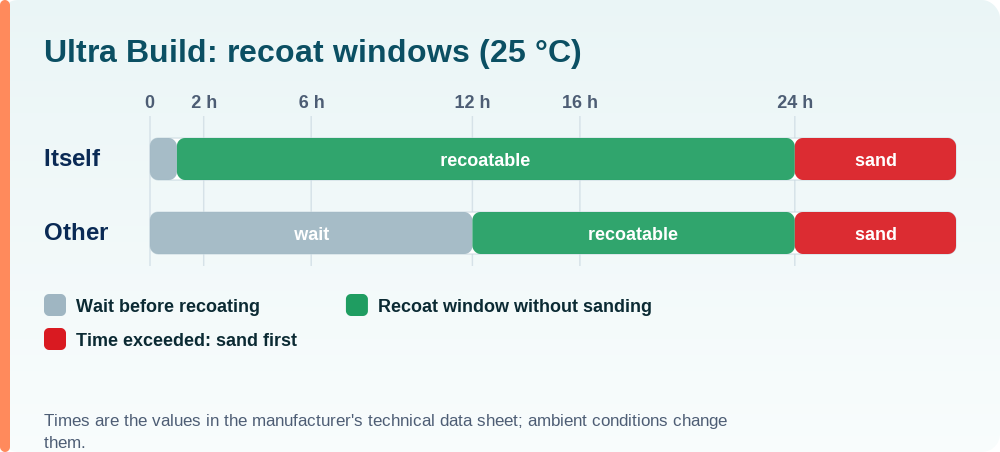
| Condition (25 °C) | Value |
|---|---|
| With itself | 1 h |
| Other products | 12 h |
| Maximum without sanding | 24 h |
| Compatible topcoats | 545, High Build, Awlfair LW, Awlquik |
Application conditions: temperature, humidity and dew point#
Surface 13–41 °C, ambient 13–41 °C, and the surface at least 3 °C above the dew point. Do not attempt to cure below 13 °C.
Tips from the professionals#
- Measure each coat with a wet film comb; over 750 µm just adds unnecessary sanding.
- It resists sagging even on vertical surfaces, but watch for build-up at edges and holes.
- To check for print-through, inspect with the light held low across the surface.
Common mistakes#
- Maximum two coats, then cure
- No reduction for airless
- Sanding before other products
- Three or four coats on top of each other on the same day
- Wrong reducer (other than T0073)
- Use below the waterline
Health and safety#
Frequently asked questions#
What is the difference between Ultra Build and High Build?
Ultra Build builds 375–500 µm dry film per coat and is more resistant to print-through; High Build builds 100–125 µm per coat.
What is the reducer for Ultra Build?
T0073; 5–25% for conventional spray, no reduction needed for airless.
How many coats of Ultra Build are applied?
A maximum of two coats at a time, followed by a 12–24 hour hard cure.
_Source: Awlgrip / AkzoNobel, Ultra Build Epoxy Primer (D8008/D3018) product data sheet; Awlgrip Application Guide (22nd edition). The values on this page are compiled from documents published by the manufacturer and may change as the product evolves. Always check the product label, the current technical data sheet (TDS) and the safety data sheet (SDS) before application._