
Paint and Coatings
Synthetic Teak Deck Alternatives and Comparison
Synthetic teak and similar deck coverings are described as alternatives to real teak upkeep; sources give pros and cons different weight. This article summarises the accounts with their limits; it is not a product, method or time recommendation.
Short answer
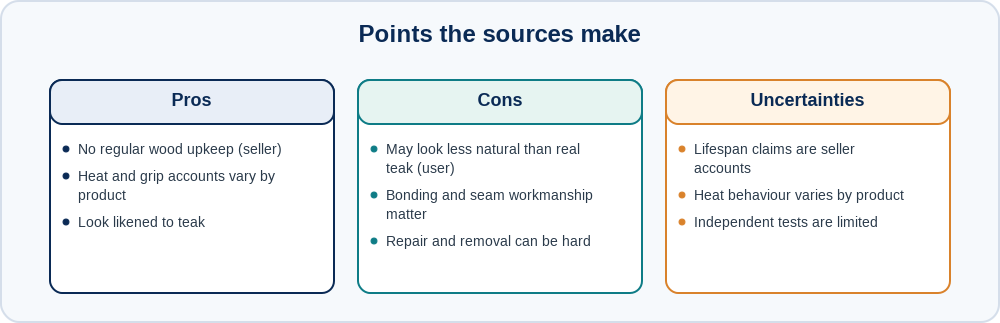
Sellers describe synthetic teak and similar coverings as alternatives needing no regular wood upkeep and looking like teak; lifespan and performance claims are seller accounts and not independently verified. User accounts say the look may be less natural than real teak, seam and bonding workmanship matter and repair can be hard. Heat and grip behaviour vary by product. This article recommends no product; the maker and a qualified yard govern.
Key points
- Synthetic deck coverings are described as alternatives to real teak upkeep; they vary by product type.
- Lifespan and performance claims are mostly seller accounts and not independently verified.
- User accounts differ on look, seams and repair.
- Weight, heat and grip vary with product and climate.
- For product, method and time the maker and a qualified yard govern.
1. Why look for alternatives?#
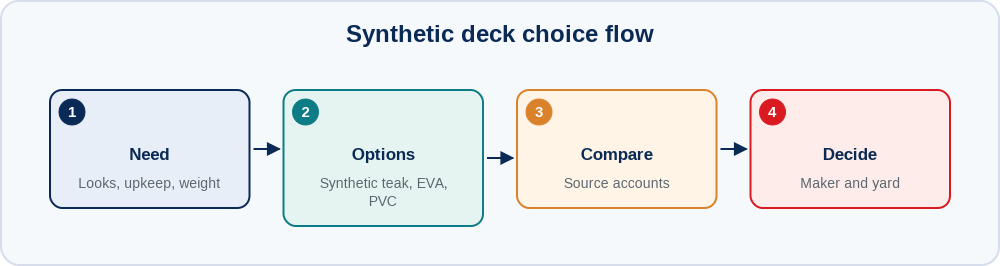
Real teak decking looks beautiful but needs regular upkeep, weight and cost; many owners therefore research alternatives. Synthetic teak, EVA foam and PVC-based coverings are such alternatives. This article is a general summary; it gives no product, thickness, adhesive or time and is not application advice. Sources are seller, magazine and forum accounts and may differ; seller and user accounts are labelled.
2. Options and described properties#
Synthetic teak coverings are usually described as a flexible material imitating teak strips; EVA foam coverings as a light, soft surface; PVC-based coverings in terms of durability and water resistance. These properties are mostly seller accounts. Real performance depends on product, colour, climate and quality of installation.
| Option | General account | Caution |
|---|---|---|
| Synthetic teak | Teak-like look, low upkeep (seller) | Look and lifespan claims unverified |
| EVA foam | Light, soft surface | Heat and wear vary by product |
| PVC-based | Durability and water resistance described | Bonding and seams matter |
3. User experiences and differences#
User accounts are varied: some report satisfaction for low upkeep; others write the look is less natural than real teak, it heats in warm weather or seams gave trouble. These are user accounts, not independently verified, and vary with product, climate and installation quality.
Seller accounts include lifespan and performance claims; these are not independent tests. On removal and repair users sometimes report difficulty; adhesives and the structure under the deck matter. So for your own boat consult the maker and a qualified yard.
Weight is also a criterion: sources describe synthetic coverings as usually lighter than real teak; but the deck’s structural condition and any added-load decision should be left to a qualified specialist.
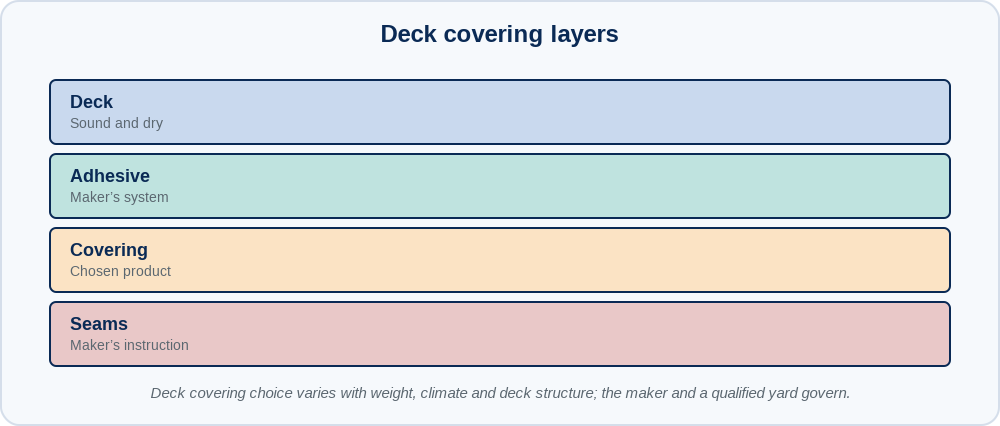
The deck structure beneath synthetic coverings is a critical point for the decision. Sources say a new covering can trap moisture beneath it, so a dry and sound deck is described as a precondition. Removing an old teak covering lets the condition of the plywood or core underneath be seen; but this job can be laborious and should be planned with a qualified yard. This article describes no removal or preparation method.
Heat behaviour is a frequently discussed topic. Dark surfaces may heat more in sun; user accounts relay differing experiences by product and colour. Some users write that walking barefoot in summer is uncomfortable while others say they have no problem. These accounts are not independently verified and vary with climate; sellers’ heat claims are also not independent tests.
Grip behaviour likewise varies with product and surface texture. Different behaviour may be described in wet and dry conditions; it is not possible to give a firm result. Deck safety is a serious matter and the choice of covering should not be made on looks alone; the maker’s information and a qualified yard’s view govern.
On upkeep, sources say synthetic coverings need no regular wood upkeep but add that cleaning and inspection are still needed. Build-up of dirt, algae or stains may behave differently by product; compatibility of cleaning products should be confirmed from the maker’s instruction. If signs such as seam separation or edge lifting are noticed early, the problem can be assessed before it grows; this too is a user observation and gives no guarantee.
Cost comparison is also complicated. Initial cost, labour, removal and possible repair costs vary by product and boat; figures in sources belong to different contexts and cannot be compared directly. This article gives no price or cost estimate; comparing written quotes from qualified yards and makers is the basis.
4. A practical frame#
- Establish the need: clarify priority among looks, upkeep, weight and budget.
- Inspect the deck’s condition; if moisture or rot, consult a qualified specialist first.
- Compare options through user accounts separately from seller claims.
- Confirm the maker’s compatibility with deck structure and climate.
- Plan bonding and seams with a qualified yard.
- Plan upkeep and inspection.
- Keep records; read the safety data sheet.
5. Limits#
Sources overlap that synthetic coverings offer low upkeep; they differ on look, lifespan, heat and repair. Seller claims are not independently verified. So there is no single right answer; deck structure, climate, use and the maker’s instruction govern. This article is not application advice.
5b. Where sources differ#
Sellers describe low upkeep and lifespan; users report look, heat and repair issues; magazines make general comparisons. These are sources speaking in different contexts and with different interests. The difference means consulting the maker and a qualified yard for your own deck.
This article is general information; it recommends no product, method, ratio, number of coats or time. The maker’s data sheet and a qualified yard govern.
5c. A practical frame for reading the sources#
The sources are magazines, makers, sellers and forums; each writes in its own context. None knows the deck structure, climate or weight limit of your boat. So taking the shared message and consulting the maker and a qualified yard for detail is reasonable.
Adhesive and solvent vapours, sanding dust and removal of an old covering can carry health and fire risks. This article describes no personal protection, ventilation or waste method; read the product’s safety data sheet, consult a qualified yard and follow the relevant safety rules. If the deck has moisture, rot or structural problems apply to a qualified specialist.
Seller and maker statements are the firm’s own account of its product and have not been independently verified. A product’s compatibility with another coating should always be checked in the product’s technical document; where a document and a guide conflict, the maker’s document and a qualified yard’s assessment should be used. Recording decisions and product details helps later maintenance.
6. Common mistakes#
- Treating seller claims as independent verification.
- Covering a damp or rotten deck.
- Underrating bonding and seam work.
- Not assessing weight and structural effect.
- Treating a user account as a firm rule.
- Not reading the safety data sheet.
- Keeping no records.
7. Checklist#
8. Conclusion#
Synthetic teak and similar deck coverings are described as a low-upkeep alternative; sources differ on look, lifespan, heat and repair. This article is general information; it gives no product or time and the maker and a qualified yard govern.
Frequently asked questions#
Does synthetic teak replace real teak?
Sellers describe similar looks and low upkeep; users say the look may differ. It is a preference and this article gives no recommendation.
Are lifespan claims reliable?
Lifespan claims are mostly seller accounts and not independently verified; climate and use change the result.
Does it get hot?
Behaviour varies by product and colour; user accounts differ. See the maker’s data sheet.
Can I bond it myself?
Bonding and seam workmanship affect the result; this article gives no method, a qualified yard and the maker’s instruction govern.
Is it easy to remove later?
User accounts say removal and repair can be hard; these accounts are not independently verified.
Was this guide helpful?
Thank you! Your feedback has been saved.
Guide content is for general information; in practice, the current technical data sheet of the product applies.
Keep reading
Related guides
Boat Colour Selection and Solar Reflectance: Effect of Heat Absorption on Surfaces
A study of the effect of boat paint colour on solar reflectance and surface temperature.
2 min read Paint and CoatingsCauses and Diagnosis of Paint Blistering
A study of the sources, types and diagnostic approach to blistering on boat paints.
2 min read Paint and CoatingsNumber of Coats in Epoxy Coating Systems
A study of the effect of the number of coats in epoxy coating systems on protective performance and thickness.
2 min read