
One UP is a single-pack primer and undercoat. It is used only on above-water surfaces. Its single-pack structure requires no mixing; it is applied beneath International single-pack finishes and deck paints.
The ease of application of One UP, the absence of mixing error risk and its compatibility with different surface types are its main strengths.
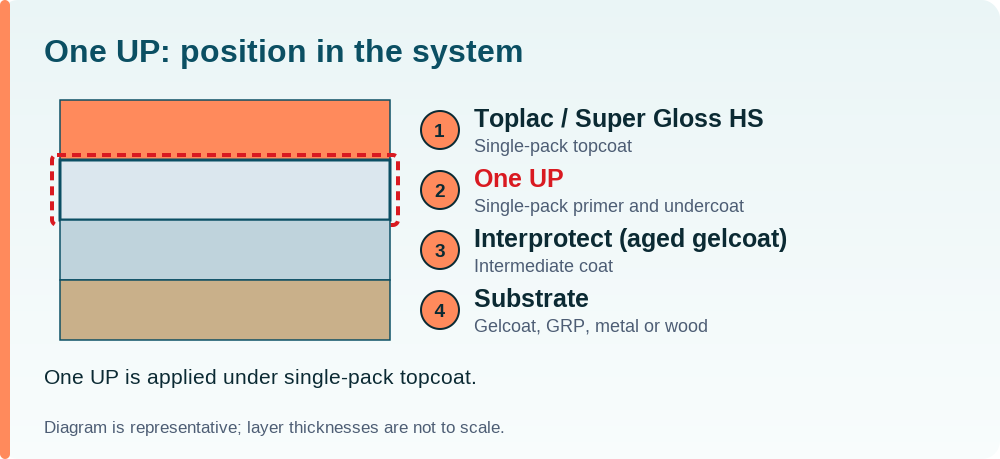
What does One UP do and where does it sit in the paint system?#
One UP is a primer used beneath single-pack top-surface paints. Applied over Interprotect on aged gelcoat, it prepares the surface for topcoats such as Toplac Plus and Toplac.
Which surfaces and where is it used?#
- Beneath single-pack finish and deck paints
- Intermediate coat over Interprotect on aged gelcoat
- Steel, aluminium, GRP and wood surfaces (above water)
- Preparation for Toplac Plus and Toplac
Surface preparation: the stage that decides the outcome#
Surface must be clean, dry and free of grease. Applied over a suitable primer.
Mix ratio, induction and pot life#
One UP is single-pack; stirring is sufficient. Stir the tin thoroughly before use.
Generally no thinning is required. Up to 10% thinning may be done depending on conditions. Thinner No.1 (YTA800) is used for cleaning.
| Value | Description |
|---|---|
| Mix | None |
| Reduction | Generally none; up to 10% |
| Cleaning | Thinner No.1 (YTA800) |
Application: step by step#
Applied by brush or 4 mm pile velour or solvent-resistant foam roller. Foam roller may reduce film thickness and hiding power.
Per coat, 48 µm dry and 100 µm wet film are targeted. On aluminium, total film target is 144–192 µm (300–400 µm wet).
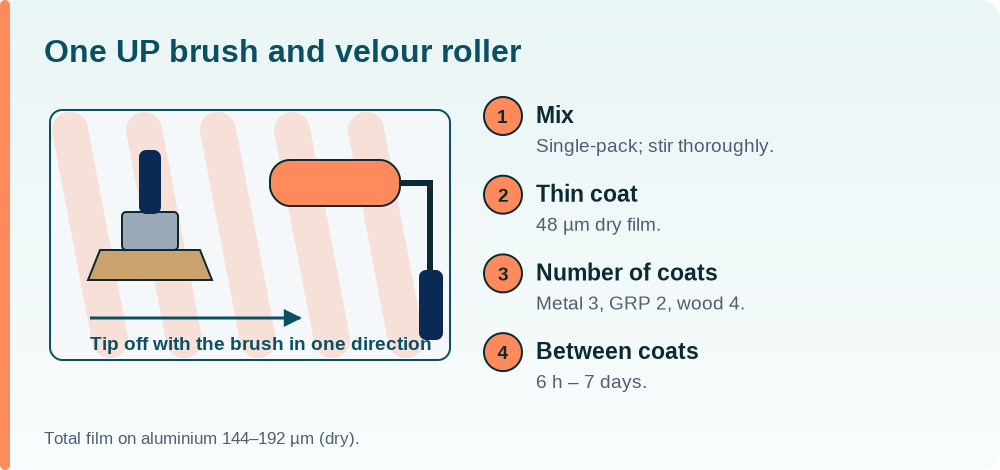
- Mix
Single-pack; stir thoroughly.
- First coat
Apply thin and even on the surface.
- Number of coats
Steel/aluminium 3, GRP 2, wood 4.
- Between coats
25 °C: min 6 h, max 7 days.
- Topcoat
Keep the surface clean before top finish.
| Surface | Number of coats | Dry film / coat |
|---|---|---|
| Steel / aluminium | 3 | 48 µm |
| GRP | 2 | 48 µm |
| Wood | 4 | 48 µm |
Drying and recoat times#
At 25 °C, One UP is touch-dry in 2 hours, hard-dry in 3 hours and sandable in 12 hours. A recoat interval of 6 hours to 7 days is expected.
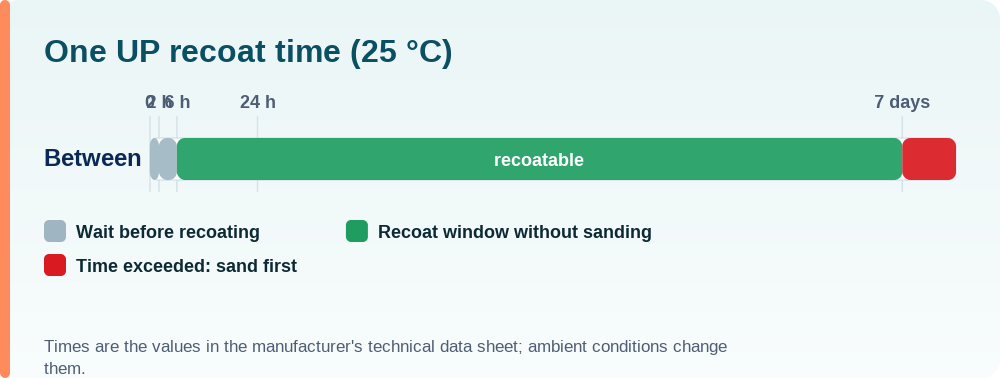
| Stage (25 °C) | Time |
|---|---|
| Touch dry | 2 hours |
| Hard dry | 3 hours |
| Sandable | 12 hours |
| Recoat interval (min–max) | 6 hours – 7 days |
Application conditions: temperature, humidity and dew point#
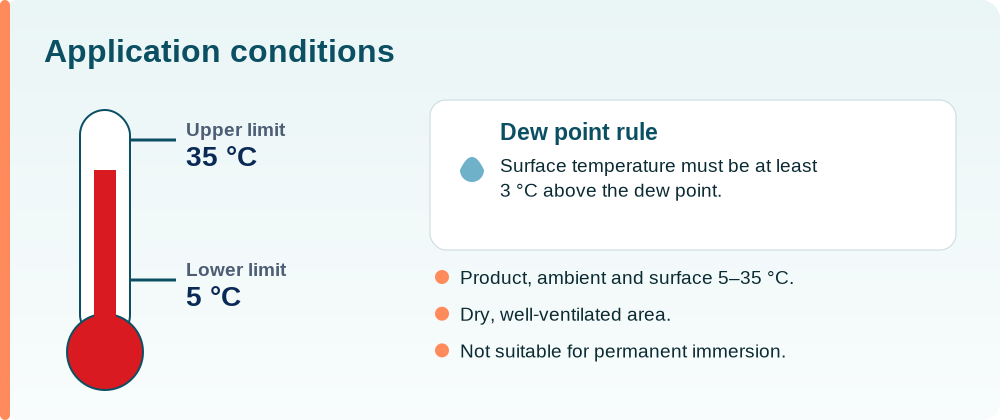
Product, ambient and surface 5–35 °C. Application must be in a dry, well-ventilated environment.
Tips from the professionals#
- Use a velour roller rather than a foam roller.
- Meet the total film target on aluminium.
- Do not exceed 7 days between coats.
- Work in a dry, well-ventilated environment.
Common mistakes#
- Single-pack, stirring sufficient
- Correct number of coats by surface
- Follow the recoat time
- Application beneath single-pack top coat
- Applying over two-pack solvent product
- Permanent immersion
- Thick film target with foam roller
- Skipping the number of coats
Health and safety#
Frequently asked questions#
How many coats of One UP?
Steel and aluminium 3, GRP 2, wood 4 coats.
Is thinning needed for One UP?
Generally not; up to 10%.
What is the recoat interval for One UP?
At 25 °C, between 6 hours and 7 days.
Which top coat is applied over One UP?
Toplac, Toplac Plus, Interdeck, Super Gloss HS and similar single-pack finishes.
_Source: International Yacht Paint (AkzoNobel) product technical data sheet (TDS) and product page (One UP, eng A4 20231115). The values on this page are compiled from the manufacturer's published documents and may change as the product develops. Before application, always check the product label, the current technical data sheet (TDS) and the safety data sheet (SDS)._