
Ultra 300 is International's hard-type biocidal antifouling. It is applied to the underwater part of the hull to prevent marine organisms from settling. The technical data sheet states that it contains biocide.
Antifouling is applied over a suitable primer system on the underwater hull. Following the dry film thickness given in the technical data sheet is recommended.
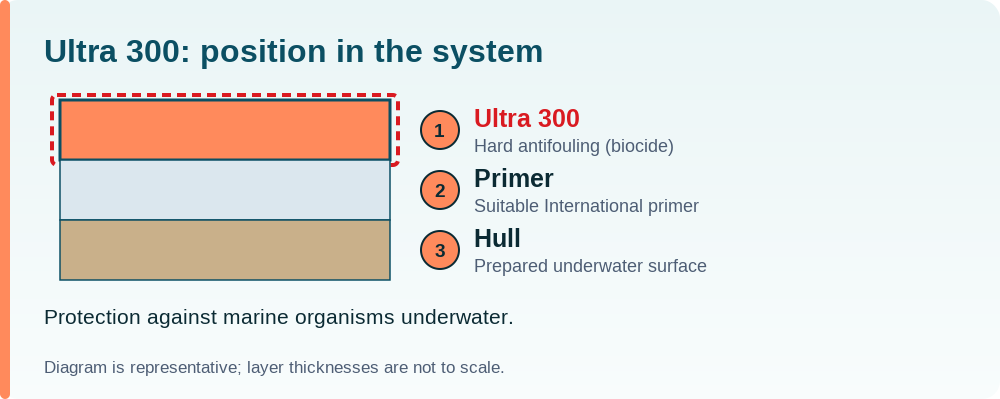
What does Ultra 300 do and where does it sit in the paint system?#
Ultra 300 protects the underwater hull against marine organisms with a hard biocidal coat.
Which surfaces and where is it used?#
- Underwater hull (hard antifouling)
- Renewing existing antifouling surfaces
- Permanently submerged surfaces
- Renewal (if old antifouling is compatible)
Surface preparation: the stage that decides the outcome#
Old antifouling is only wet-sanded; dry sanding and burning are not done. The surface must be clean and grease-free.
Mix ratio, induction and pot life#
Ultra 300 is single-pack; stir thoroughly before use.
Thinning is not recommended. YTA085 Thinner No.3 is used for cleaning.
| Value | Description |
|---|---|
| Mix | None |
| Reduction | Not recommended |
| Cleaning | YTA085 No.3 |
Application: step by step#
By brush or roller, 2 coats of 60 µm dry film each (wet 103 µm). For spray by airless, 1 coat of 120 µm dry film (wet 206 µm).
An extra stripe coat is applied to the sine (waterline-crevice) area.
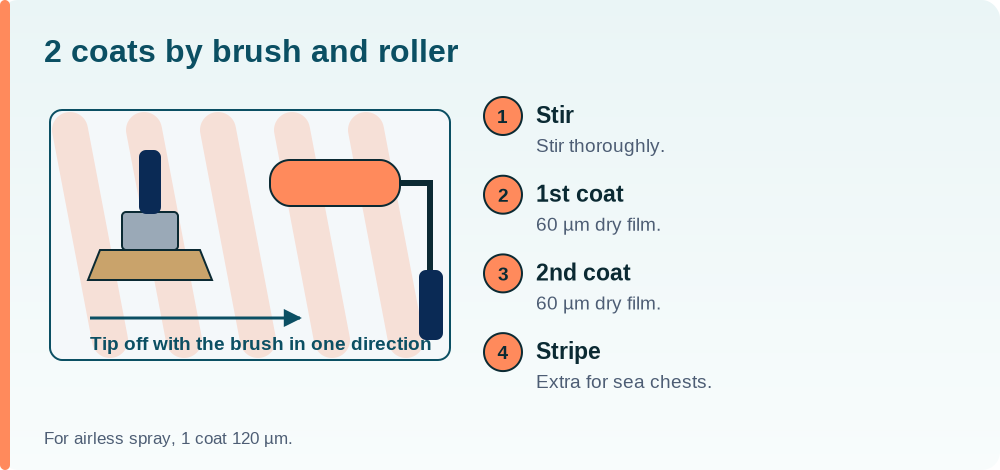
- Mix
Stir the tin thoroughly.
- First coat
60 µm dry film.
- Between coats
23 °C: min 6 h.
- Stripe coat
Sine area.
- Immersion
After 8 hours (23 °C).
| Application | Coat | Dry film / coat | Wet film / coat |
|---|---|---|---|
| Brush / roller | 2 | 60 µm | 103 µm |
| Airless spray | 1 | 120 µm | 206 µm |
Drying and recoat times#
Ultra 300 is touch-dry in 30 minutes at 23 °C and can be immersed in 8 hours. A minimum of 6 hours is expected before recoating.
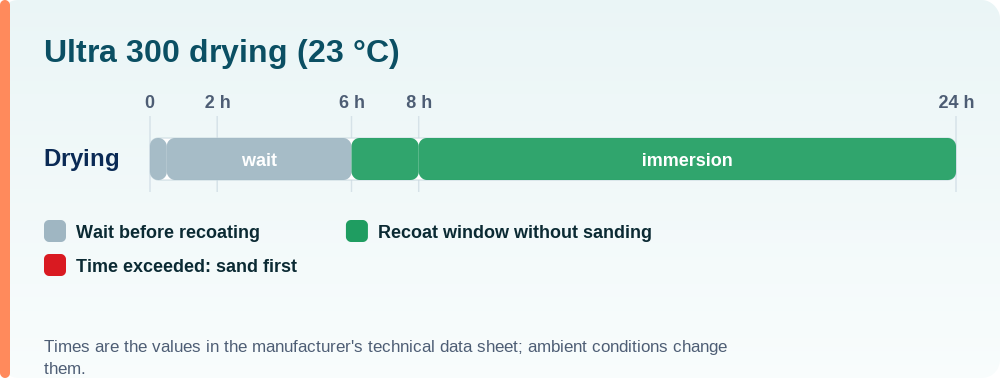
| Stage (23 °C) | Time |
|---|---|
| Touch dry | 30 min |
| Immersion | 8 h |
| Recoat (min) | 6 h |
| Maximum immersion (5–35 °C) | 6 months |
Application conditions: temperature, humidity and dew point#
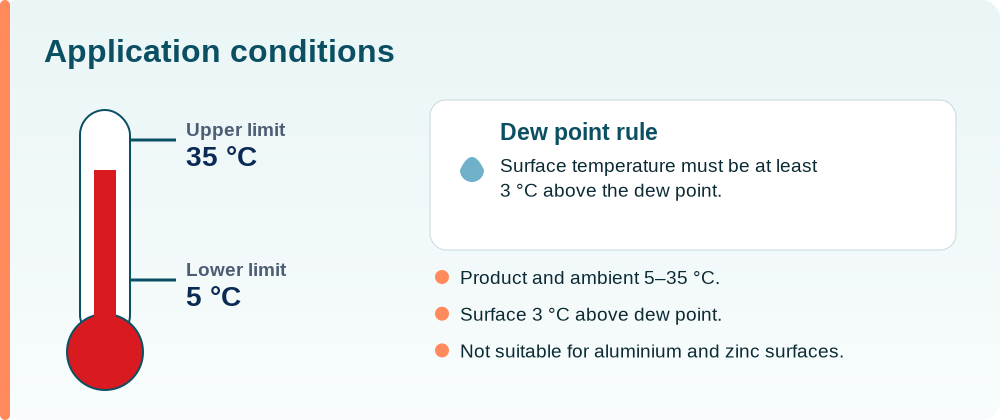
Product and ambient 5–35 °C; surface must be at least 3 °C above dew point.
Tips from the professionals#
- Apply the number of coats and DFT value given in the technical data sheet.
- Wet sand.
- Do not neglect the sine stripes.
- Wait for the drying time before immersion.
Common mistakes#
- Recommended coat thickness
- Wet sanding
- Stripe coat
- Drying before immersion
- Reduction
- Dry sanding or burning
- Direct application on aluminium
- Insufficient coats
Health and safety#
Frequently asked questions#
How many coats of Ultra 300?
Brush/roller 2 coats, spray 1 coat.
Is Ultra 300 thinned?
Not recommended; YTA085 No.3 for cleaning.
How long can Ultra 300 be immersed?
Up to 6 months at 5–35 °C.
Can Ultra 300 be applied to aluminium?
No, it is not suitable for aluminium and zinc surfaces.
_Source: International Yacht Paint (AkzoNobel) product technical data sheet (TDS) and product page (Ultra 300 data sheet). The values on this page are compiled from the manufacturer's published documents and may change as the product develops. Before application, always check the product label, the current technical data sheet (TDS) and the safety data sheet (SDS)._