
Refit and Maintenance
Aluminium Hull Refit: Galvanic Corrosion and Compatible Coating Systems
Aluminium is light and durable, but it can dissolve quickly when it touches the wrong metal. In this hull, the real refit task is managing how metals behave against each other.
Short answer
Aluminium hull refit is a process that prevents galvanic corrosion caused by dissimilar metal contact through insulation and a compatible coating system. Choice of fasteners, fittings and antifouling directly affects this compatibility.
Key points
- Galvanic corrosion occurs when two dissimilar metals contact in an electrolyte.
- Insulating gaskets and bushes electrically separate different metals.
- Copper-based antifouling creates galvanic corrosion on aluminium.
- The coating system is chosen according to aluminium surface preparation and compatible primer.
How aluminium behaves#
Aluminium protects itself by forming a thin oxide layer on its surface. Thanks to this layer, an aluminium hull lasts many years under suitable conditions. But that protection weakens when aluminium touches another metal and an electrolyte such as seawater is present. Then the aluminium becomes the anode of a galvanic couple and loses its own material. This is the most insidious problem of aluminium boats, because the loss often advances at the joint and in hidden places.
How galvanic corrosion forms#
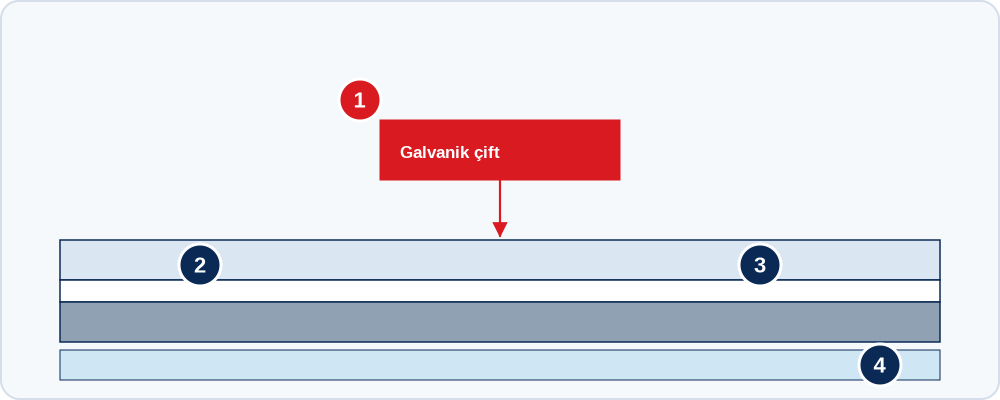
Galvanic corrosion needs three conditions together: two different metals, an electrical connection between them, and an electrolyte covering both. Seawater, a wet surface or condensation can act as the electrolyte. The electrochemical potential difference between metals determines which one is protected and which dissolves. Noble metals such as copper, stainless steel and bronze are cathodic compared with aluminium; when they touch, the aluminium becomes the anode.
For this reason the refit maps every metal contact, including fasteners, fittings, shafts and coatings. It identifies which metal touches which, and whether an electrolyte bridges them. This map shows where insulation is needed.
| Type of contact | Risk | Precaution |
|---|---|---|
| Aluminium with stainless steel | High | Insulating gasket and insulated bush |
| Aluminium with copper or brass | Very high | Separator and coating, replace if possible |
| Aluminium with aluminium | Low | Same alloy and surface preparation |
| Aluminium with wood | Medium | Moisture barrier and isolation tape |
Insulation#
Insulation means electrically separating dissimilar metals. This is done by placing plastic or rubber based insulating gaskets, bushes and washers between them. In screwed joints, insulated bushes keep the screw from touching the hull. The insulation material is chosen to resist seawater and keep its flexibility for years.
Insulation is not considered complete once installed; at each refit period the joints are checked and it is confirmed that the insulation has not degraded. If the insulation fails, the metals touch again and corrosion begins.
Compatible coating system#
Coating on aluminium starts with surface preparation. The oxide layer and contamination are removed by blasting or suitable etching; then a zinc or epoxy based primer compatible with aluminium is applied. The primer bonds to both the aluminium and the paint and prevents oxidation. The topcoat provides UV and mechanical resistance.
The coating must be compatible with the substrate. Some paints adhere poorly to aluminium or react chemically with it. Each coat should therefore come from a system approved by the manufacturer for aluminium.
Choosing antifouling#
The most important coating error on an aluminium boat is using copper-based antifouling. When copper contacts aluminium, it forms a strong galvanic couple and dissolves the aluminium quickly. For this reason copper-free antifouling is preferred for an aluminium hull. The product is chosen for both compatibility with aluminium and effectiveness against marine growth in the area.
Acceptance check#
When the refit is finished, the joints, insulating gaskets and coating thickness are checked. The metal contact map is updated and the soundness of the insulation is recorded. Finally, photographs of the surface and the batch numbers of the products used are added to the record.
Surface preparation on aluminium#
Surface preparation on aluminium follows different rules from steel. A thin oxide layer forms on aluminium as soon as it meets air. The layer protects the metal but weakens paint adhesion. The surface is therefore prepared shortly before priming and is not left exposed for long.
The blasting abrasive is chosen separately too. Abrasive previously used on steel can leave iron particles on the aluminium surface. These particles form small galvanic cells and start pitting under the paint. For aluminium, iron-free abrasive used only on aluminium is preferred. The same principle applies to hand tools: stainless or aluminium-specific brushes replace steel wire brushes.
Welding and the heat-affected zone#
When aluminium is welded, the heat can reduce the strength of the metal around the seam. This area is called the heat-affected zone. In hardened alloys the loss is significant and is allowed for in design. Weld repairs in a refit are therefore done with a method and filler wire suited to the plate and alloy. Seams are checked after welding, and any cracks or porosity are repaired.
Because aluminium conducts heat quickly, distortion also forms easily during welding. Short, balanced weld sequences, suitable clamping and, where needed, preheating limit the effect.
Common mistakes#
The first mistake is using copper-based antifouling. Copper particles in contact with aluminium form a strong galvanic couple, and even small damage to the paint leads to fast corrosion. On an aluminium hull, antifouling that the manufacturer states is suitable for aluminium is used.
The second is fitting stainless fasteners without isolation. Direct contact between a stainless bolt and aluminium plate, especially in damp conditions, makes the aluminium corrode around the bolt. Insulating washers, sleeves and a suitable sealant break the contact.
The third is ignoring shore power and the boat's earthing. Stray currents from other boats in a marina can cause rapid corrosion of an aluminium hull. An isolation transformer or galvanic isolator on the shore connection reduces the risk.
Which anode is used on an aluminium boat?
The choice depends on the water the boat lives in and on the manufacturer's advice. Aluminium alloy anodes are a common choice in seawater.
How can galvanic corrosion be spotted early?
White powder around fittings, blistering paint and anodes wearing away unexpectedly fast are early signs.
Conclusion#
The essence of an aluminium hull refit is managing where metals touch. When insulation, compatible coating and copper-free antifouling are applied together, the light and durable hull is protected for years. The next article turns to wood, the other traditional hull material.
Was this guide helpful?
Thank you! Your feedback has been saved.
Guide content is for general information; in practice, the current technical data sheet of the product applies.
Keep reading
Related guides
Steel Hull Refit: Thickness Gauging, Plate Renewal and Corrosion Protection
How is plate thickness measured on a steel boat, when is plate renewed and how is corrosion prevented? Principles of gauging, welding and coating.
7 min read Refit and MaintenanceFilling and Fairing: Rebuilding the Hull Form
How is a hull surface corrected with filler and fairing compound? Filler selection, straightedge checks and coat thickness principles.
6 min read Refit and MaintenanceUnderwater System: Antifouling Selection and Coating Plan
How is antifouling selected for the underwater part of a boat, and how is the coating plan set up? Marine growth, tie coats and maintenance periods.
4 min read