
Refit and Maintenance
Steel Hull Refit: Thickness Gauging, Plate Renewal and Corrosion Protection
A steel hull can look sound on the outside and still be thinned from within. A refit begins by knowing the remaining plate thickness and ends by re-establishing corrosion protection.
Short answer
Steel hull refit is the process of measuring plate thickness ultrasonically, renewing plates below the design limit, and re-protecting the surface with a multi-coat corrosion system after blasting. Each step is documented in records.
Key points
- Remaining plate thickness is compared with the design limit to decide on renewal.
- Welding heat can distort neighbouring plates; sequence and cooling are controlled.
- Corrosion protection combines blast grade and primer system.
- Measurement points and results are recorded on a hull map.
Appearance can mislead#
A steel boat often looks sound from outside: the paint has not blistered and the surface looks whole. But corrosion usually advances from the underside of the plate and appears late on the outer surface. The plate may have thinned from inside, and that thinning becomes a structural risk in rough seas or when the boat is hauled out. The first step in a steel refit is therefore not to trust appearance, but to measure the remaining thickness of the plate.
Thickness measurement#
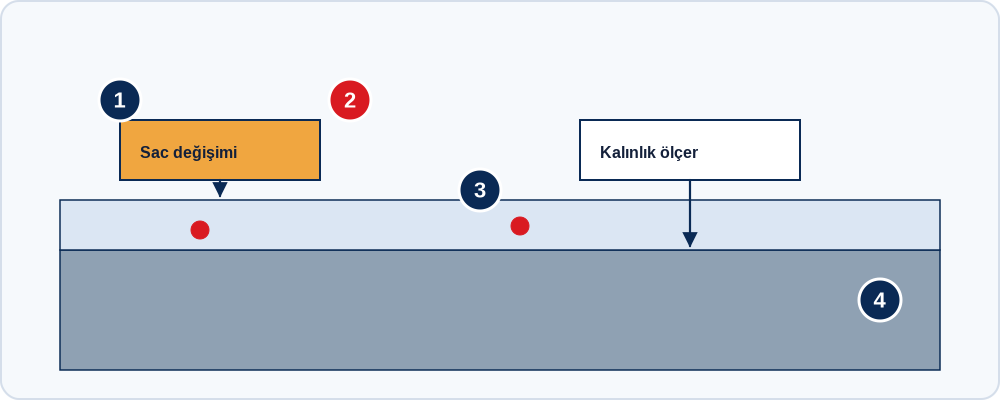
Plate thickness is read with an ultrasonic thickness gauge. The instrument sends a sound wave through the plate and measures the time it takes to return from the opposite face, from which it calculates thickness. Measurement points are spread around the whole hull; the bow, stern, keel, deck and welded joints must always be included. The readings are compared with the original plate thickness and recorded.
Thickness readings are turned into a map. Measurement points are marked on a drawing of the hull, and each point is written with its value. The map shows at a glance which plates must be renewed and which are only partly worn. It is also used for comparison in later refit periods.
| Remaining thickness | Condition | Decision |
|---|---|---|
| Most of original thickness | Sound | Protect with coating, monitor |
| Moderate thinning | Borderline | Increase measurement frequency, consider local repair |
| Below design limit | Critical | Renew the plate |
| Hole or crack | Critical | Renew immediately and investigate the cause |
Plate renewal#
Plates below the design limit must be renewed. Renewal means cutting out the plate and welding in new steel. The cut is planned so that it does not damage the sound plate around it. The thickness and quality of the new plate must match the original hull; using a different material or thickness creates zones of different flexibility and stress in the hull.
Welding is the most critical step. Heat can distort the plate and change the structure of the plate around it. For this reason the welding sequence is planned to be symmetrical rather than jumping from one point to another. After welding the plate is allowed to cool, and distortion is checked. Welds are inspected for tightness and structural integrity.
Blasting and surface preparation#
Corrosion protection starts with proper surface preparation. A steel hull is usually cleaned by blasting. The aim is to remove rust and old paint completely. The blast grade is set according to the cleanliness levels defined in international standards; after blasting the surface should show bright metal colour and a clear profile. Primer goes on as soon as blasting finishes, because clean steel starts to rust again within hours in humid air.
Multi-coat protection system#
The corrosion protection system consists of a primer, an intermediate coat and a topcoat. The primer bonds to the steel and stops corrosion; zinc-rich or epoxy primers are common. The intermediate coat adds thickness and barrier properties. The topcoat provides UV and mechanical resistance. The dry film thickness of each coat must be within the range in the product data sheet.
Additional measures may be needed for the underwater zone, such as antifouling and cathodic protection. Cathodic protection protects steel even when there is a defect in the coating; this topic will be covered separately in the cathodic protection article.
Acceptance check#
When the refit is finished, the plate thickness is measured again and the map is updated. Welds are inspected, coating thickness is measured and final surface images are added to the record. This record serves as the reference for future maintenance periods.
Hidden areas: where corrosion hides#
On a steel hull, corrosion usually advances not on the visible surface but in places that are hard to reach. Bilges, tank interiors, the back of insulation panels, the space under engine beds and the corners where interior joinery rests against the hull are the main ones. Water collects there, ventilation is poor, and the paint has often not been renewed since the boat was built. Even when the outside looks sound, the inner surface may have thinned seriously.
For this reason, surveying the inner surface in a refit matters as much as surveying the outside. Part of the interior is removed, insulation panels are opened and measurement points are marked on the inner surface too. Even if thickness is gauged from outside, seeing the inner surface is necessary to understand where pitting corrosion is and how widespread it is. Pitting can cause local perforation even in plate whose average thickness looks acceptable.
Welding and heat distortion#
In plate renewal, welding is the most delicate stage. Welding heat expands the plate, contraction follows on cooling, and the hull form can be distorted. On thin plate this distortion leaves waves that later have to be faired. To limit it, welding is done in short runs and in a balanced sequence, jumping from one side to the other so that heat does not concentrate in one area.
Preparation of the weld seam also decides the result. Edges are bevelled at a suitable angle and the surface is cleaned of rust, paint and grease. After welding, seams are checked visually and, where required, by non-destructive testing. The back of each seam is cleaned and protected so that it does not become a starting point for corrosion.
Common mistakes#
The first mistake is leaving the surface exposed for a long time after blasting. Clean steel quickly develops flash rust in humid air, and primer applied over it bonds poorly. The interval between blasting and priming is kept short to suit the conditions.
The second is ignoring salt on the surface. A hull that has worked at sea carries soluble salts. Trapped under paint, they draw in moisture and cause blistering. The surface is washed with fresh water before coating and checked with a soluble salt test where needed.
The third is welding a doubler plate over thinned plate to cover the problem. This leaves a gap between the two plates that holds moisture, and corrosion continues out of sight. The lasting solution is to cut out the thinned area and replace it with new plate.
At what thickness should plate be replaced?
The acceptance limit depends on the design, classification rules and the plate's role in the hull. The measured value is compared with that limit, and the decision rests on the measurement record.
Is mechanical cleaning enough instead of blasting?
It can be used on small or hard-to-reach areas. On large surfaces, the cleanliness and profile that the coating system requires are usually reached by blasting.
Conclusion#
A steel hull refit begins not with the visible surface but with the real condition of the plate. Measurement determines the renewal decision and the corrosion protection system directly. A hull whose surface is properly prepared, primed correctly and welded under recorded procedures can be protected for many years. The next article looks at how the same logic differs on an aluminium hull.
Was this guide helpful?
Thank you! Your feedback has been saved.
Guide content is for general information; in practice, the current technical data sheet of the product applies.
Keep reading
Related guides
Blasting Inside Tanks: Surface Preparation Standards and Good Practice
How blasting is described for the interior surface preparation of steel tanks: Sa grades, profile, salt and humidity limits and confined-space safety, summarised from standards and maker accounts.
14 min read Refit and MaintenanceSteel Yacht Freshwater Tanks: Design, Material and Internal Lining Guide
The material, design and drinking-water-suitable internal lining of a steel boat’s freshwater tank, summarised from organisation, magazine and maker accounts with their limits.
14 min read Refit and MaintenanceRemoving Old Coatings: Sanding, Blasting and Chemical Stripping
How are old paint and gelcoat removed? The effect of sanding, blasting and chemical stripping on laminate, selection criteria and safety.
6 min read