
Paint and Coatings
Antifouling Compatibility on Aluminium Hulls
Choosing antifouling for an aluminium hull raises two compatibility questions: does the paint harm the aluminium, and does it work with the old paint? This article summarises seller, maker and magazine accounts with their limits; it is not a product recommendation.
Short answer
Practical Sailor writes that most of today’s bottom paints are copper-oxide based and cannot be painted directly onto metal, especially aluminium hulls. West Marine (seller) says there is no safe copper threshold on aluminium and that antifouling for submerged aluminium must be copper-free; the same guide mentions zinc pyrithione, cuprous thiocyanate in very low concentrations and organic biocides such as Econea. Brands such as Pettit and TotalBoat present copper-free ablative products for aluminium (maker or seller claims). West Marine also says compatibility problems between formulations are common and that the new paint maker’s compatibility chart should be checked. This article is general information; product and coat count vary by maker.
Key points
- Copper bottom paints can form a galvanic couple with aluminium; sources describe copper-free options (Practical Sailor, West Marine, seller).
- Most of today’s bottom paints are copper-oxide based and cannot go directly on bare metal (Practical Sailor).
- Compatibility problems between old and new antifouling are common; check the maker’s compatibility chart (West Marine).
- Copper-free ablatives may perform differently from copper paints in some conditions (seller account).
- For product, coat count and time the maker and a qualified yard govern.
1. Two sides of compatibility#
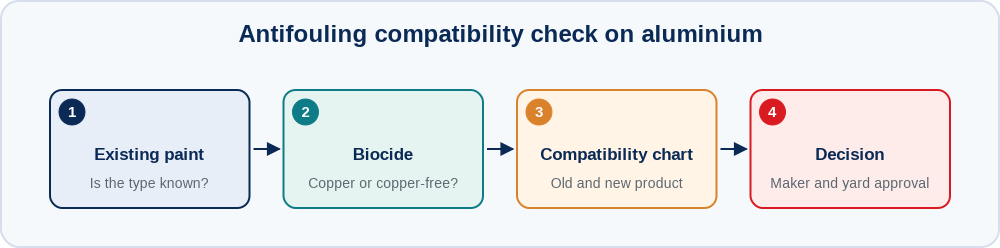
Antifouling compatibility on an aluminium boat covers two separate questions. The first is whether the paint harms the aluminium; the second is whether the new paint works with the old coating. Practical Sailor writes that most of today’s bottom paints are copper-oxide based and cannot be painted directly onto metal, especially aluminium hulls; the same source adds that copper-based bottom paints don’t like aluminium. This article is a general summary; it gives no product, coat count, thickness or waiting time and is not application advice. Some sources are seller or maker claims and are labelled as such.
In the aluminium boat painting guide article we covered the galvanic risk of copper paint separately. This article focuses on compatibility questions met when moving to a copper-free product or applying a new product over old paint.
2. Compatibility with aluminium: the copper issue#
West Marine (seller) writes that when copper-based antifouling is applied to aluminium every copper particle in contact with the aluminium through the paint film creates a galvanic couple and that there is no safe copper concentration threshold on aluminium; it adds that antifouling for submerged aluminium must be copper-free. The same guide mentions zinc pyrithione, cuprous thiocyanate in very low concentrations and organic biocides such as Econea as copper-free options. That is a seller account; a maker such as International says a suitably primed copper-thiocyanate-based product is allowed (see the aluminium painting guide article). There is that difference between sources.
TotalBoat (seller) presents a copper-free ablative designed for aluminium as dual-biocide with an organic biocide and zinc and says it can also be used on steel and iron boats. A Pettit product page (maker or seller) says a copper-free hybrid paint can be safely applied to all aluminium-hulled boats and is compatible over most bottom paints. These are product claims and have not been independently verified.
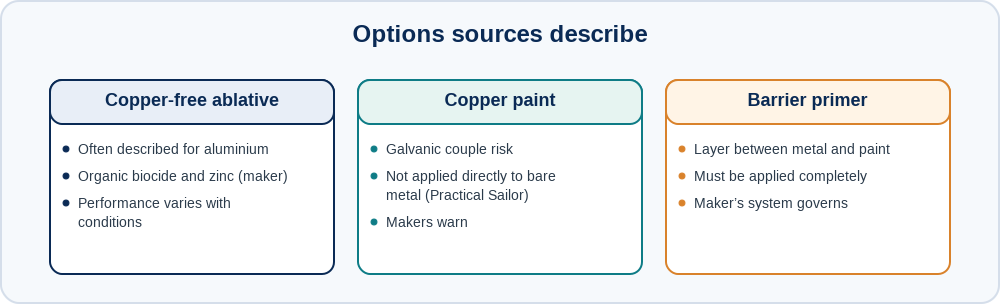
| Option | Sources’ general account | Caution |
|---|---|---|
| Copper-free ablative | Often described for aluminium; organic biocide and zinc (maker or seller) | Performance varies with conditions |
| Copper paint | Galvanic couple risk; not applied directly to bare metal (Practical Sailor) | Makers warn |
| Barrier primer | Layer between metal and paint (seller) | Must be applied completely |
3. Compatibility with old paint#
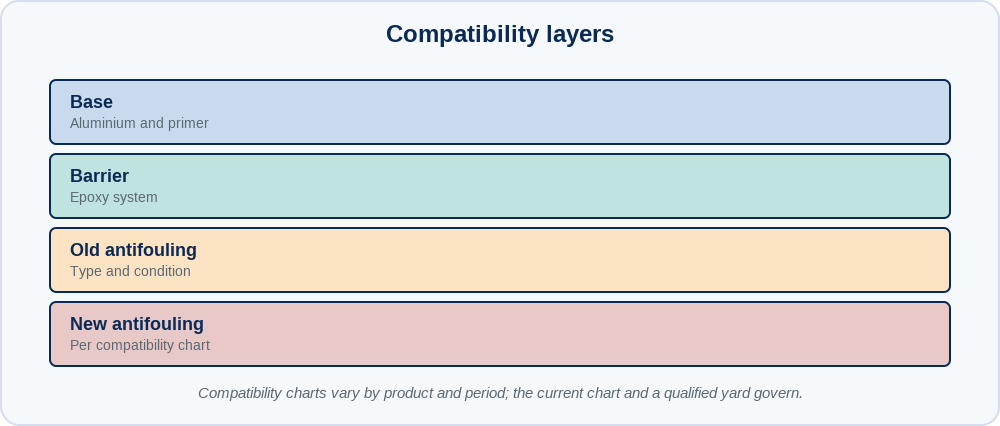
West Marine writes that compatibility problems between different formulations are common, that incompatibility can cause adhesion failure, blistering or accelerated paint loss and that the new paint maker’s compatibility chart should be checked. Another West Marine page recommends consulting the Interlux and Pettit compatibility charts and says that if you apply the same type of bottom paint already on the hull you may not need a primer. These are seller accounts; if the type of the coating on your boat is unknown the situation differs.
A forum user relays that a local dealer described sanding and cleaning the aluminium for a copper paint, then a vinyl wash primer, a two-part epoxy primer and only then the bottom paint. That is a user relay and unverified; for the risk of copper paint on aluminium ask the maker.
4. Environment and regulation#
A West Marine article says copper has been the dominant biocide in bottom paints since the 1980s, that in some coastal regions copper-free or low-leach paints are increasingly a requirement, and that copper-free ablatives face a steeper challenge in some conditions. That is a seller view and regulation varies by place and time. For local rules consult the relevant authority and the marina; this article is not legal advice.
- Establish the type of the existing coating on the boat.
- Discuss a copper-free or maker-approved antifouling for aluminium with the maker.
- Check the current compatibility chart for old and new product.
- Clarify the barrier primer system with the maker if needed.
- Mask the anodes and leave them bare.
- Find out local marina and regulatory rules.
- Record decisions and product information.
5. Limits#
Sources largely agree copper paint can be a problem on aluminium; they differ on how to manage the risk. One seller describes copper-free paints as the only safe option while a maker allows a particular suitably primed copper-thiocyanate product. Compatibility charts also vary by product and period. This article is not application or legal advice.
5b. Where sources differ#
West Marine (seller) says there is no safe copper threshold on aluminium and recommends copper-free paint; International (maker) accepts a suitably primed copper-thiocyanate-based product or an expertly kept impressed current system; Practical Sailor says copper paint cannot go directly onto bare metal. These are sources with different interests. Also West Marine on one page describes copper-free paint as the only safe option while on another it says copper-free ablatives are challenged in some conditions. The difference shows the importance of asking the maker for your boat and environment.
This article summarises the sources’ general accounts; it may not hold for a particular boat. For product, coat count and time the maker’s data sheet and a qualified yard govern.
5c. A practical frame for reading the sources#
The sources are sellers, makers, a magazine and a forum; each writes in its own context. Sellers describe their range, makers their systems, magazines a general assessment and forum users personal experience. None knows the old paint on your boat, whether it has an impressed current system or the properties of your berthing water. So taking the shared message, that copper paint on aluminium needs care and that the compatibility chart matters, and consulting the maker for detail, is reasonable.
If the type of the existing coating is unknown, applying a new product over it carries a risk of incompatibility. This article proposes no test or method for that; consult the maker and a qualified yard on compatibility. Because antifouling products contain biocides, personal protection may be needed during application and sanding; read the product’s safety information sheet.
Finally, antifouling alone is not a corrosion solution; the anode system, electrical isolation and regular inspection should be considered together. If you see blistering or pitting consult a specialist. Recording decisions and keeping the maker’s instruction helps later maintenance.
In addition, seller and maker statements are the firm’s own account of its product and have not been independently verified. A product’s compatibility with aluminium or another paint should always be checked in the product’s technical document; where a document and a guide conflict, the maker’s document and a qualified yard’s assessment should be used.
6. Common mistakes#
- Putting copper paint on aluminium.
- Applying new paint without knowing the old coating’s type.
- Skipping the compatibility chart.
- Assuming copper-free paint works the same in every environment.
- Painting the anodes.
- Not learning local rules.
- Keeping no records.
7. Checklist#
8. Conclusion#
Antifouling compatibility on an aluminium boat covers both the aluminium and the old paint; sources emphasise copper-free options and the compatibility chart but differ on product and risk management. This article is general information; it gives no product, coat count or time, and the maker and a qualified yard govern.
Frequently asked questions#
Can copper antifouling go on aluminium?
Practical Sailor writes that copper-based bottom paints do not like aluminium and cannot be applied to bare metal; West Marine (seller) says there is no safe copper threshold on aluminium. Ask the maker.
What does copper-free paint contain?
West Marine (seller) mentions zinc pyrithione, cuprous thiocyanate in very low concentrations and organic biocides such as Econea. That is a seller account; product details are on the label and data sheet.
Can new paint go over old paint?
West Marine says compatibility problems between formulations are common and the new paint maker’s compatibility chart should be checked. That one may not need primer if applying the same type already on the hull is also a seller account.
Does copper-free paint work in every environment?
A West Marine article says copper-free ablatives face a steeper challenge than copper paints in some conditions. That is a seller view; ask the maker for local conditions.
Are there copper restrictions in marinas?
A West Marine article describes copper restrictions in some regions; rules vary by place and time. For current local rules consult the relevant authority.
Was this guide helpful?
Thank you! Your feedback has been saved.
Guide content is for general information; in practice, the current technical data sheet of the product applies.
Keep reading
Related guides
Boat Colour Selection and Solar Reflectance: Effect of Heat Absorption on Surfaces
A study of the effect of boat paint colour on solar reflectance and surface temperature.
2 min read Paint and CoatingsCauses and Diagnosis of Paint Blistering
A study of the sources, types and diagnostic approach to blistering on boat paints.
2 min read Paint and CoatingsNumber of Coats in Epoxy Coating Systems
A study of the effect of the number of coats in epoxy coating systems on protective performance and thickness.
2 min read