
Paint and Coatings
Gloss or Matte Varnish? For Decks and Cabins
The choice between gloss and matte varnish is not only about looks but, in some accounts, about coat order and UV protection. This article summarises magazine, maker and user accounts with their limits; it is not a product recommendation or application advice.
Short answer
A boat-supplies retailer’s wood-finish guide describes varnish as the best choice for exterior brightwork where maximum gloss and appearance are the goal, and some synthetic satin coatings as popular low-maintenance UV-resistant options in the tropics. A varnish maker says that when a satin or matte finish is wanted the coats should be built with gloss varnish and satin or matte used only for the final coat. Forum users explain the order by saying some satin varnishes may contain no UV inhibitors and flattening additives may soften the film; but these are user accounts and vary by product. For interiors satin is often mentioned. This article recommends no product; the maker’s data sheet governs.
Key points
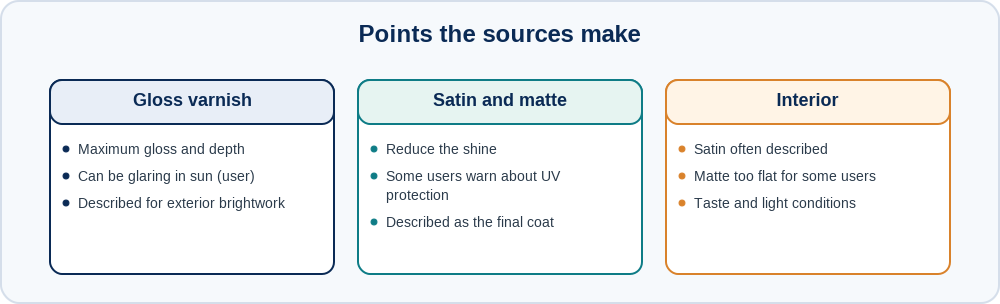
- For exterior brightwork where maximum gloss and depth are the goal, gloss varnish is described (retailer guide).
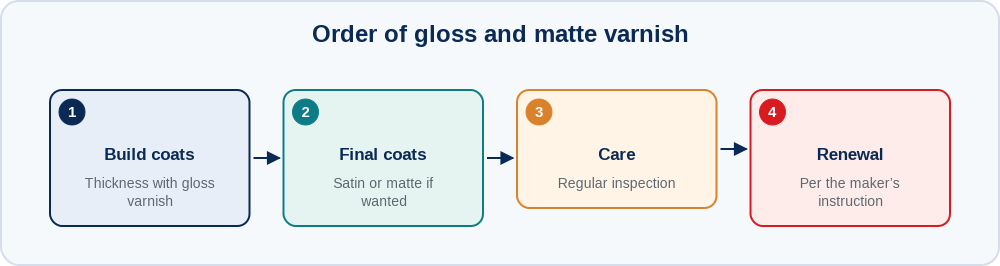
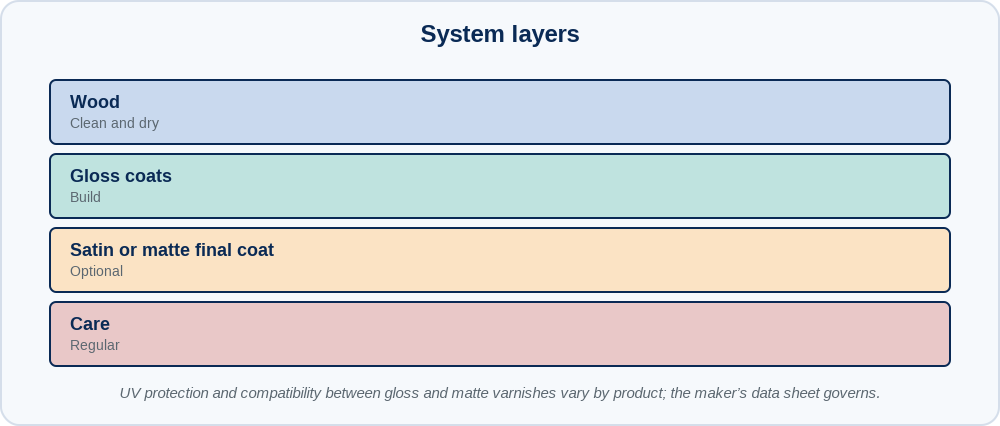
- When satin or matte is wanted, building coats with gloss and using satin or matte only as the final coat is described (maker instruction).
- Some users warn satin varnishes may contain no UV inhibitors; this is a user account and varies by product.
- For interiors satin is often described; matte is too flat for some users and gloss too shiny.
- The choice depends on taste and conditions; the maker and a qualified yard govern.
1. Gloss, satin and matte: what is described?#
The difference between gloss, satin and matte varnish is described in sources first as the reflectivity and look of the surface; but the choice also affects coat order and, in some accounts, the protection expected. A retailer guide writes that varnish is a complex coating of oil, solvents, thinners, resins, driers and additives and that a gloss varnish properly applied and maintained looks very good on exterior wood. This article is a general summary; it gives no product, coat count, ratio or time and is not application advice. Sources are magazine, retailer, maker and forum accounts and may differ; maker statements are labelled.
2. Exterior brightwork#
The same retailer guide says varnish is described as the best choice for exterior brightwork where maximum gloss and appearance are the goal, for example toe rails, cockpit coamings, hatches and companionway trim, and that numbers up to ten coats are common for an exterior build. It also says some synthetic satin coatings gained popularity among cruisers in the tropics as UV-resistant low-maintenance options, remarkably durable and fast drying. That is a seller’s guide; it adds that oil is not appropriate as a build finish for fine exterior brightwork where high gloss is the goal.
A boat-materials maker, for varnish products offered in gloss and satin or matte, describes that when a satin or matte finish is desired the coats should be built with gloss varnish and satin or matte used only for the final coat, as directed on the product labels. That is a maker instruction and holds only for those products. A separate maker page says the gloss version is very shiny and smooth while the satin version is softer and less shiny; that is marketing language.
| Option | General account | Caution |
|---|---|---|
| Gloss varnish | Maximum gloss and depth for exterior brightwork | Can be glaring in sun (user) |
| Satin or matte | Reduces the shine; described as the final coat | UV protection varies by product |
| Interior | Satin often described | Taste and light conditions |
3. UV protection and coat order#
In a boatbuilding forum several users write that many satin varnishes may contain no UV inhibitors and that, to protect epoxy, several coats of a marine gloss varnish with UV inhibitors should go on first and then the satin; another relays having heard that satin varnishes are essentially gloss varnishes with a flattening agent added; another says the flattening additives make the film softer so satin should be the final coat. These are user accounts, have not been independently verified and vary by product; for each product check the label and data sheet.
A user in the same forum says he did the combination of gloss varnish coats with a few satin coats on two boats and does not like how glaring gloss finishes can be in the sun, and that satin does not show scratches as readily as gloss; another user refers to a maker saying satin can be used in all coats of one product. These different experiences show why one should look at one’s own product’s instruction.
For interiors, in a forum thread one user writes that all the interior varnish on his boat is satin, that matte is too flat and gloss too shiny, and that teak needs special preparation before varnishing because of its own oils. That is a user account and a matter of taste; an interior film may need a different film build and maintenance schedule from exterior brightwork.
4. A practical frame#
- First decide where it is used: exterior brightwork or interior; conditions differ.
- Check UV protection and compatibility between gloss and satin or matte in the maker’s data sheet.
- If you want satin or matte follow the maker’s coat-order instruction; matte or satin is generally described as the final coat.
- Think of practical effects such as glare in sun and how visible scratches are.
- Confirm wood preparation and varnish system compatibility with the maker.
- Plan regular inspection and maintenance.
- Keep records; read the safety data sheet.
5. Limits#
Sources overlap that gloss varnish is described for maximum gloss and depth and that satin or matte is generally described as the final coat; they differ on UV protection of satin varnishes and on which combination is suitable. A maker says satin and matte only for the final coat while some users describe using satin in all coats of a single product. So there is no single right answer; the product, where it is used and the maker’s instruction govern. This article is not application advice.
5b. Where sources differ#
The retailer guide describes gloss varnish for exterior brightwork and synthetic satin coatings in the tropics; the maker’s instruction says satin and matte only for the final coat; forum users differ on UV protection of satin varnishes, one liking gloss-under-satin, another describing satin coats of a single product; for interiors satin is often mentioned. These are sources speaking in different contexts and with different interests. The difference means consulting your own product’s data sheet and the maker.
This article is general information; it recommends no product, method, ratio, number of coats or time. The maker’s data sheet and a qualified yard govern.
5c. A practical frame for reading the sources#
The sources are magazines, makers, sellers and forums; each writes in its own context. None knows where it is used, the light conditions or the UV protection of your product of your boat. So taking the shared message and consulting the maker and a qualified yard for detail is reasonable.
Sanding dust and varnish vapours can carry health and fire risks, and varnish-soaked rags can self-heat. This article describes no personal protection, ventilation or waste method; read the product’s safety data sheet, consult a qualified yard and follow the relevant safety rules.
Seller and maker statements are the firm’s own account of its product and have not been independently verified. A product’s compatibility with another coating should always be checked in the product’s technical document; where a document and a guide conflict, the maker’s document and a qualified yard’s assessment should be used. Recording decisions and product details helps later maintenance.
6. Common mistakes#
- Using satin in all coats without checking UV protection.
- Looking only at appearance and not at where it is used.
- Not reading the coat-order instruction.
- Treating a forum account as a firm rule.
- Treating maker marketing language as independent verification.
- Not reading the safety data sheet.
- Keeping no records.
7. Checklist#
8. Conclusion#
The choice between gloss, satin and matte varnish concerns coat order and product-specific UV protection as well as looks; sources describe building with gloss coats and satin or matte on the final coat, and differ on details. This article is general information; it recommends no product or value and the maker and a qualified yard govern.
Frequently asked questions#
Which for exterior wood?
A retailer guide describes gloss varnish for exterior brightwork where maximum gloss is the goal; some synthetic satin coatings are also mentioned as a popular low-maintenance option in the tropics. The choice depends on taste and conditions.
Can I apply matte varnish directly?
A maker says when satin or matte is wanted the coats should be built with gloss varnish and satin or matte used only for the final coat. See the product instruction.
Does satin varnish protect against UV?
Some forum users write that satin varnishes may contain no UV inhibitors; this varies by product and is a user account. Check the label and data sheet.
Which for interiors?
In a forum thread one user writes that interior varnish is satin, that matte is too flat and gloss too shiny; that is a matter of taste.
Can I go from gloss to satin or back?
A forum user writes satin can go over gloss and vice versa but stresses gloss coats first for UV protection; confirm product compatibility with the maker.
Was this guide helpful?
Thank you! Your feedback has been saved.
Guide content is for general information; in practice, the current technical data sheet of the product applies.
Keep reading
Related guides
Boat Colour Selection and Solar Reflectance: Effect of Heat Absorption on Surfaces
A study of the effect of boat paint colour on solar reflectance and surface temperature.
2 min read Paint and CoatingsCauses and Diagnosis of Paint Blistering
A study of the sources, types and diagnostic approach to blistering on boat paints.
2 min read Paint and CoatingsNumber of Coats in Epoxy Coating Systems
A study of the effect of the number of coats in epoxy coating systems on protective performance and thickness.
2 min read