
Paint and Coatings
Antifouling Differences in Fresh Water and Salt Water
Is the boat kept in fresh or salt water? That question changes antifouling choice, though sources also show the difference should not be exaggerated. This article summarises the differences and their limits using general sources.
Short answer
Fouling organisms differ by water type: West Marine says fouling is predominantly a salt and brackish water problem and that fresh water has species such as zebra mussels, while Practical Sailor writes that in most fresh water areas the biggest challenge is weed and slime rather than shell. In Practical Sailor’s Lake Erie test paints that did well in salt water generally did well in fresh water too, and some low-copper paints that did poorly in salt water did very well in fresh water. Vendors state that some products suit only a particular water type; see the product data sheet and the maker. This article is general information and recommends no product.
Key points
- Shelled growth stands out in salt water; in fresh water weed and slime are mostly the problem (West Marine, Practical Sailor).
- In the Lake Erie test paints good in salt water were also good in fresh water; some low-copper paints performed very well in fresh water.
- Some products suit a particular water type (vendor claim); see the data sheet.
- When moving from sea to fresh water salt-water species are said to die within weeks and fresh-water species settle afterwards (boats.com).
- On aluminium hulls copper-based paint carries a galvanic risk; consult the maker.
1. Why does water type make a difference?#
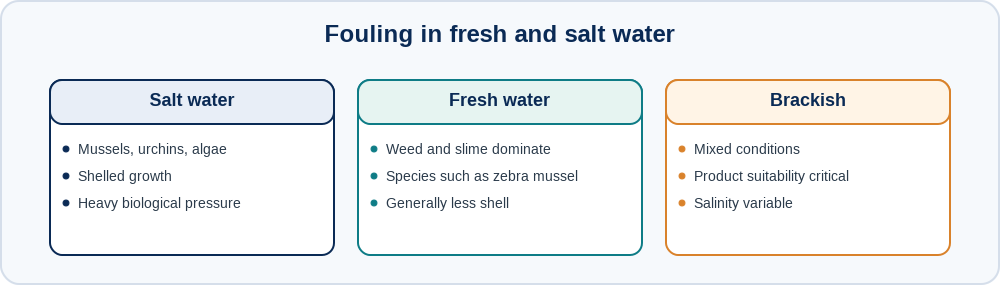
Fouling organisms change with water type. West Marine says fouling is predominantly a salt and brackish water problem, that shelled growth such as barnacles, tube worms and heavy algae accumulation are driven by salt-water species and that fresh water has species such as zebra mussels. Good Old Boat writes that fresh-water sailors do not worry about barnacles or teredo worms. In an answer to a reader question Practical Sailor says that for most fresh-water areas the biggest challenge is not shell fouling but weed and slime growth. This article is a general summary; it recommends no product and gives no fouling intensity for a particular body of water.
These differences mean product choice should take water type into account, though the difference should not be exaggerated: as seen below test results show paints good in salt water are generally good in fresh water too. The product data sheet governs the decision.
2. What do test results say?#
The conclusions of Practical Sailor’s fresh-water test in Lake Erie say that in general paints that did well in salt water also did well in fresh water, but that some low-copper paints that did poorly in the salt-water test did very well in fresh water. Another article from the magazine says they have not had much luck in salt water with low-copper, slick racing paints like Pettit SR-21 and Interlux VC-17m, while these fresh-water paints hold up well in Lake Erie. These are magazine tests in particular years and places; results may not apply identically to another lake or sea.
The same magazine’s brackish water test reports that the 12-month failures are usually fresh-water paints (when tested in salt water), copper-free paints with “eco-friendly” formulas or low-copper budget paints designed to last one season. So putting a product in the wrong environment is a consistent risk. That is a magazine view and should be verified against the product data sheet.
| Situation | General observation | Note |
|---|---|---|
| Salt-water paint in salt water | Intended use | See data sheet |
| Salt-water paint in fresh water | Generally good (Erie test) | Product-specific limits possible |
| Fresh-water paint in salt water | Often poor (PS brackish test) | Wrong-environment risk |
| Brackish water | Mixed conditions | Consult the maker |
3. Product suitability by water type#
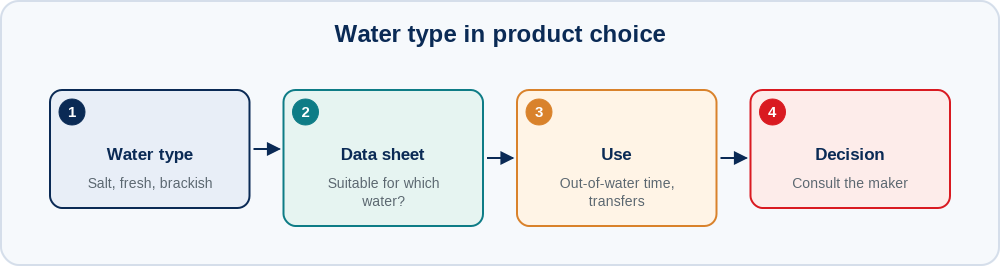
West Marine’s antifouling buying questions guide says some paints are formulated for a particular environment; for example that Interlux Micron 66 depends on a chemical reaction with salt water to activate its biocide and should not be used in fresh water, and that Pettit SR-21, favoured for racing boats, is best suited to fresh water or short-term use in low-fouling cold salt water. These are vendor and product statements, product-specific and subject to change. Always confirm a product’s intended environment with the maker.
Copper is a broad-spectrum biocide in both fresh and salt water. Practical Sailor advises sailors in sensitive fresh-water areas to avoid soft-sloughing paints or paints with high copper content and to consider the low- or no-copper paints designated for these environments; that is a magazine view and should be weighed with local regulation and environmental rules (see the biocide regulation article).
4. Moving from sea to fresh water (or back)#
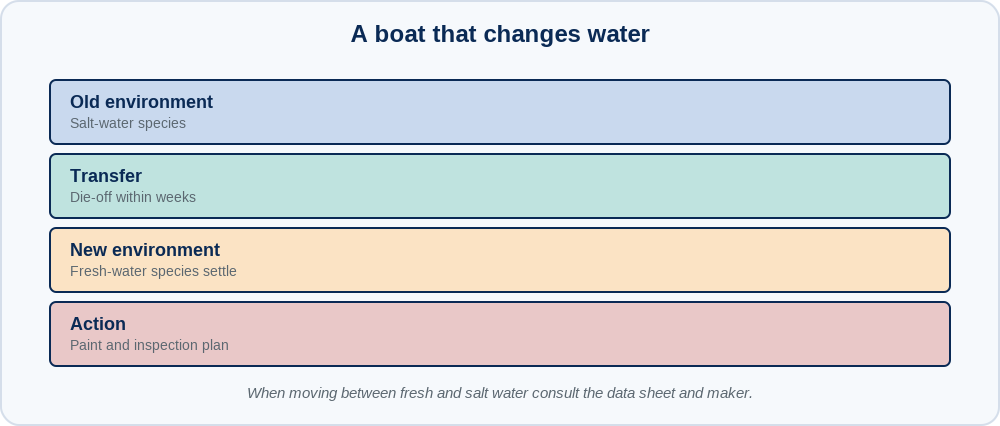
The boats.com guide says that if you move a boat from the sea to inland waterways it will take several weeks for fresh-water species to become established and during this time existing growth from the salt-water environment is likely to die. That suggests a “gap” period at the transition, though dead growth can remain on the surface and need cleaning. An article in Practical Sailor suggests considering a hard paint if a thin-film paint is not cutting it or if you plan some salt-water sailing the following year. These are general comments; for your own product’s environment-change and out-of-water limits see the data sheet.
The situation is different for boats regularly hauled: Wholesale Marine says trailering a boat after each use or storing it out of the water may eliminate the need for bottom paint in fresh water. Whether that holds depends on use pattern and local rules.
- Determine the water type the boat will stay in: salt, fresh, brackish.
- Confirm the product’s intended water from the data sheet.
- If the water type will change consult the maker.
- Expect weed and slime pressure in fresh water; question shell risk by local conditions.
- Do not use copper products on an aluminium hull; see the maker’s system.
- Check environmental rules and biocide regulation.
- Record your observations.
5. Brackish water and mixed conditions#
In estuaries and brackish lakes where salinity changes both salt-water and fresh-water species can occur and conditions vary with season. Product suitability is especially critical in these environments: if a product is activated by salt water it may not deliver expected performance when salinity falls. Practical Sailor’s brackish water test shows the importance of a locally specific trial for this reason. See the experience of local users and yards and the maker’s brackish-water recommendation.
Environmental rules can be more sensitive in brackish and fresh-water areas; biocide restrictions vary from region to region. For regulation see the related article and the local authority; this article is not legal advice.
5b. Aluminium hulls and metal parts#
West Marine says cuprous oxide is far more noble than aluminium, that applying copper-based antifouling to an aluminium hull creates a galvanic couple and that the aluminium corrodes rapidly and irreversibly. TotalBoat’s support page also writes that for aluminium hulls aluminium bottom paint typically uses a copper-free biocide such as Econea and that underwater metals such as outdrives and trim tabs also need metal-free antifouling. These are vendor statements and product-specific. For aluminium hulls and metal parts see the maker’s approved system.
Water type and metal must be considered together: even in fresh water copper paint on an aluminium hull can carry risk. So the assumption that “fresh water means fewer problems” is not safe for metal hulls.
6. Common mistakes#
- Never asking water type in product choice.
- Using a product designed for salt water in low-salinity water.
- Using fresh-water paint in salt water.
- Applying copper paint to an aluminium hull.
- Not consulting the maker when the environment changes.
- Generalising one lake’s test everywhere.
- Skipping environmental rules.
7. Checklist#
8. Conclusion#
In fresh water fouling is mostly weed and slime while in salt water shelled growth stands out. The Lake Erie test reports that paints good in salt water are generally good in fresh water and some low-copper paints performed very well in fresh water; but some products suit only a particular environment. Copper paints carry risk on aluminium hulls. This article is general information; the product data sheet and maker’s instruction govern.
Frequently asked questions#
Is antifouling needed in fresh water?
It depends on use. Wholesale Marine says trailering after each use or storing out of water may eliminate the need for bottom paint in fresh water; for boats left afloat see the product data sheet.
Does salt-water paint work in fresh water?
In Practical Sailor’s Lake Erie test paints doing well in salt water generally did well in fresh water too; but some products are designed for a particular water type. See the data sheet.
Does fresh-water paint work in salt water?
Practical Sailor reports that fresh-water paints tested in salt water are often among the failures at 12 months. Verify your product’s intended water.
What happens if I move from sea to fresh water?
boats.com says it takes several weeks for fresh-water species to become established and that during this time existing salt-water growth is likely to die; consult the maker about paint.
Can I use copper paint on an aluminium boat?
West Marine says not to use antifouling containing cuprous oxide on an aluminium hull or outdrive because of galvanic corrosion risk. See the maker’s aluminium system.
Was this guide helpful?
Thank you! Your feedback has been saved.
Guide content is for general information; in practice, the current technical data sheet of the product applies.
Keep reading
Related guides
Boat Colour Selection and Solar Reflectance: Effect of Heat Absorption on Surfaces
A study of the effect of boat paint colour on solar reflectance and surface temperature.
2 min read Paint and CoatingsCauses and Diagnosis of Paint Blistering
A study of the sources, types and diagnostic approach to blistering on boat paints.
2 min read Paint and CoatingsNumber of Coats in Epoxy Coating Systems
A study of the effect of the number of coats in epoxy coating systems on protective performance and thickness.
2 min read