
Paint and Coatings
Antifouling Choice for Fast Boats
On a boat that cruises at high speed antifouling must consider not just fouling but resistance to abrasion and surface smoothness. This article summarises sources’ tendencies while keeping vendor claims separate.
Short answer
Sources generally highlight hard or semi-ablative antifoulings for fast boats: Powerboat Magazine names hard or semi-ablative types as the best option for high-speed use (30-plus knots) and for boats trailered or run on and off lifts; West Marine writes that hard modified epoxy paints are excellent for racing sailboats and fast powerboats because of their ability to resist abrasion and be burnished to a smooth surface. Makers such as Jotun present hard-matrix products developed for speed boats (40+ knots) (maker claim). The drawback noted is that hard paints need stripping and sanding. This article is general information; it recommends no product and the data sheet and maker govern.
Key points
- Hard or semi-ablative types stand out for fast, trailered and often-hauled boats (Powerboat Magazine, Boating, West Marine).
- Hard modified epoxy paints resist abrasion and can be burnished smooth (West Marine).
- Slick racing paints are listed for speed-priority boats; but little luck has been had with low-copper slick paints in salt water (Practical Sailor).
- Hard paints require stripping and sanding over time; effectiveness may drop out of water.
- Speed limits and out-of-water rules are product-specific; see the data sheet.
1. Why is antifouling for a fast boat looked at differently?#
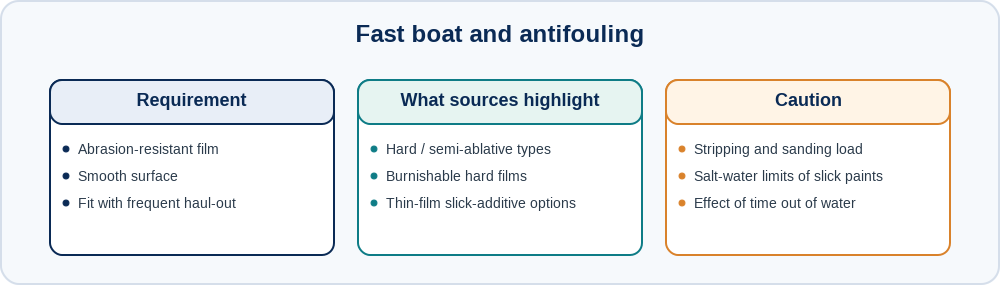
A hull cruising at high speed is exposed to strong water flow, which can increase wear of the paint film. At the same time, because speed matters, a smooth hull surface is wanted. For these reasons sources treat antifouling for fast boats as a separate topic tied to use and haul-out pattern. This article is a general summary; it recommends no product, gives no speed limit and states no fouling intensity for a given region.
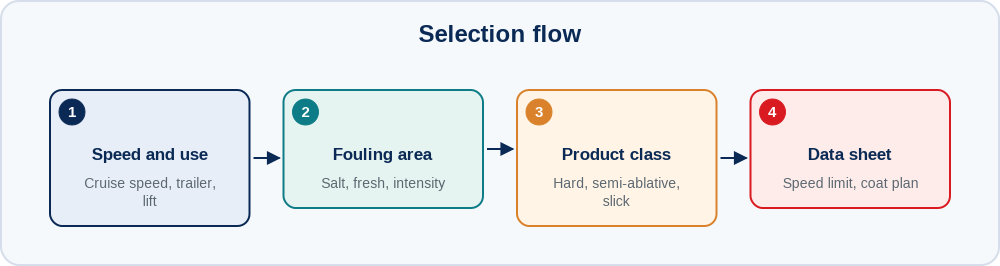
The questions that stand out in sources are: at what speeds does the boat cruise, how often is it launched and hauled, is it trailered, does it sit in salt or fresh water and how important is surface smoothness for racing or performance? Below you will find sources’ tendencies on these questions.
2. Hard and semi-ablative types#
Powerboat Magazine writes that hard or semi-ablative types are the best option for high-speed use (30-plus knots) and for boats trailered or run on and off boat lifts with some regularity, but that they are difficult to remove and stripping or soda-blasting is necessary after a few seasons. The same source says that with a semi-ablative product a boat may need slipping only about every 18 months, with a light wet-and-dry sand using 80 grit to remove spent antifouling from the bottom; that is a magazine view and depends on the product. Boating magazine says hard paint releases biocide slowly while the film itself remains largely intact and that this durability lets it stand up well to trailering, beaching, frequent scrubbing and high-speed operation, making it popular for performance boats, racing sailboats and vessels regularly hauled; it adds that periodic sanding or stripping becomes inevitable.
West Marine’s paint selection guide describes hard modified epoxy paints as a good choice for high-fouling waters and as excellent for racing sailboats and fast powerboats because of their ability to resist abrasion and be burnished to a smooth surface. West Marine’s overview says vinyl bottom paints are a great choice for performance boats but that antifouling effectiveness begins to diminish when the boat is hauled out and that they require plenty of sanding when it is time to repaint. These are vendor and guide views.
| Class | What sources highlight | Caution |
|---|---|---|
| Hard modified epoxy | Abrasion resistance, burnishable | Sanding / stripping load |
| Semi-ablative | Listed for speed and trailer use | Product-dependent |
| Vinyl / thin film | Performance, easy clean-up | Compatibility, out-of-water effect |
| Slick racing paints | For speed-priority boats | Limited results in salt water (PS) |
3. Slick racing paints and their limits#
West Marine lists slick “go-fast” antifouling paints with additives such as molybdenum disulfide, PTFE, graphite and silicon as a good choice for boats where speed is the number one priority, including racing sailboats and high-performance powerboats. The description of Jotun’s Racing product says it was developed for speed boats (40+ knots), has a hard matrix, can be used for trailer boats or dry moorings and can be burnished for racing sail boats; on aluminium hulls only white and grey colours are recommended as part of an approved system. These are maker claims, product-specific and subject to change.
Practical Sailor, for its part, reports little luck in salt water with low-copper slick racing paints like Pettit SR-21 and Interlux VC-17m, while these hold up well in fresh water; West Marine also writes that SR-21 is best suited to fresh water or short-term use in low-fouling cold salt water. So the speed advantage of slick paints must be weighed with environment and fouling pressure. Soundings magazine says racers wet sand and polish their bottoms in-season for a few tenths of a knot; that is a racing practice and not needed on every boat.
4. Trailer, lift and time out of water#
Trailered boats or those often taken from a lift wait out of water. Good Old Boat writes that the ultra-thin film of epoxy-ester hard paints is tough and unaffected by air, making it a good choice for trailerable boats. Jotun’s description likewise says Racing can be used for trailer boats or boats on dry moorings. On the other hand according to West Marine hard paints can begin to lose effectiveness when out of water, so for each product’s out-of-water time and relaunch limit the data sheet must be consulted.
Frequent haul-out also offers a chance to clean and inspect. Use it to check the hull surface and paint film each time; for build-up and cracking see the article on applying a new system over old antifouling. Remember that sanding and stripping make toxic dust; see the related safety article.
- Record the boat’s cruising speed and how it is operated.
- Determine the trailer, lift or permanently afloat pattern.
- Clarify the salt- or fresh-water environment and fouling pressure.
- Read the product class (hard, semi-ablative, slick) and the maker’s speed limit in the data sheet.
- Check out-of-water and relaunch limits.
- Consult the maker for compatibility and coat plan.
- Inspect and record the hull at each haul-out.
5. Surface smoothness and performance#
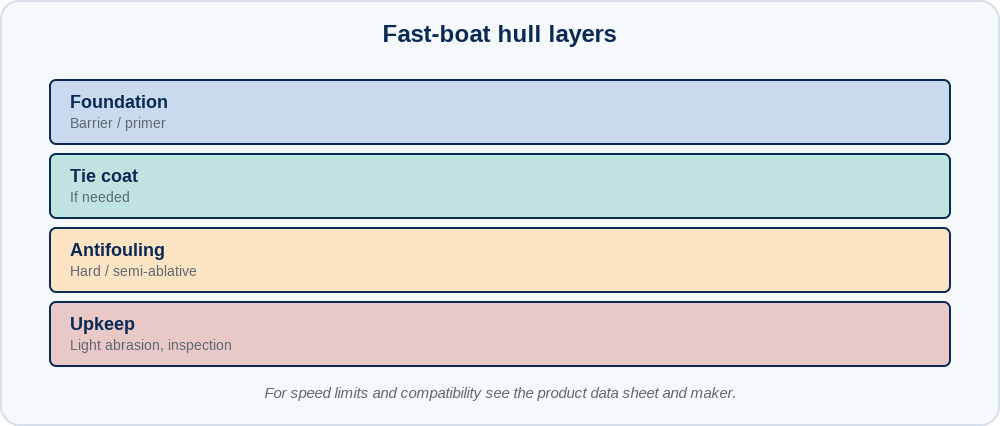
Keeping the surface smooth matters on fast boats for both performance and fuel. Hull roughness and fuel consumption is covered in a separate article. What matters here is whether the antifouling film leaves a smooth surface and whether this can be maintained in upkeep. Burnishable hard films stand out in this respect, but whether burnishing or wet sanding is permitted by the product must be checked in the data sheet.
On speed limits sources use different figures and wording; Powerboat Magazine speaks of 30 knots and above and Jotun of 40 knots and above. These differences come from product class and the source’s context; for your own product’s limit contact the maker.
5b. Aluminium and metal parts#
Many fast powerboats may have an aluminium hull or aluminium outdrive. West Marine says not to use antifouling containing cuprous oxide on an aluminium hull or outdrive because of the galvanic corrosion risk. The Jotun Racing description likewise notes that for aluminium hulls only particular colours are recommended as part of an approved system. These warnings are product-specific; for aluminium and metal parts see the maker’s approved system.
There are special antifouling coatings for parts such as trim tabs, outdrives and transducers; for product class and application see the maker’s instruction. This article recommends no specific product.
6. Common mistakes#
- Not checking the speed limit in the data sheet.
- Not allowing for the stripping and sanding load of hard paint.
- Treating a low-copper slick paint alone as enough in high-pressure salt water.
- Ignoring the effect of time out of water.
- Using copper products on aluminium parts.
- Not checking compatibility with the existing system.
- Neglecting personal protection when sanding.
7. Checklist#
8. Conclusion#
Sources highlight hard or semi-ablative antifoulings, burnishable hard films and, for speed-priority boats, slick racing paints for fast, trailered and often-hauled boats; but the stripping and sanding load, the limits of slick paints in salt water and the effect of time out of water must be kept in view. This article is general information; for speed limit, compatibility and coat plan the data sheet and maker’s instruction govern.
Frequently asked questions#
Which type for a fast powerboat?
Powerboat Magazine names hard or semi-ablative types as the best option at 30-plus knots; West Marine recommends hard modified epoxy for fast powerboats. Check the maker’s speed limit.
For a trailered boat?
Boating magazine notes hard paint stands up well to trailering, beaching and frequent scrubbing. Time out of water can reduce effectiveness; see the data sheet.
Are slick racing paints reliable?
Practical Sailor writes it has not had much luck with low-copper slick racing paints in salt water; West Marine lists them for speed-priority boats. Check environment and product data sheet.
What is the downside of hard paint?
West Marine and Boating magazine note hard paints eventually require sanding or stripping; effectiveness may also drop out of water.
Does this article recommend a product?
No. For speed limit, compatibility and coat plan see the product data sheet and the maker.
Was this guide helpful?
Thank you! Your feedback has been saved.
Guide content is for general information; in practice, the current technical data sheet of the product applies.
Keep reading
Related guides
Boat Colour Selection and Solar Reflectance: Effect of Heat Absorption on Surfaces
A study of the effect of boat paint colour on solar reflectance and surface temperature.
2 min read Paint and CoatingsCauses and Diagnosis of Paint Blistering
A study of the sources, types and diagnostic approach to blistering on boat paints.
2 min read Paint and CoatingsNumber of Coats in Epoxy Coating Systems
A study of the effect of the number of coats in epoxy coating systems on protective performance and thickness.
2 min read