
Paint and Coatings
Differences in Antifouling Choice for Sailboats and Powerboats
A sailboat’s hull and a powerboat’s hull meet the water in different ways and at different speeds. This article summarises, from sources, the common ground, the differences and the areas to watch on each type.
Short answer
Sources show different priorities on the two types: West Marine’s sailboat guide says paint priorities for cruisers and racers are opposite and treats sailboat-specific areas such as keel, rudder and waterline separately; on powerboats hard or semi-ablative types stand out at high speed and with trailer use (Powerboat Magazine, Boating). Common determinants are frequency of use, water type and region, compatibility with the existing system and suitability for metal parts. On aluminium hulls and metals such as outdrives, copper products carry risk (West Marine). This article is general information; it recommends no product and the data sheet and maker govern.
Key points
- On a sailboat cruiser and racer priorities are opposite; keel, rudder and waterline are treated separately (West Marine).
- On powerboats hard or semi-ablative types stand out at high speed and with trailer use (Powerboat Magazine, Boating).
- On both types frequency of use, water type and compatibility with the existing system decide.
- On aluminium hulls and outdrives copper products carry galvanic risk (West Marine).
- Growth can build on small parts such as trim tabs; see local users’ experience and the maker.
1. Two boat types, different hulls and use#
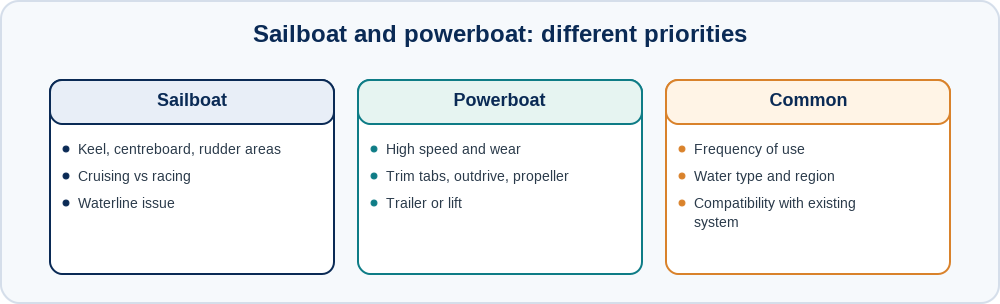
The hulls of sailboats and powerboats meet water at different speeds and in different ways. A sailboat has a deep keel, rudder and sometimes a centreboard and similar appendages; on a powerboat parts such as the outdrive, propeller and trim tabs stand out. Sources therefore treat antifouling choice by considering boat type, manner of use and metal parts together. This article is a general summary; it recommends no product, gives no speed limit and states no fouling intensity for a given region.
The two types also share determinants: how often the boat is used, whether it sits in salt or fresh water, which region it is in and compatibility with the existing antifouling system. These are covered separately in related articles.
2. Sailboat: cruiser and racer, keel and waterline#
West Marine’s sailboat paint guide says paint priorities for cruisers and racers are opposite; the guide treats hull antifouling, the “sailboat waterline problem”, keel paint (lead, cast iron and composite), rudder and appendages, topside paint, spars and standing rigging and deck in separate sections and says the specific preparation requirements for keel materials are something most general guides treat as an afterthought. That is a vendor guide; for your keel material see the maker’s preparation instructions.
On racing sailboats surface smoothness is the priority: Soundings magazine writes that sailboat racers want their bottoms as smooth and slick as possible and will wet sand and polish them in-season for a few tenths of a knot in a race. Good Old Boat notes that epoxy-ester hard paints are favoured by racing sailors and that their ultra-thin film is tough; Sail magazine says vinyls are the hardest antifouling paints and are used on racing boats because they can be wet-sanded and burnished. On cruising sailboats, in the boats.com example a 33 ft cruiser used at least three weekends a month from May to September is described as relatively easy to protect, and a mid-priced eroding product may be enough. These are magazine and guide views.
| Topic | Sailboat | Powerboat |
|---|---|---|
| Stand-out priority | Cruising vs racing split; smoothness | High speed and abrasion resistance |
| Special areas | Keel, rudder, centreboard, waterline | Outdrive, trim tabs, propeller |
| Type tendency | Eroding for cruising, hard / vinyl for racing | Hard or semi-ablative at speed |
| Common | Frequency of use, water, compatibility | Frequency of use, water, compatibility |
3. Powerboat: speed, wear, outdrive and trim tabs#
Powerboat Magazine says hard or semi-ablative types are the best option for high-speed use (30-plus knots) and for boats trailered or regularly run on and off lifts; the same article shows a photo of heavy mussel growth on a boat’s trim tab, illustrating that such parts are open to growth. It advises learning the regional favourite products from local yards and marine stores. Boating magazine says special antifouling coatings are used for parts such as trim tabs and transducers and the author describes protecting his transducers with one (FoulFree); that is a user account.
West Marine says not to use antifouling containing cuprous oxide on an aluminium hull or outdrive; TotalBoat’s support page also writes that underwater metals such as outdrives and trim tabs need metal-free antifouling. These are vendor statements and product-specific. For aluminium and metal parts see the maker’s approved system.
4. Common determinants#
On both types frequency of use, water type and region, wintering and haul-out pattern, compatibility with the existing system and metal parts decide. Eroding types generally stand out on regularly sailed boats and hard types on seldom-used or fast boats; but sources also disagree. For detail see the articles on usage profile and fast boats. For the fresh/salt water difference and compatibility with the existing system see the related articles.
Whatever the boat type, the product data sheet carries information such as speed limit, out-of-water limit, compatibility and suitability for metal parts. This article does not give that information in place of the maker.
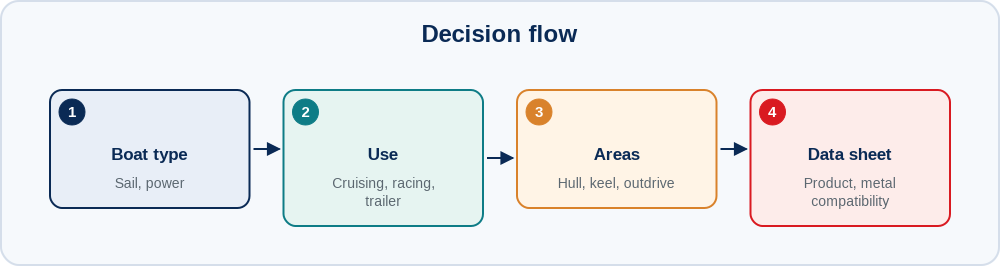
- Determine boat type and manner of use (cruising, racing, trailer, lift).
- List the areas: main hull, keel, rudder, outdrive, trim tabs, propeller.
- Note metals and materials (aluminium, lead, cast iron).
- Read product class, speed limit and out-of-water limit in the data sheet.
- Check compatibility with the existing system.
- Consult the maker and a yard in your area if needed.
- Inspect and record all areas at each haul-out.
5. Planning and records#
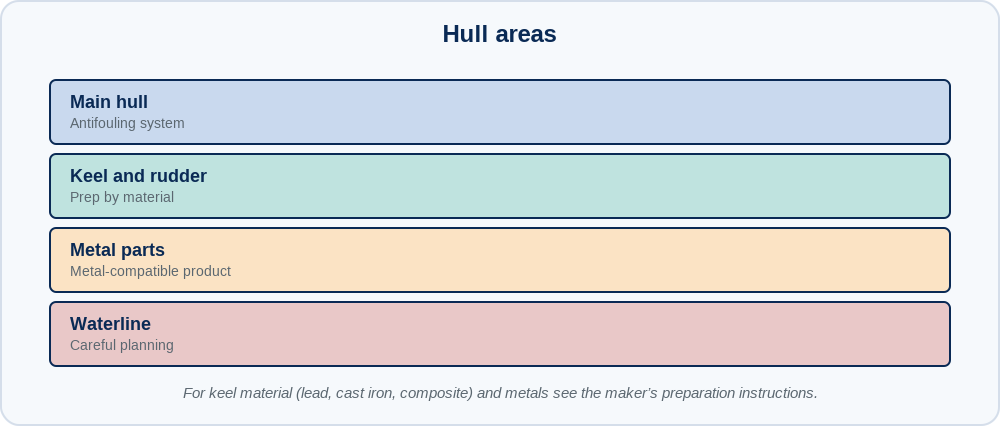
Recording the areas specific to the boat type makes the job easier: on a sailboat the keel and rudder area and the waterline; on a powerboat the outdrive, trim tabs and propeller. If the product, date and observed growth are recorded for each area it becomes clear next season which area needs separate attention. This record also gives a concrete basis when talking to the yard.
When buying a new boat or changing boat type (for example moving from sail to power) question habits carried over from the previous boat; different speed, use and metal parts may need a different system.
5b. Notes on keel, rudder and waterline#
On a sailboat the keel is usually a different material from the hull (lead, cast iron or composite) and may need material-specific preparation; the West Marine guide notes it treats this separately. Keel and rudder surfaces steer water flow so keeping them smooth matters; in applying paint to these areas the maker’s instruction governs. The waterline is a difficult zone between water and air for both fouling and paint; for detail see the related articles and the maker.
On a powerboat, alongside the waterline area, parts such as the outdrive and trim tabs stand out. Learn from local users and your own observation in which area growth starts first; that information makes planning for the next season easier.
6. Common mistakes#
- Skipping areas specific to the boat type.
- Using copper products on an aluminium hull or outdrive.
- Ignoring keel-material-specific preparation.
- Applying racer advice unchanged to a cruising boat.
- Not checking the speed limit and out-of-water limit.
- Not verifying compatibility with the existing system.
- Not keeping area-by-area records.
7. Checklist#
8. Conclusion#
Antifouling choice for sailboats and powerboats must weigh common determinants (use, water, compatibility) and type-specific differences (keel, rudder, waterline; speed, outdrive, trim tabs) together. Sources show the opposition of cruiser and racer priorities on sailboats and the prominence of speed and abrasion resistance on powerboats; copper products carry risk on aluminium and metals. This article is general information; the data sheet and maker’s instruction govern.
Frequently asked questions#
Can the same antifouling be used on a sailboat and a powerboat?
Some products may suit both; but use, speed and metal parts differ. See the product data sheet and the maker.
Which areas need special attention on a sailboat?
West Marine’s sailboat guide treats keel, rudder and appendages and the waterline problem in separate sections; preparation varies with keel material (lead, cast iron, composite).
Which type stands out on a powerboat?
Powerboat Magazine names hard or semi-ablative types as the best option at 30-plus knots; it depends on use and product.
Can I apply copper paint to an outdrive?
West Marine says not to use antifouling containing cuprous oxide on an aluminium hull or outdrive; TotalBoat writes that underwater metals such as outdrives and trim tabs need metal-free antifouling.
Does this article recommend a product?
No. For product see the data sheet, the maker and the experience of yards in your area.
Was this guide helpful?
Thank you! Your feedback has been saved.
Guide content is for general information; in practice, the current technical data sheet of the product applies.
Keep reading
Related guides
Boat Colour Selection and Solar Reflectance: Effect of Heat Absorption on Surfaces
A study of the effect of boat paint colour on solar reflectance and surface temperature.
2 min read Paint and CoatingsCauses and Diagnosis of Paint Blistering
A study of the sources, types and diagnostic approach to blistering on boat paints.
2 min read Paint and CoatingsNumber of Coats in Epoxy Coating Systems
A study of the effect of the number of coats in epoxy coating systems on protective performance and thickness.
2 min read