
Paint and Coatings
How to Tell Anode Life and Replacement Time
Anodes should be replaced before they run out; but when? This article summarises the common fifty percent rule, differing views, misreadings in visual assessment and the habit of monitoring, keeping maker claims apart.
Short answer
Most sources advise replacing sacrificial anodes when about fifty percent has deteriorated (BoatUS, West Marine, maker manuals); Axopar’s manual says to inspect anodes monthly. Yachting Monthly writes that the old rule was to replace zinc when 50 percent remained, that for aluminium this can probably be extended to about 30 percent in some cases, but that the real rule is to have enough anode to last until the next chance to replace it. A forum user notes that surface area is misleading because pitting increases it. An anode that still looks new after months, per Fisheries Supply, is probably not making contact. This article is general information; it gives no firm time and the maker’s instruction governs.
Key points
- The common rule is to replace an anode when about fifty percent has deteriorated (BoatUS, West Marine, maker manuals).
- Yachting Monthly says for aluminium this can in some cases be extended to about thirty percent; the real principle is enough anode until the next chance to replace.
- Looking at surface area is misleading; estimating weight or volume is more meaningful (user view).
- An anode that still looks new after months is probably not making contact (Fisheries Supply).
- An anode deteriorating beyond half may be inadequate; a larger one may be considered (Yachting Monthly).
1. Why replace in time?#
A sacrificial anode protects by wearing away before the metals to be protected; once it is gone corrosion turns to the propeller, drive or seacocks. West Marine writes that anodes should be replaced when about 50 percent eroded and that waiting too long can leave metal parts unprotected and lead to costly repairs. This article is a general summary; it gives no firm time, recommends no product and some sources are seller or maker claims.
Replacement frequency varies from boat to boat. Good Old Boat magazine writes that the time between replacements varies but that as a rule of thumb the anode should be replaced when it is about 50 percent destroyed. An anode’s efficiency depends on its surface area and an anode should never be painted; when fitting, the mounting surfaces of the two metals must be clean and bright.

2. The fifty percent rule#
The common rule is: replace the anode when about fifty percent has deteriorated. BoatUS writes that outboards and sterndrives are typically fitted with at least three anodes, every one essential, and to replace one when 50 percent has been lost. Axopar’s manual says to inspect anodes monthly and replace them when approximately fifty percent has deteriorated (maker). MBY advises replacing at 50 percent worn, especially if the boat is going to be afloat longer than it took the first 50 percent to disappear, and also to replace the pads under anodes on items such as trim tabs.
Yachting Monthly writes that the old rule of thumb was to replace zinc when 50 percent remained but that for aluminium this can probably be extended to only about 30 percent in some cases. The basic rule of the same article is that you need sufficient anode to provide protection until the next opportunity arises to replace it. This difference shows the rule is a sensible practical guide rather than a fixed law of physics; on your own boat the maker’s instruction governs.
| Source | View | Caution |
|---|---|---|
| BoatUS, West Marine | Replace when about fifty percent deteriorated | General rule |
| Axopar (maker) | Monthly check; about fifty percent | For its own boats |
| Yachting Monthly | In aluminium can in some cases be extended to about thirty percent | Depends on conditions |
| Forum users | Assess by volume or weight; surface misleading | User view |
3. How to assess#
A forum answer reads fifty percent as fifty percent of the metal volume and says corrosion should be cleaned off before going in the water; another user writes that surface area is misleading because wastage can create craters that increase surface area. The same user says a saildrive anode had wasted around 50 percent in two and a half years so he would probably replace it next year; that is a single user’s observation and cannot be generalised. Estimating weight or volume is not difficult for regularly shaped anodes.
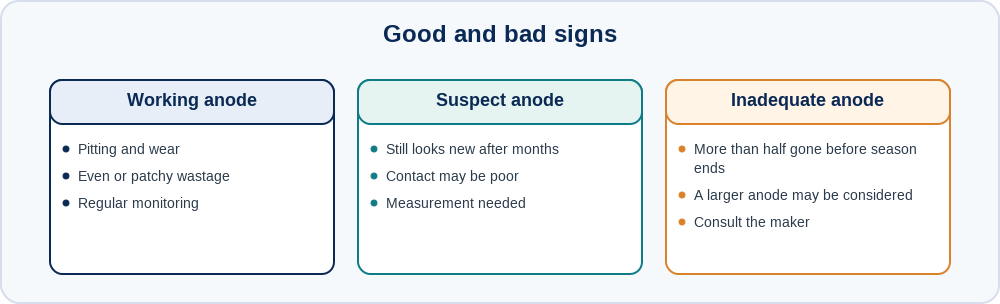
An anode that looks new may not be good news. Fisheries Supply says an anode that still looks brand new after months in the water is likely not making a proper electrical connection and failing to protect the boat. Clean contact surfaces and an unpainted anode matter for that reason (Good Old Boat). In doubt measurement is needed; BoatTest writes that protection level can be measured with a reference cell.
4. Inadequate anode and quantity#
Yachting Monthly writes that if an anode has corroded more than 50 percent it isn’t big enough and you’ll need to replace it with a larger one; it adds that shaft anodes need to be large enough that they don’t corrode over 50 percent in the time the boat will be afloat. In PBO Professor Watson said many boats carry more anode than needed. The two views stress different directions: if anode is inadequate enlarge it, if excessive reduce it. This article gives no quantity or size value; consult the maker.
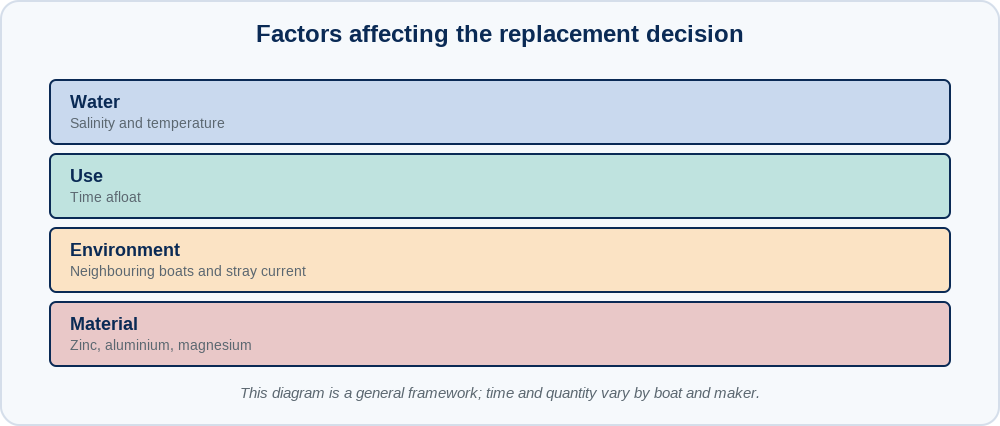
Yachting Monthly also writes that painting the propeller with antifouling has been found to double anode life by reducing the cathode area. This shows paint and anode planning should be considered together. Anode type, water type and environment (neighbouring boats, stray current) change life; these topics are covered in related articles.
- Record the location and type of anodes.
- Inspect by eye monthly or at haul-out.
- Estimate whether about half the mass has gone; do not trust surface appearance alone.
- For an anode that looks new after months check contact and measure.
- If inadequate discuss a larger anode or another solution with the maker.
- When fitting clean contact surfaces; do not paint the anode; renew pads and bolts.
- Record date and condition.
5. Fitting and contact#
A Yachting Monthly account describes removing the nuts and sliding the anode off the studs, replacing the spring washers when fitting the new one and using a drop of thread-lock to keep the nuts in place; for shaft anodes it adds that the two halves must be snugged up to a clean shaft and the screws secured. That is a magazine account; sizes, torque and method vary by boat and product. Shaft anode fitting detail is covered in a separate article.
Good Old Boat writes that a sacrificial anode must be in electrical contact with the metals it protects and that mounting surfaces must be clean and bright. That basic rule prevents one of the commonest causes of “the anode is new but not working”.
5b. Where sources differ, and limits#
Sources broadly agree on fifty percent but the figure is a guide, not a firm threshold. Yachting Monthly writes that in aluminium it can in some cases be extended to thirty percent; MBY advises also allowing for how long the boat will be afloat. One forum answer reads fifty percent as volume while another user says surface area is misleading. These differences show there is no single correct reading and that estimation and monitoring matter in practice.
Anode life also depends not just on material but on environment: corrosion from neighbouring boats or stray current can consume anodes quickly (see the galvanic corrosion and isolator articles). Unexpectedly fast wastage can be a sign of a problem other than the anode; in that case consult a specialist. This article is not diagnosis or safety advice.
6. Common mistakes#
- Estimating fifty percent by looking at the surface.
- Treating an anode that looks new as good.
- Painting the anode or fitting without cleaning the contact surface.
- Launching with anodes that will not last the season.
- Not renewing trim-tab pads and bolts.
- Changing anode type without consulting the maker.
- Keeping no records.
7. Checklist#
8. Conclusion#
By the common rule an anode is replaced when about fifty percent has deteriorated; for aluminium some sources say it can be extended and the real principle is enough anode until the next chance. Surface appearance misleads, a new-looking anode is suspect and contact matters. This article is general information; it gives no firm time or quantity and the maker’s instruction governs.
Frequently asked questions#
When is an anode replaced?
Many sources advise replacing when about fifty percent has deteriorated (BoatUS, West Marine). Yachting Monthly writes that for aluminium this can in some cases be extended to thirty percent; see the maker’s instruction.
What does fifty percent mean?
Per one forum answer fifty percent of the metal volume; another user says surface area is misleading as pitting increases it. These are user views.
Is an anode that looks new good?
Per Fisheries Supply an anode that still looks new after months is probably not making proper electrical contact and not protecting. Contact surfaces must be clean and unpainted.
What if the anode is more than half gone before the season ends?
Yachting Monthly writes that in that case the anode is not big enough and should be replaced with a larger one. Consult the maker.
How often should it be checked?
Axopar’s manual says to check anodes monthly and replace at about fifty percent deterioration (maker). MBY also advises inspection at haul-out and replacement where needed.
Was this guide helpful?
Thank you! Your feedback has been saved.
Guide content is for general information; in practice, the current technical data sheet of the product applies.
Keep reading
Related guides
Boat Colour Selection and Solar Reflectance: Effect of Heat Absorption on Surfaces
A study of the effect of boat paint colour on solar reflectance and surface temperature.
2 min read Paint and CoatingsCauses and Diagnosis of Paint Blistering
A study of the sources, types and diagnostic approach to blistering on boat paints.
2 min read Paint and CoatingsNumber of Coats in Epoxy Coating Systems
A study of the effect of the number of coats in epoxy coating systems on protective performance and thickness.
2 min read