
Paint and Coatings
Epoxy Wood Consolidation and Rot Repair
Epoxy consolidation is a repair approach described for reinforcing wood that kept its shape but weakened; when and where it is suitable differs among sources. This article summarises the accounts with their limits; it is not a product, ratio or method recommendation or structural advice.
Short answer
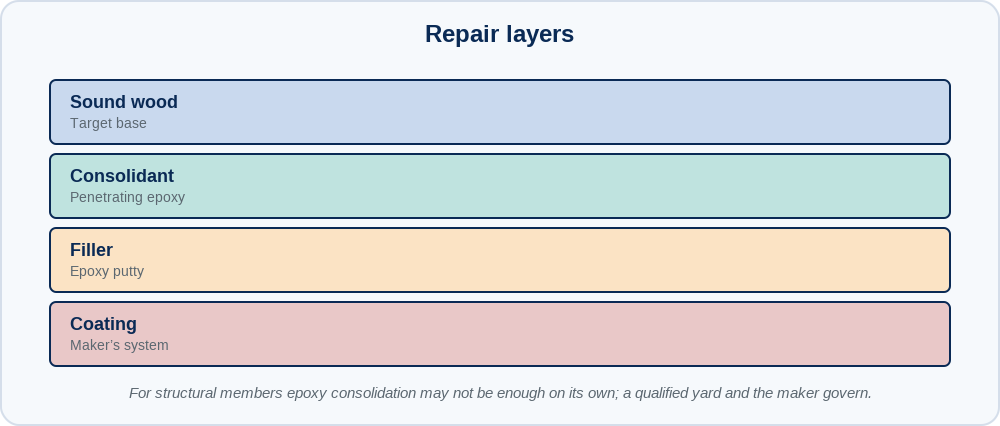
A retailer’s guide writes that there is no universal rot repair method, that the location and severity of damage must be assessed and that if the wood retains its shape a penetrating epoxy sealer or consolidant can reinforce the remaining fibres. An epoxy maker says its solvent-free system does not shrink and strengthens loose fibres from within; the maker’s instructions say the application depth should be limited and that for penetration the wood should be as dry as possible. A US government historic preservation procedure describes consolidant and filler as separate materials. These are maker and agency accounts; for structural members a qualified yard and the maker govern.
Key points
- There is no universal rot repair method; the location and severity of damage are assessed (retailer guide).
- Penetrating epoxy is described for reinforcing wood that kept its shape but weakened.
- Maker instructions say the wood should be as dry as possible and the application depth limited.
- Consolidant and filler are described as separate materials (official procedure).
- For structural members a qualified yard and the maker govern; maker claims are unverified.
1. What is epoxy consolidation?#
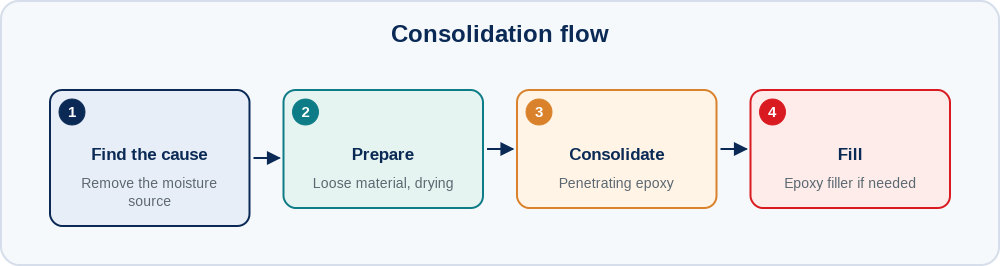
Epoxy wood consolidation is described as soaking a low-viscosity epoxy into rotted, softened or weakened wood and then, if needed, filling voids with an epoxy filler. This article is a general summary; it gives no product, mix ratio, depth, number of coats or time and is not application or structural advice. Sources are maker, retailer, official agency and forum accounts and may differ from one another; maker statements are labelled.
2. What the sources say#
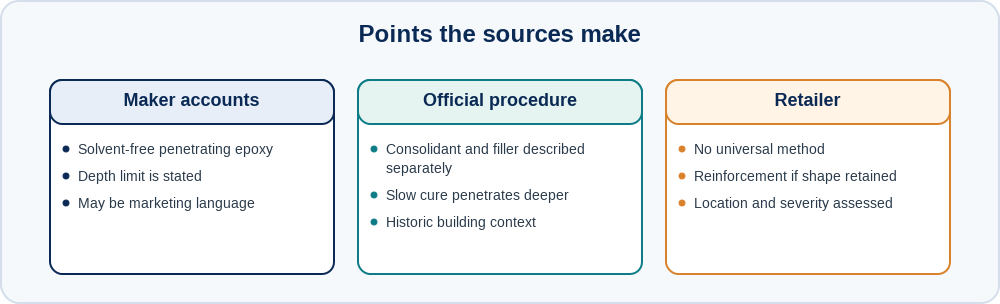
A boat-supplies retailer’s rot-repair guide writes that there is no universal wood rot treatment, that the location of the damage should be assessed and its severity gauged. If the wood still retains its shape but has been compromised by rot, fungal growth or insects, it says a penetrating epoxy sealer or wood consolidant can reinforce the remaining fibres, adding that if insects are also involved a borate may be needed. This is a seller’s guide and has a sales interest.
An epoxy maker writes that its rot-repair epoxy is 100% solids, meaning solvent-free, and that other penetrating epoxies containing solvents are susceptible to shrinkage and may cause unwanted voids. A European boating magazine, presenting the same maker’s system, relays that the two-component highly fluid epoxy penetrates deep into rotten areas and strengthens weakened fibres from within, that according to the maker it does not shrink and remains flexible enough to accommodate natural movement of the wood. These are maker statements and have not been independently verified.
The same maker’s kit instruction says the system is designed for deep penetration through low viscosity and slow cure, but because it is not a casting system the depth of application should be limited, recommends other techniques for thicker applications, and says that for best penetration the wood should be as dry as possible, that it can still cure on damp wood but the result may differ. It also recommends a different system for new construction, high-performance or submerged applications. For numerical limits see the instruction itself; this article gives no value.
| Source type | General account | Caution |
|---|---|---|
| Retailer guide | No universal method; damage assessed | May carry a sales interest |
| Maker instruction | Depth limited; wood as dry as possible | Product-specific |
| Official procedure | Consolidant and filler are separate materials | Historic building context |
3. Consolidant and filler#
A US government historic preservation unit’s technical procedure on epoxy repair of decay in wooden members writes that epoxy consolidant and epoxy filler are both multi-part compounds. It describes different consolidants as having different depths of penetration, a slower-curing product able to penetrate deeper, and a clay being usable to stop consolidant leaking through cracks. This is a historic building context; marine immersion and load conditions differ and for a boat the maker’s instruction and a qualified yard govern.
On a conservation specialists’ mailing list a user planning to treat a wooden boat exposed to extreme conditions writes that it is important to ensure the wood is as dry as possible before using a consolidant. That is a user account, not a source or standard, but the importance of dryness also matches the maker’s instruction.
4. A practical frame#
- First find and remove the cause of rot and moisture; otherwise the repair can recur.
- Have a qualified yard assess extent and depth, especially for structural members.
- Prepare loose and softened material by the maker’s method; dry the wood as far as possible.
- Use penetrating epoxy only within the depth and conditions in the maker’s instruction.
- Fill voids if needed with the epoxy filler the maker recommends.
- Confirm compatibility of the coating system to follow with the maker.
- Keep records; read the safety data sheet.
5. Limits#
Sources overlap that epoxy is described for reinforcing weakened wood and that dryness matters; they differ on which members and what extent it suffices for. A retailer writes there is no universal method while makers present their systems as broad repair solutions. So there is no single right answer; the boat’s construction, wood species, extent of damage and a qualified yard’s assessment govern. This article is not structural advice.
5b. Where sources differ#
The retailer guide says decide by location and severity of damage; makers say their systems do not shrink and stay flexible; instructions limit depth and recommend other systems for new construction or submerged use; the official procedure treats consolidant and filler separately in a historic building context; some accounts prefer cutting out and replacing the rotten part. These are sources speaking in different contexts and with different interests. The difference means consulting the maker and a qualified yard for each repair.
This article is general information; it recommends no product, method, ratio, number of coats or time. The maker’s data sheet and a qualified yard govern.
5c. A practical frame for reading the sources#
The sources are magazines, makers, sellers and forums; each writes in its own context. None knows wood species, extent of rot, the structural role of the part or its moisture state of your boat. So taking the shared message and consulting the maker and a qualified yard for detail is reasonable.
Epoxy and some preparation products can carry skin, respiratory and allergy risks; mixes can heat up and be hazardous under unsuitable conditions. This article describes no personal protection or mixing method; read the product’s safety data sheet, consult a qualified yard and follow the relevant safety rules. For hull integrity and safety at sea apply to a qualified specialist; do not repair structural members yourself.
Seller and maker statements are the firm’s own account of its product and have not been independently verified. A product’s compatibility with another coating should always be checked in the product’s technical document; where a document and a guide conflict, the maker’s document and a qualified yard’s assessment should be used. Recording decisions and product details helps later maintenance.
6. Common mistakes#
- Repairing without removing the source of moisture.
- Applying to wet wood outside the maker’s conditions.
- Exceeding the depth limit.
- Confusing consolidant with filler.
- Treating a maker claim as independent verification.
- Repairing structural members yourself.
- Keeping no records.
7. Checklist#
8. Conclusion#
Epoxy wood consolidation is described for reinforcing wood that kept its shape but weakened; sources stress removing moisture, dryness and depth limits and differ on when it suffices. This article is general information; it gives no product, ratio or method and is not structural advice.
Frequently asked questions#
Can rotten wood be repaired with epoxy?
Sources describe penetrating epoxy as reinforcement for wood that kept its shape but weakened; they also write that there is no universal method and damage must be assessed.
How dry should the wood be?
A maker’s instruction and a conservation discussion say the wood should be as dry as possible for penetration. Ask the maker for a value; this article gives none.
Are consolidant and filler the same?
No; an official procedure describes them as separate multi-part materials: one penetrates, the other fills voids.
Is it used on structural members?
That is a structural decision; sources note some maker instructions recommend a different system for new construction or high-performance use. Consult a qualified yard.
Can maker claims be trusted?
Maker statements are the firm’s own account of its product and are not independently verified; rely on the technical document and a qualified yard.
Was this guide helpful?
Thank you! Your feedback has been saved.
Guide content is for general information; in practice, the current technical data sheet of the product applies.
Keep reading
Related guides
Boat Colour Selection and Solar Reflectance: Effect of Heat Absorption on Surfaces
A study of the effect of boat paint colour on solar reflectance and surface temperature.
2 min read Paint and CoatingsCauses and Diagnosis of Paint Blistering
A study of the sources, types and diagnostic approach to blistering on boat paints.
2 min read Paint and CoatingsNumber of Coats in Epoxy Coating Systems
A study of the effect of the number of coats in epoxy coating systems on protective performance and thickness.
2 min read