
Paint and Coatings
Wooden Boat Painting: Primer, Filler and Topcoat
In wooden boat painting primer, filler and topcoat form a system; but sources differ on whether a primer is needed and which system to choose. This article summarises the general accounts with their limits; it is not a product, method or time recommendation.
Short answer
A wooden boat paint system generally consists of preparation, primer, filler if needed and topcoat; but sources do not agree on the details. Some magazine and user accounts stress careful sanding and cleaning, dry wood and compatibility of the new coating with the old; some accounts describe epoxy sealing, some traditional paint and varnish, some oil. The type, number of coats and times of primer, filler and topcoat vary by wood species, old coating and maker’s system. This article is general information; it recommends no product or method and the maker and a qualified yard govern.
Key points
- Wooden boat painting is generally described as preparation, primer, filler if needed and topcoat.
- Sources differ on whether a primer is required and on system choice; there is no single right answer.
- Wood dryness and compatibility of the new coating with the old are often stressed.
- Product, number of coats and times vary by maker and wood species.
- No product or method is recommended; the maker and a qualified yard govern.
1. What is a paint system on a wooden boat?#
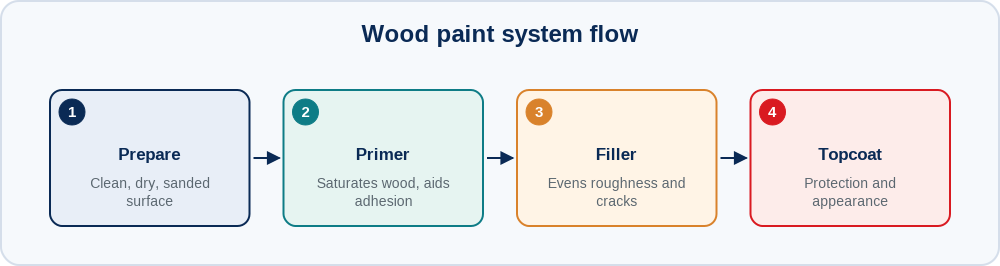
In wooden boat painting preparation, primer, filler if needed and topcoat are generally described as one system. Because wood takes up and gives off moisture, the compatibility of the system with the wood and the dryness of the wood are often stressed. This article is a general summary; it gives no product, method, number of coats or time and is not application advice. Sources are magazine, maker, seller and forum accounts and may differ from one another.
2. Primer and filler#
A primer is generally described as saturating the wood and giving adhesion for later coats; filler as evening out roughness, cracks and seam marks. Their types, number of coats and waiting times vary by maker and wood species and this article gives no value. The maker’s data sheet and a qualified yard govern.
Sources describe compatibility of the new coating with the old as important, with blistering or peeling seen on incompatibility. So if the old coating is unknown, consulting the maker and testing a small area is often suggested; this is a general account, not a firm method.
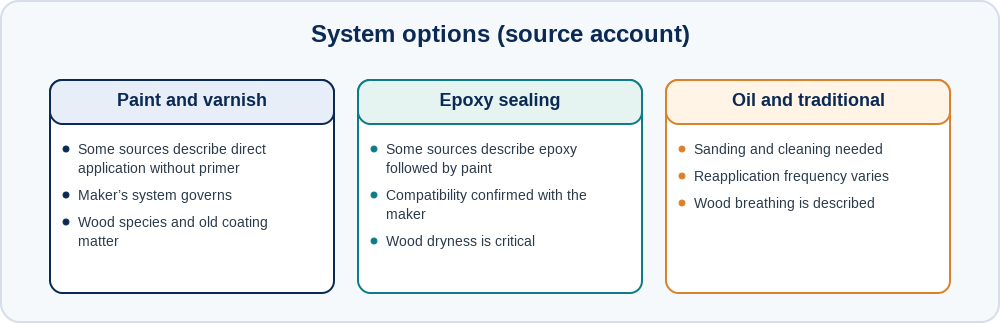
| Option | Sources’ general account | Caution |
|---|---|---|
| Paint and varnish | Preparation, primer, topcoat | Maker’s system |
| Epoxy sealing | Epoxy followed by paint described | Compatibility and dryness |
| Oil and traditional | Sanding and cleaning | Reapplication frequency |
3. Topcoat and care#
The topcoat provides protection and appearance; its type and number of coats vary by maker. Sources describe boat wood as constantly tested by sun, salt and moisture, so regular inspection and timely maintenance matter. This is a general account; it gives no product or time.
4. A practical frame#
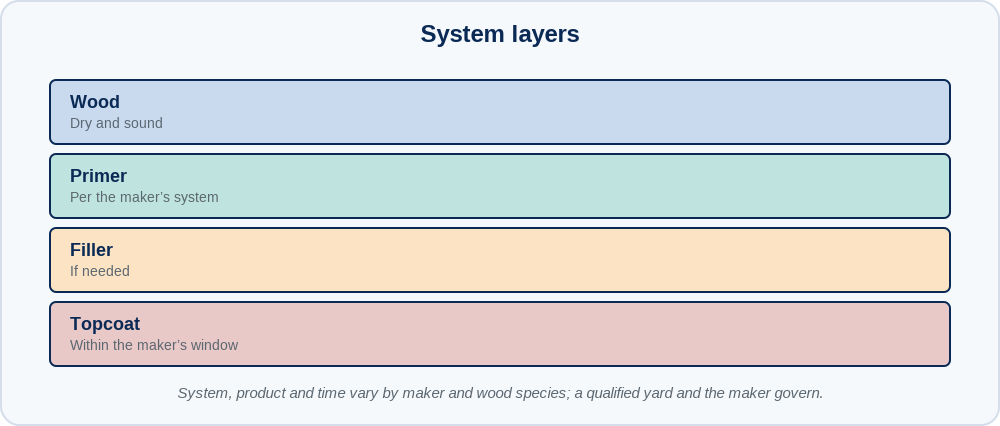
- Confirm the wood is dry and sound; for rotten or damp wood consult a qualified yard.
- Clean the surface and sand by the maker’s method.
- Confirm the old coating type and compatibility with the new system with the maker.
- Apply the primer per the maker’s system.
- If needed even out roughness and cracks with filler.
- Apply the topcoat within the maker’s window.
- Keep records; read the safety data sheet.
5. Limits#
Sources agree on the importance of preparation, dryness and compatibility; they differ on whether a primer is required and on system choice. So there is no single right answer; the maker’s system, the wood species and a qualified yard’s assessment govern. This article is not application advice.
5b. Where sources differ#
Some accounts treat primer as the basis of the system; some describe direct application on certain systems; some describe epoxy sealing, some traditional paint and varnish, some oil. These are magazine, maker, seller and forum accounts speaking in different contexts and with different interests. The difference means consulting the maker and a qualified yard for your own boat’s wood species and old coating.
This article summarises the general account; it may not hold for a particular boat. For product, method and time the maker’s data sheet and a qualified yard govern.
5c. A practical frame for reading the sources#
The sources are magazines, makers, sellers and forums; each writes in its own context. None knows your boat’s wood species, age, old coating or moisture state. So taking the shared message, the importance of preparation, dryness and compatibility, and consulting the maker and a qualified yard for detail, is reasonable.
Sanding dust and some paint or filler products can carry health and fire risks. This article describes no personal protection or ventilation; read the product’s safety data sheet, consult a qualified yard and follow the relevant safety rules. For rot or structural concerns apply to a qualified specialist.
Finally, a paint system does not solve rotten or damp wood; if there is an underlying problem it must be addressed first. Recording decisions and keeping the maker’s instruction helps later maintenance.
In addition, seller and maker statements are the firm’s own account of its product and have not been independently verified. A product’s compatibility with another paint should always be checked in the product’s technical document; where a document and a guide conflict, the maker’s document and a qualified yard’s assessment should be used.
Wood species affects how the system behaves: some species contain resin or oil, which can make adhesion of some coatings harder, while others swell and shrink more with moisture. Sources therefore describe stating the species and age of the surface and asking the maker for compatibility information. This is a general account; it cannot give detail for a particular species and recommends no product or method.
In preparation the state of the old coating is decisive: a sound coating can be a base for the new system, while a blistered, peeling or cracked coating is described in most sources as a problem to be removed. The colour, softness and smell of the wood beneath the coating are among the signs described as indicating rot; if in doubt a qualified yard should be consulted. This article does not describe rot detection or repair; those are a separate topic.
Season and environment are also often mentioned: application in damp or very cold weather is described as able to affect drying and adhesion, while in direct sun the coating may dry quickly and form defects. For values and times see the maker’s data sheet; this article gives no temperature, humidity or time.
The waiting window between coats is a point often mentioned: if the window is missed, adhesion of the next coat can be affected and re-sanding may be needed. The choice of brush, roller or other tool also depends on the maker’s recommendation. Sources also note the places where moisture enters most easily, such as seams, joints and end grain; these can be noted for regular inspection. These are general accounts and give no time or method.
Another shared point is record keeping: writing down which system was applied, when and in what conditions eases compatibility questions at later maintenance. If the boat changes hands such a record is described as valuable for the new owner too.
6. Common mistakes#
- Painting over damp or rotten wood.
- Not confirming compatibility with the old coating.
- Skipping sanding and cleaning.
- Missing the maker’s window.
- Treating one source as a firm rule.
- Not reading the safety data sheet.
- Keeping no records.
7. Checklist#
8. Conclusion#
Wooden boat painting is a system of primer, filler and topcoat; sources stress preparation, dryness and compatibility and differ on system choice. This article is general information; it gives no product, method or time and the maker and a qualified yard govern.
Frequently asked questions#
What is the order in wooden boat painting?
Sources generally describe preparation, primer, filler if needed and topcoat; details vary by maker and wood species.
Is a primer mandatory?
Sources differ; some recommend a primer, some describe direct application on certain systems. See the maker’s system.
When is filler used?
It is described for evening out roughness and cracks; its type and application vary by maker.
Can I paint over the old coating?
Compatibility depends on the old coating and the new system; confirm with the maker.
How dry should the wood be?
Sources stress dryness; ask the maker and a qualified yard for a value, this article gives none.
Was this guide helpful?
Thank you! Your feedback has been saved.
Guide content is for general information; in practice, the current technical data sheet of the product applies.
Keep reading
Related guides
Boat Colour Selection and Solar Reflectance: Effect of Heat Absorption on Surfaces
A study of the effect of boat paint colour on solar reflectance and surface temperature.
2 min read Paint and CoatingsCauses and Diagnosis of Paint Blistering
A study of the sources, types and diagnostic approach to blistering on boat paints.
2 min read Paint and CoatingsNumber of Coats in Epoxy Coating Systems
A study of the effect of the number of coats in epoxy coating systems on protective performance and thickness.
2 min read