
Paint and Coatings
Fibreglass Repair: Layup Plan and Resin Choice
Fibreglass repair is described in sources as depending on damage depth, resin compatibility and final finish; resin choice and layup order are handled with different approaches. This article summarises the accounts with their limits; it is not a product, ratio or time recommendation.
Short answer
A boat-maintenance writer says epoxy is a stronger adhesive than polyester and usually the best choice for repair work, but when the repair will be finished with gelcoat the laminating should be done with polyester, because epoxy adheres to cured polyester while the reverse is not true. Another magazine describes, if polyester is used and there is no reason for another schedule, alternating layers of mat and cloth. A boating magazine says compatibility and toxicity are the two main criteria in resin choice. An epoxy maker describes two-sided repair as the strongest option. This article recommends no product, ratio or number of layers; the maker and a qualified yard govern.
Key points
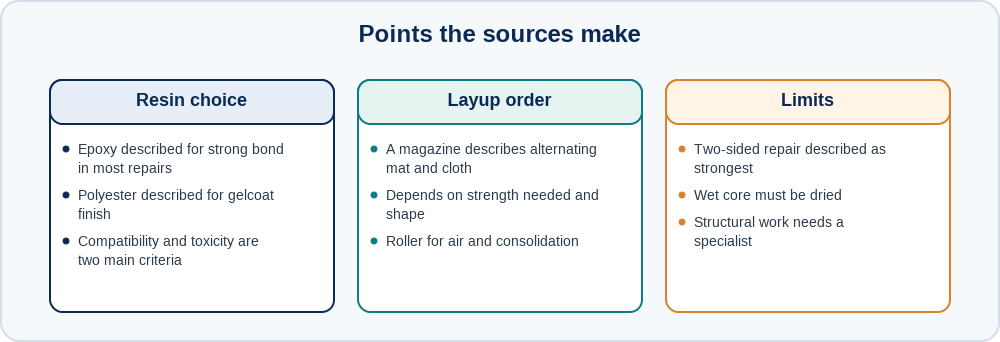
- Epoxy is described as giving a strong bond for most repairs; where a gelcoat finish is planned, polyester laminating is described (magazine).
- Compatibility and toxicity are described as two main criteria in resin choice.
- Layup order depends on strength needed and shape; alternating mat and cloth is described in one magazine.
- Two-sided repair is described as the strongest option (maker article).
- For layer count, ratio and time the maker and a qualified yard govern.
1. Why does the repair plan start with damage depth?#
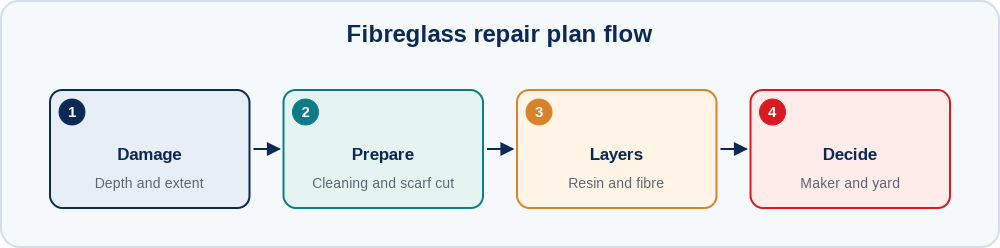
How a fibreglass repair is made depends on how deep the damage goes: a superficial scratch, a gelcoat crack, laminate damage and a hole call for different approaches. A boat-maintenance site describes the first step of repair as gauging the depth of damage. This article is a general summary; it gives no product, ratio, layer count or time and is not application advice. Sources are magazine, maker, seller and user accounts and may differ; maker and seller statements are labelled.
2. Resin choice#
A boat-maintenance writer says polyester is excellent for lay-up because polyester laminating resin does not fully cure while exposed to air, so each application joins the previous one at a molecular level; that polyester is an adequate adhesive but not as good as epoxy, as a general rule a polyester bond being around 20 percent weaker in tensile strength than the same bond made with epoxy. The same writer says that when the repair will be finished with gelcoat the laminating or filling needs to be done with polyester because epoxy adheres tenaciously to cured polyester while the reverse is not true, so the bond between an epoxy repair and a polyester gelcoat overcoat will not be strong.
| Resin | Sources’ general account | Caution |
|---|---|---|
| Epoxy | Strong bond; most repairs | Polyester for gelcoat finish |
| Polyester | General purpose; gelcoat compatibility | Bond described as weaker than epoxy |
| Vinylester | Described as more water resistant | Often in blister repair |
3. Layup order, compatibility and limits#
A boating magazine writes that epoxy is a common choice for fibreglass repairs, aftermarket projects and some new-boat construction, and that for basic fibreglass projects two considerations in choosing resin type are compatibility and toxicity. Another boating magazine says vinylester and polyester are styrene-based and catalysed with MEKP, and that epoxy differs from them in many ways.
A boat-maintenance writer describes, unless you have reason to follow a different schedule, beginning with two layers of 1.5-ounce mat and then alternating mat and 6-ounce cloth; another magazine repeats the same schedule for polyester. That is a writer’s suggestion, may not hold for every repair, and this article gives no layer count; strength needed, shape and existing hull thickness matter.
A British boating magazine says epoxy is stronger and sticks to pretty much everything, that most people are drawn to it but it is rarely wrong yet often not the best choice; it notes epoxy creates heat as it cures and that brushes tend to pull chopped strand mat apart, a roller being better.
An epoxy maker describes in a serious impact repair a two-sided method repairing inside and outside as the strongest option, with several layers of biaxial fabric used to match the existing hull thickness; that is a maker and applicator account, specific to its own system.
A test publication writes that epoxy’s adhesive bond is much stronger than polyester, that the resin on its own is not much harder or stronger but that with fibre reinforcement the picture changes; that is a test-publication account and may not hold for every product.
A maker’s support page says the final coat of a polyester-resin layup must contain wax in order to cure properly, either by using a finishing resin containing wax or adding wax to laminating resin; that is a maker’s account for its own products.
A public publication and an agency technical document describe that wet or delaminated laminate must be removed in full and that merely covering it does not give a lasting repair; wet core and deep delamination therefore call for assessment by a qualified specialist.
On user forums people report different resin and fibre combinations; some prefer epoxy for every job and some polyester for gelcoat jobs. These are experiences not independently verified and vary by boat.
Shared points: damage depth must be assessed correctly, resin chosen to be compatible with the existing hull and final finish, and wet or weak laminate removed. The difference lies in which resin is preferred for which repair and which layup order is enough.
4. A practical frame#
- Establish damage depth and type; for damage that may be structural apply to a qualified specialist.
- Confirm compatibility with the existing hull resin and final finish (gelcoat or paint) from the data sheet.
- Decide the layup order with a craftsman by hull thickness and strength needed.
- Decide preparation, cure and sanding details per the maker’s instruction.
- If wet core or delamination exists consult a qualified specialist.
- Separate maker, seller and user accounts.
- Keep records; read the safety data sheet.
5. Limits#
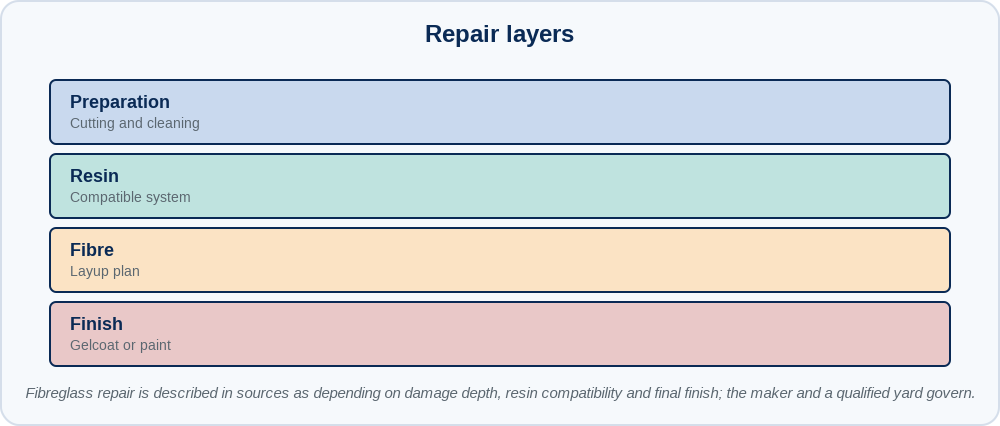
Sources overlap that resin compatibility, damage depth and final finish determine the repair plan; they differ on which resin is preferred for which repair and on layup order. Maker and user accounts are specific to their contexts. So there is no single right answer; the maker’s instruction and a qualified yard govern. This article is not application advice.
5b. Where sources differ#
One writer describes epoxy for most repairs and polyester for gelcoat finishes; one magazine says epoxy is often not the best choice; a maker describes two-sided epoxy repair; users report opposite preferences. These are sources speaking in different contexts and with different interests. The difference means consulting the maker and a qualified yard for your own job.
This article is general information; it recommends no product, method, ratio, number of coats or time. The maker’s data sheet and a qualified yard govern.
5c. A practical frame for reading the sources#
The sources are magazines, makers, sellers and forums; each writes in its own context. None knows the damage depth, the resin or the layup order of your boat. So taking the shared message and consulting the maker and a qualified yard for detail is reasonable.
Resins, hardeners, styrene vapour, solvents and glass-fibre dust can carry skin and respiratory irritation or allergic sensitisation risk; sanding and cutting carry injury risk. This article describes no personal protection, ventilation or waste method; read the product’s safety data sheet, consult a qualified yard and follow the relevant safety rules. For damage that may be structural apply to a qualified specialist.
Seller and maker statements are the firm’s own account of its product and have not been independently verified. A product’s compatibility with another coating should always be checked in the product’s technical document; where a document and a guide conflict, the maker’s document and a qualified yard’s assessment should be used. Recording decisions and product details helps later maintenance.
6. Common mistakes#
- Starting repair without establishing damage depth.
- Not considering resin compatibility for a gelcoat finish.
- Leaving wet or delaminated laminate.
- Not setting layup order by hull thickness.
- Treating a maker claim as an independent test.
- Not reading the safety data sheet.
- Keeping no records.
7. Checklist#
8. Conclusion#
Fibreglass repair is described in sources as depending on damage depth, resin compatibility and final finish. This article is general information; it gives no product, ratio, layer count or time and the maker and a qualified yard govern.
Frequently asked questions#
Epoxy or polyester for fibreglass repair?
A magazine describes epoxy giving a strong bond for most repairs but polyester preferred where a gelcoat finish is planned; it varies by product and job.
What is vinylester used for?
A magazine writes vinylester is generally more resistant to water absorption than polyester and often used in blister repair.
What layup order?
A magazine describes alternating layers of mat and cloth where there is no reason for another schedule; this article gives no layer count.
Why does compatibility matter?
A magazine writes compatibility and toxicity are the two main criteria in resin choice; compatibility with the existing hull resin is confirmed from the data sheet.
Should I do it myself?
Hull repair is safety-related; for damage that may be structural apply to a qualified specialist.
Was this guide helpful?
Thank you! Your feedback has been saved.
Guide content is for general information; in practice, the current technical data sheet of the product applies.
Keep reading
Related guides
Boat Colour Selection and Solar Reflectance: Effect of Heat Absorption on Surfaces
A study of the effect of boat paint colour on solar reflectance and surface temperature.
2 min read Paint and CoatingsCauses and Diagnosis of Paint Blistering
A study of the sources, types and diagnostic approach to blistering on boat paints.
2 min read Paint and CoatingsNumber of Coats in Epoxy Coating Systems
A study of the effect of the number of coats in epoxy coating systems on protective performance and thickness.
2 min read