
Paint and Coatings
Painting Over Sealant: Compatibility and the Fisheye Problem
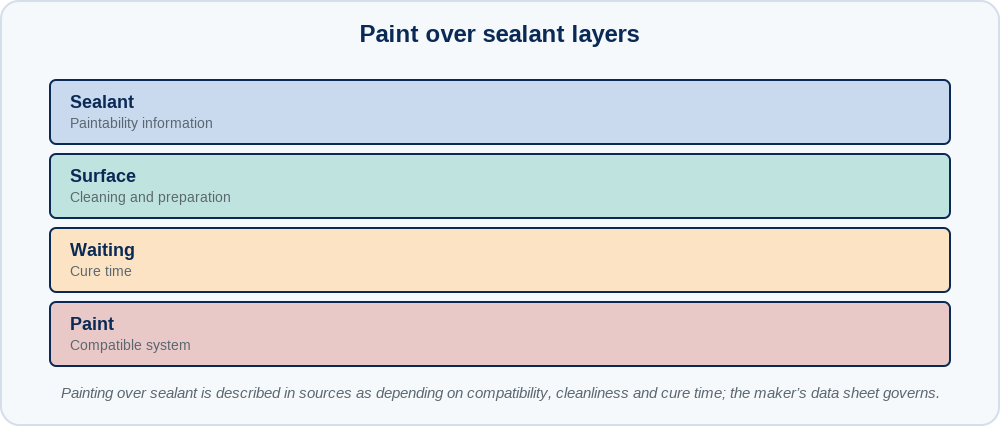
Painting over sealant is described in sources as depending on compatibility, surface cleanliness and cure time; silicone contamination is linked to fisheye defects. This article summarises the accounts with their limits; it is not a product, ratio or time recommendation.
Short answer
A building-materials guide writes that polyurethanes can be painted while silicones cannot. A paint maker describes fisheye defects as caused by foreign substances on the surface, especially silicone, and says even very small amounts can cause trouble; that is a maker’s account. A British boating magazine says sealant should be given enough time to skin off and begin curing before over-painting with solvent-based coatings. A test publication writes that a silicone-containing product can inhibit bonding in subsequent projects. This article recommends no product or time; the maker governs.
Key points
- Polyurethanes are paintable and silicones are not; sealant choice near painted areas follows this (building guide).
- Fisheye defects are linked to foreign substances, especially silicone; a very small amount may suffice (maker).
- Sealant should be given time to skin and cure before solvent-based coatings (magazine).
- Silicone contamination may not be fully cleanable, so prevention matters.
- For product and time the maker and a qualified yard govern.
1. Why can painting over sealant go wrong?#
Sealant used near surfaces to be painted raises two separate risks: the sealant itself being incompatible with paint, and contamination causing defects on surrounding surfaces. A building guide writes that polyurethanes can be painted while silicones cannot. This article is a general summary; it gives no product, cure time or time and is not application advice. Sources are maker, magazine, test publication and user accounts and may differ; maker and seller statements are labelled.
2. Fisheye and contamination#
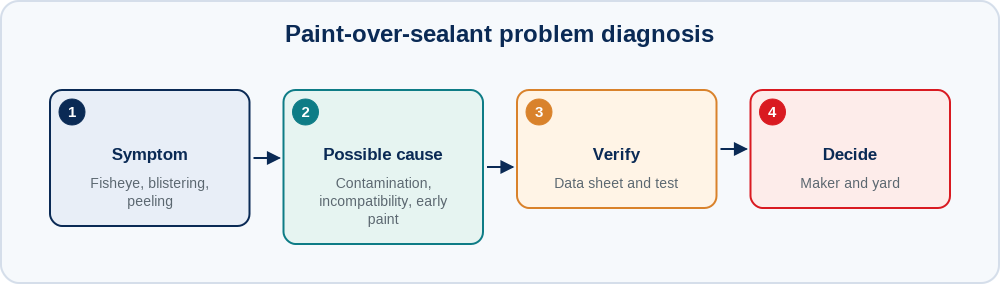
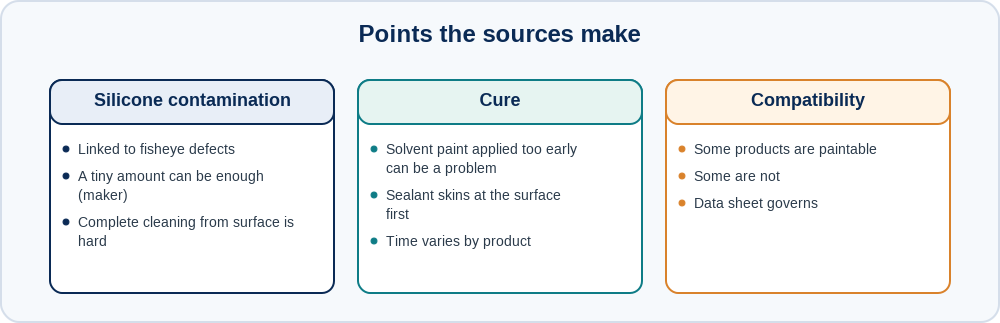
A paint maker describes the fisheye defect as paint forming crater-like pits on the surface, caused by foreign substances such as oil and silicone, and says very small amounts can cause trouble; that is a maker’s account given in the context of its own products. On a yacht-painting forum users report silicone-containing polishes and sprays causing trouble through contamination in the workshop; these are user experiences not independently verified.
| Topic | Sources’ general account | Caution |
|---|---|---|
| Paintability | Polyurethane paintable; silicone not | Product data sheet |
| Contamination | Silicone linked to fisheye | Full cleaning hard |
| Cure | Allow time before solvent-based paint | Time varies by product |
3. Magazine, test and maker accounts#
A British boating magazine says sealant should be given enough time to skin off and start curing before over-painting with solvent-based coatings, otherwise problems can arise, and that antifoul solvents can affect sealant between keel and hull. A test publication writes that a silicone-containing product repelled dirt but can inhibit bonding in subsequent projects, while polyurethane sealants can be painted.
A retailer guide writes that new modified polymer sealants are also good options but checking the technical data sheet for compatibility with the surface and topcoat is critical. A building guide says MS polymer hybrids combine some strengths of silicone and polyurethane; their paintability may vary by product and the data sheet governs.
A boating magazine article from 2013 says that beyond portlights and special uses you save yourself grief by keeping silicone away from deck and hull; that is a magazine view. Some users say silicone suits removable hardware needing a soft seal; those are user opinions and vary by boat.
A sealing blog writes that sealant keeps water out of a sound joint; that is a blog account and gives no general rule on paint compatibility. So for a sealant used in a region to be painted, its paintability information should be confirmed from its own data sheet.
What the sources share is that sealant choice should be made together with the painting plan: where painting is planned a product stated as paintable is sought, silicone contamination is avoided and cure is given time. They differ on which product suits which paint system and how long to wait.
In practice the problem often comes from the wrong order: sealant is applied first and painting is thought of afterwards. Sources therefore implicitly favour making the painting plan before choosing the sealant; still, each source speaks in its own context and this is not application advice. A maker account and a user experience should not be read with equal weight; a maker document describes its own product and a user experience describes that user’s own boat.
On contamination the sources mention not only the sealant itself but also polishes, sprays and cleaners in the workshop. These accounts are not independently verified and vary by boat; reviewing with a qualified craftsman which products are used in the work area is described as an approach consistent with the sources’ shared advice. For the exact method and time the maker’s instruction governs.
4. A practical frame#
- Make the painting plan before choosing the sealant; identify the areas to be painted.
- Confirm paintability from the product’s data sheet.
- Review with a qualified craftsman the use of silicone near surfaces to be painted and sources of contamination.
- Allow the cure time stated in the maker’s instruction.
- Separate maker and seller claims from independent accounts.
- If a problem occurs consult the maker and a qualified yard.
- Keep records; read the safety data sheet.
5. Limits#
Sources overlap that polyurethanes are paintable and silicones are not, that silicone contamination is linked to fisheye, and that cure time should be allowed; they differ on which product suits which paint and the waiting time. Maker and user accounts are specific to their contexts. So there is no single right answer; the product data sheet and the maker’s instruction govern. This article is not application advice.
5b. Where sources differ#
The building guide separates paintability by type; the maker links fisheye to foreign substances; the magazine describes cure time and solvent effects; the test publication says silicone can inhibit bonding; users hold opposite views on silicone. These are sources speaking in different contexts and with different interests. The difference means consulting the maker and a qualified yard for your own job.
This article is general information; it recommends no product, method, ratio, number of coats or time. The maker’s data sheet and a qualified yard govern.
5c. A practical frame for reading the sources#
The sources are magazines, makers, sellers and forums; each writes in its own context. None knows the painting plan, the surface or the cure time of your boat. So taking the shared message and consulting the maker and a qualified yard for detail is reasonable.
Sealants, solvents, cleaners and paints can carry skin and respiratory irritation or allergic risk; sanding and removal work carries injury risk. This article describes no personal protection, ventilation or waste method; read the product’s safety data sheet, consult a qualified yard and follow the relevant safety rules. At safety-critical places such as a hull-deck joint apply to a qualified specialist.
Seller and maker statements are the firm’s own account of its product and have not been independently verified. A product’s compatibility with another coating should always be checked in the product’s technical document; where a document and a guide conflict, the maker’s document and a qualified yard’s assessment should be used. Recording decisions and product details helps later maintenance.
6. Common mistakes#
- Making the painting plan after choosing the sealant.
- Not confirming paintability from the data sheet.
- Using silicone near surfaces to be painted.
- Applying solvent-based paint before cure.
- Treating a maker claim as an independent test.
- Not reading the safety data sheet.
- Keeping no records.
7. Checklist#
8. Conclusion#
Painting over sealant is described in sources as depending on compatibility, cleanliness and cure time; silicone contamination is linked to fisheye. This article is general information; it gives no product or time and the maker and a qualified yard govern.
Frequently asked questions#
Can every sealant be painted?
No; sources describe polyurethanes as paintable and silicones as not. For any product the data sheet governs.
What is fisheye?
Paint forming craters or pits on the surface; sources link it to foreign substances, especially silicone (maker).
Is wiping off silicone enough?
Sources describe even very small amounts of silicone causing trouble; full cleaning can be hard and a qualified yard and the maker’s instruction are needed.
When can I paint sealant?
A magazine says to give enough time for the surface to skin and curing to begin before solvent-based coatings; time varies by product.
What if paint fails over sealant?
Consult the maker’s data sheet and a qualified yard first; this article gives no repair method.
Was this guide helpful?
Thank you! Your feedback has been saved.
Guide content is for general information; in practice, the current technical data sheet of the product applies.
Keep reading
Related guides
Boat Colour Selection and Solar Reflectance: Effect of Heat Absorption on Surfaces
A study of the effect of boat paint colour on solar reflectance and surface temperature.
2 min read Paint and CoatingsCauses and Diagnosis of Paint Blistering
A study of the sources, types and diagnostic approach to blistering on boat paints.
2 min read Paint and CoatingsNumber of Coats in Epoxy Coating Systems
A study of the effect of the number of coats in epoxy coating systems on protective performance and thickness.
2 min read