
Paint and Coatings
Hull Fairing: Correct Sanding with a Fairing Board
In hull fairing, a long sanding board is described in sources as a tool that removes the high spots of filler, flexible along its length yet stiff enough not to dip into lows. This article summarises the accounts with their limits; it is not a product, grit or time recommendation.
Short answer
An epoxy maker’s article says fairing boards should be flexible enough along their length to curve with the hull yet stiff enough to resist dipping into low spots, that fairing in opposing directions quickly establishes a fair surface, and that on tight curves the board cannot flex across its width so little of the paper touches. A boating magazine writes that on a project boat a grid or laser level was used to check highs and lows. A wooden-boat magazine says fairing a large hull is arduous. This article recommends no product or method; the maker and a qualified yard govern.
Key points
- A fairing board is described as flexible along its length yet stiff enough not to dip into lows (maker article).
- Fairing in opposing directions establishes and maintains a fair surface (maker article).
- On tight curves the board cannot flex across its width, so special tools may be needed.
- Grid, tape or laser lines can be used to check highs and lows (magazine).
- For method, grit and time the maker and a qualified yard govern.
1. Why is fairing done?#
Areas of a hull where filler has been applied must be brought to the same form as their surroundings before painting; sources describe this work as fairing. A wooden-boat magazine writes that fairing a 40-foot hull is arduous and often done by two-person teams. This article is a general summary; it gives no product, grit, mix ratio or time and is not application advice. Sources are maker, magazine and user accounts and may differ; maker and seller statements are labelled.
2. Qualities of a long board#
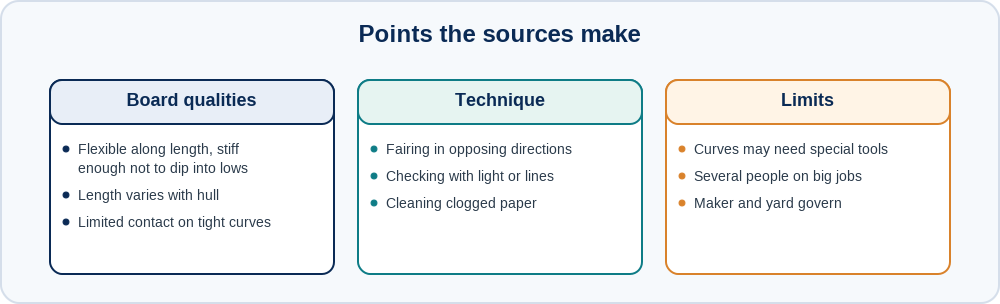
An epoxy maker’s article says long, stiff sanding boards are often used for fairing large hulls and decks, and that ideally the boards are flexible enough along their length to curve with the hull, yet stiff enough to resist dipping into the low spots of the area being faired. The same article says this board works on gently curving structures but where surfaces are more tightly curved, as near a bow, very little of the paper touches because the board cannot flex across its width; on a concave surface only the edges touch and on a convex one only the middle.
| Topic | Sources’ general account | Caution |
|---|---|---|
| Board | Flexible along length, stiff enough not to dip | Size depends on hull |
| Direction | Fairing in opposing directions | Method depends on craftsman |
| Checking | Grid, tape, laser or light | Repeated checks |
3. Checking methods and limits#
A British boating magazine describes a kit boat whose instructions suggested drawing a grid over the whole hull before an initial sand with a long board, masking tape stuck over chines showing hollows and flats, and a laser level projecting a straight line that shows lumps and bumps on an irregular surface. The same article says fairing is an odd sort of job in which much of what you do makes the boat look worse before better; that is a magazine account.
The maker article describes opposing-direction fairing as quickly establishing a fair surface and helping maintain it, with special boards and user-built tools for tight curves. A material seller writes that a longboard is usually a stiff yet flexible board a few inches wide and that knocking dust off the paper with a rod extends its life; that is a seller account.
A sanding-abrasives maker says long file boards are designed for filler and primer sanding in marine production and can be used with dust-free, clog-resistant abrasives; that is a maker and seller account, specific to its own products and not an independent test.
On user forums people report building boards of different lengths and thicknesses, finding the thinner board better on curves and the thicker on flat areas, and that a very flexible board can bend over the hull edge and take off too much at the end; these are experiences not independently verified and vary by boat.
Many users say that if the hull is already built fair a long board may not be needed and the real job is preparing the surface for paint; that is a user view and may not hold for every hull. Sources describe different approaches by size of the area.
Compatibility of the filler used in fairing matters too: this article does not describe filler choice, but other articles describe confirming filler compatibility with substrate and paint system from the data sheet. Sanding work carries injury and dust risk.
Shared points are that the board should be long and follow the hull along its length, checking should be repeated and work should cross directions. The difference lies in which board size, grit and method suits whom; this article does not decide these.
For tight curves such as bow and keel joint, sources describe special sanding tools, roll paper or bendable blocks; using these takes practice and this article describes no method.
Keeping records helps too: where what was done, which product was used and what checks it passed can ease diagnosis if paint problems appear later.
4. A practical frame#
- Establish the area and damage type; for damage that may be structural apply to a qualified specialist.
- Plan with a craftsman how to check highs and lows by grid, tape or light.
- Decide board size and type with a craftsman by hull curvature.
- Decide grit, direction and time per the maker’s instruction.
- Confirm filler and primer compatibility from the data sheet.
- Separate maker, seller and user accounts.
- Keep records; read the safety data sheet.
5. Limits#
Sources overlap that the long board should be flexible yet stiff, that checking should be repeated and that work should cross directions; they differ on board size, grit and method. Maker and user accounts are specific to their contexts. So there is no single right answer; the maker’s instruction and a qualified yard govern. This article is not application advice.
5b. Where sources differ#
The maker article describes board flexibility and opposing directions; the magazine describes checking with grid and laser; the seller gives a paper-cleaning tip; users report their own boards and experiences. These are sources speaking in different contexts and with different interests. The difference means consulting the maker and a qualified yard for your own job.
This article is general information; it recommends no product, method, ratio, number of coats or time. The maker’s data sheet and a qualified yard govern.
5c. A practical frame for reading the sources#
The sources are magazines, makers, sellers and forums; each writes in its own context. None knows board size, method or surface preparation of your boat. So taking the shared message and consulting the maker and a qualified yard for detail is reasonable.
Sanding dust, fillers and solvents can carry skin and respiratory irritation risk; sanding carries injury risk. This article describes no personal protection, ventilation or waste method; read the product’s safety data sheet, consult a qualified yard and follow the relevant safety rules. For damage that may be structural apply to a qualified specialist.
Seller and maker statements are the firm’s own account of its product and have not been independently verified. A product’s compatibility with another coating should always be checked in the product’s technical document; where a document and a guide conflict, the maker’s document and a qualified yard’s assessment should be used. Recording decisions and product details helps later maintenance.
6. Common mistakes#
- Using a very flexible board and over-sanding the ends.
- Sanding in one direction only.
- Not repeating the check.
- Using a flat board on tight curves.
- Treating a maker or seller claim as an independent test.
- Not reading the safety data sheet.
- Keeping no records.
7. Checklist#
8. Conclusion#
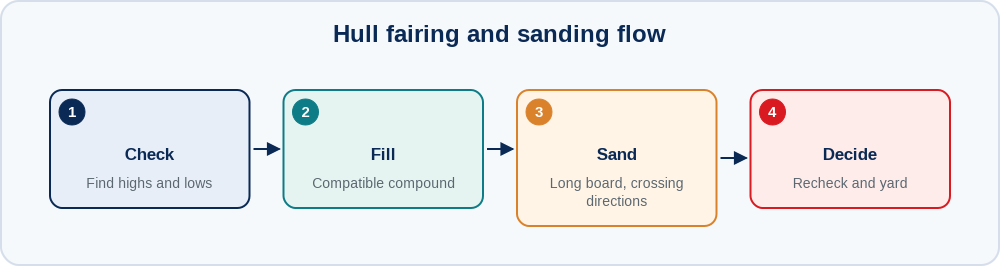
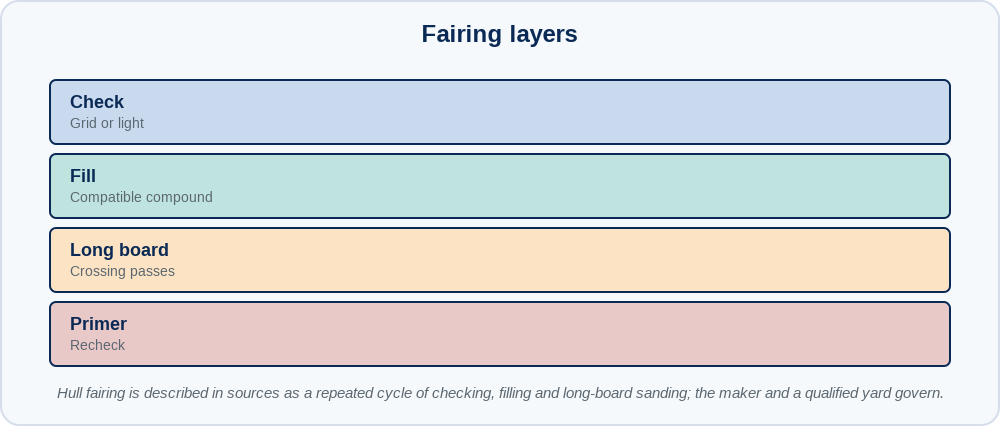
Hull fairing is described in sources as a repeated cycle of checking, filling and long-board sanding. This article is general information; it gives no product, grit or time and the maker and a qualified yard govern.
Frequently asked questions#
What is a fairing board?
Sources describe a long, flexible board carrying sandpaper, used to smooth and fair a surface.
How flexible should the board be?
A maker article describes flexible enough along its length to follow the hull yet stiff enough not to dip into low spots.
Why sand in opposing directions?
A maker article writes that fairing in opposing directions quickly establishes a fair surface and helps maintain fairness.
How are highs and lows checked?
A magazine describes drawing a grid, using tape to show hollows and flats, and using a laser level to show a light line.
What grit and time?
This article gives no grit or time; the maker’s instruction and a qualified yard govern.
Was this guide helpful?
Thank you! Your feedback has been saved.
Guide content is for general information; in practice, the current technical data sheet of the product applies.
Keep reading
Related guides
Boat Colour Selection and Solar Reflectance: Effect of Heat Absorption on Surfaces
A study of the effect of boat paint colour on solar reflectance and surface temperature.
2 min read Paint and CoatingsCauses and Diagnosis of Paint Blistering
A study of the sources, types and diagnostic approach to blistering on boat paints.
2 min read Paint and CoatingsNumber of Coats in Epoxy Coating Systems
A study of the effect of the number of coats in epoxy coating systems on protective performance and thickness.
2 min read