
Paint and Coatings
Delamination Signs and Test Methods
Delamination is described in sources as fibreglass layers separating from each other or from the core; signs listed include soft areas, dull sounds and blistering, and the tap test is the most commonly described method. This article summarises the accounts with their limits; it is not survey or repair advice.
Short answer
A sailing magazine writes that well-built solid fibreglass hulls almost never delaminate unless they have suffered impact damage or water has penetrated the gelcoat, and that introducing a core raises the likelihood of delamination dramatically. The same publication describes tapping the hull every two or three inches, being especially suspicious of the area around through-hulls and signs of skin damage or repair, and notes percussion testing can reveal filler patches. A boating magazine says that tapped with a plastic hammer sound areas ring solid and delaminated areas dull. An acoustic-inspection firm writes that the traditional tap test is slow, tiring and dependent on the inspector, and can be supported by technology; that is a firm account. This article recommends no method or repair; a qualified specialist governs.
Key points
- Delamination is layers separating from each other or the core; likelihood rises in cored hulls (magazine).
- In tap testing sound areas ring sharp and delaminated areas dull or hollow (magazine).
- Areas around through-hulls and with signs of damage or repair are especially suspect.
- Moisture meters and imaging can support tap testing.
- For structural decisions, survey and repair a qualified specialist governs.
1. What is delamination and why does it matter?#
A sailing magazine writes that delamination in fibreglass is the functional equivalent of rot in a wooden boat; with proper construction each layer is added before the previous one has cured, so the resin links chemically into a solid mass, whereas with a core the bond between outer skin, core and inner skin is strictly mechanical. This article is a general summary; it gives no diagnosis, survey, repair method or time and is not advice. Sources are magazine, organisation, firm and user accounts and may differ; maker and seller statements are labelled.
2. Signs and the tap test#
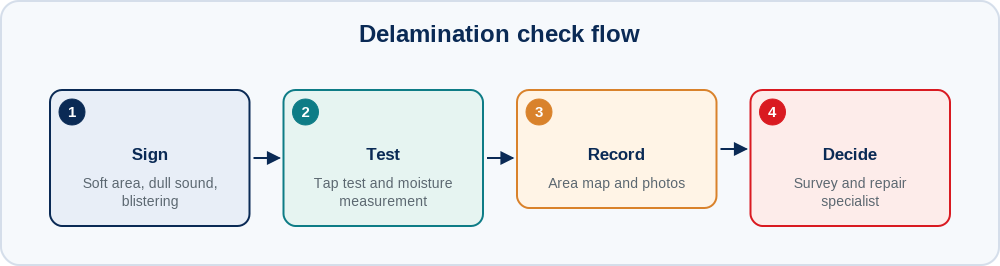
A sailing magazine says a thorough evaluation of a cored hull is essential because core delamination is common and robs the hull of much of its designed strength, and describes tapping every two or three inches over the hull surface. Another source describes the tap test as sound areas giving a sharp, solid sound and delaminated areas a dull one. A magazine writes that a suspect area is tapped with a plastic hammer, unaffected areas sounding solid and delaminated ones dull.
| Topic | Sources’ general account | Caution |
|---|---|---|
| Sign | Soft area, dull sound, blistering | Not every sign is delamination |
| Tap test | Sharp sound is sound, dull sound is a problem | Depends on experience |
| Support | Moisture meter, imaging | Specialist assessment |
3. Higher-risk areas and limits#
A sailing magazine writes that areas around through-hull fittings and near signs of skin damage or repair are especially suspect and that percussion testing can also reveal filler patches. A test publication says a firm phenolic hammer is the workhorse for fibreglass and that near fasteners a small, smooth metal hammer tapped very lightly can reveal critical delamination just below the surface by a higher-frequency sound; that is a publication account and tool choice depends on the qualified craftsman.
A boating publication writes that when core rots it loses its bond to the skins, which is delamination, and that damp laminate can also be damaged by repeated freeze-thaw cycles. A sailing magazine writes that well-built solid, non-cored fibreglass hulls almost never delaminate except through impact damage or water penetrating the gelcoat.
A fibreglass material seller writes that a small crack may look cosmetic at first but can carry risks of water intrusion, structural weakness and progressive delamination, that blisters can signal osmosis and that yellowing or darkening can indicate long-running water seepage; that is a seller account.
An acoustic-inspection firm writes that the traditional tap test is common in hull inspection but can be slow, tiring and dependent on the inspector’s experience, these limits showing on large or hard-to-reach areas, and that tools such as ultrasound, thermography and AI-assisted acoustic methods are also used; that is a firm account which includes promotion of its own product and is not independent verification.
On user forums people report that the sound in a tap test varies with thickness, paint and filler, so interpretation needs experience; these are experiences not independently verified. This article does not teach how to interpret sounds.
The causes of delamination are described differently in sources: a weak mechanical bond with the core, water ingress, impact, freeze-thaw and construction faults. One writer says polyester adheres strongly to itself but less well to other materials; that is a writer’s view.
Shared points: the tap test is a common first method, care is needed in cored hulls and around through-hulls, and results should be confirmed by specialist assessment. The difference lies in how often to tap, which tool to use and which finding needs repair.
Keeping records helps too: which area was checked, when and by what method, with findings and photos, eases later comparison.
4. A practical frame#
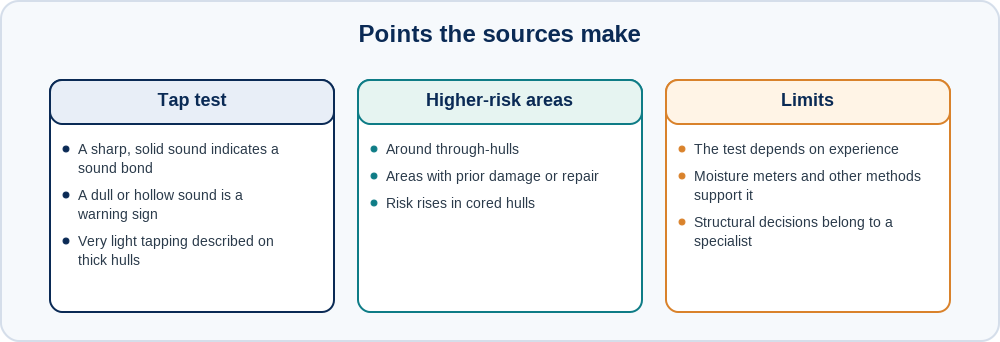
- Note signs (soft area, stain, blistering) by visual inspection.
- Plan the tap test with a qualified surveyor or craftsman; map the results.
- Record the areas around through-hulls and with repair marks in particular.
- If needed consult a specialist about supporting methods such as moisture meters or imaging.
- If delamination is suspected apply to a surveyor and repair specialist.
- Separate maker, seller and user accounts.
- Keep records.
5. Limits#
Sources overlap that delamination is layer separation, that tap testing is a common method and that cored hulls and areas around through-hulls need attention; they differ on how often and with which tool to test and which finding needs repair. Firm and user accounts are specific to their contexts. So there is no single right answer; a qualified specialist governs. This article is not survey, engineering or repair advice.
5b. Where sources differ#
The magazine describes the tap test and higher-risk areas; the test publication describes tool choice; the seller describes blisters and colour change; the acoustic firm promotes technological methods; users report that interpretation needs experience. These are sources speaking in different contexts and with different interests. The difference means consulting a qualified specialist for your own boat.
This article is general information; it recommends no product, method, ratio, number of coats or time. The maker’s data sheet and a qualified yard govern.
5c. A practical frame for reading the sources#
The sources are magazines, makers, sellers and forums; each writes in its own context. None knows the interpretation of the test, the significance of a finding or the need for repair of your boat. So taking the shared message and consulting the maker and a qualified yard for detail is reasonable.
Delaminated or damp laminate can carry structural weakness risk; inspection can carry risks from working at height, confined spaces and repair materials with injury and irritation. This article describes no method or personal protection; read the safety data sheets of products and consult a qualified specialist. For safety-critical matters such as hull integrity apply to a qualified specialist.
Seller and maker statements are the firm’s own account of its product and have not been independently verified. A product’s compatibility with another coating should always be checked in the product’s technical document; where a document and a guide conflict, the maker’s document and a qualified yard’s assessment should be used. Recording decisions and product details helps later maintenance.
6. Common mistakes#
- Tapping only once.
- Skipping higher-risk areas in a cored hull.
- Interpreting sound differences without experience and deciding.
- Not recording findings.
- Treating a seller or firm claim as independent verification.
- Not consulting a specialist when delamination is suspected.
- Keeping no records.
7. Checklist#
8. Conclusion#
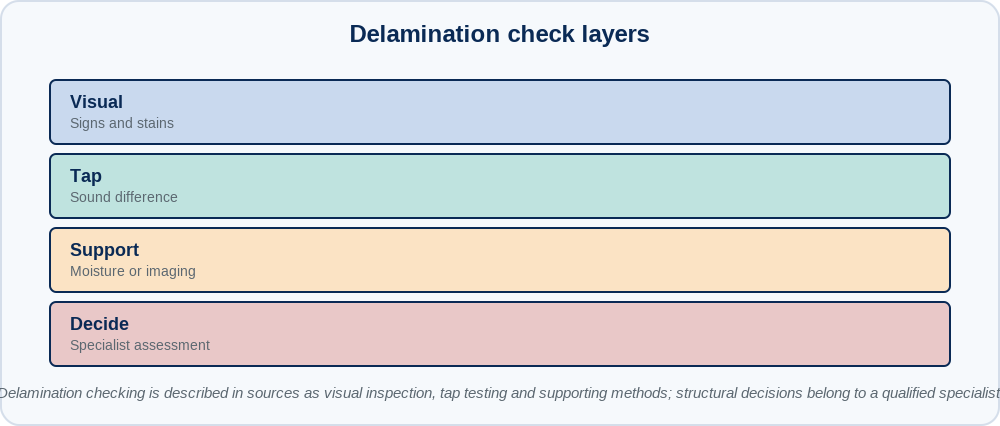
Delamination checking is described in sources as visual inspection, tap testing and supporting methods; structural decisions belong to a qualified specialist. This article is general information; it gives no survey, repair or time.
Frequently asked questions#
What is delamination?
Sources describe fibreglass layers separating from each other or from the core; likelihood rises in cored hulls.
How is a tap test done?
Sources describe tapping with a small hammer or a plastic-handled tool and listening; sound areas ring sharp and problem areas dull. This article does not describe the method.
Where is it checked most?
A magazine treats the area around through-hulls and places with signs of damage or repair as especially suspect.
Is the tap test enough?
An organisation says the test depends on the inspector and can be supported by other methods; structural decisions belong to a specialist.
What if I find delamination?
Consult a qualified surveyor and repair specialist; this article gives no repair method.
Was this guide helpful?
Thank you! Your feedback has been saved.
Guide content is for general information; in practice, the current technical data sheet of the product applies.
Keep reading
Related guides
Boat Colour Selection and Solar Reflectance: Effect of Heat Absorption on Surfaces
A study of the effect of boat paint colour on solar reflectance and surface temperature.
2 min read Paint and CoatingsCauses and Diagnosis of Paint Blistering
A study of the sources, types and diagnostic approach to blistering on boat paints.
2 min read Paint and CoatingsNumber of Coats in Epoxy Coating Systems
A study of the effect of the number of coats in epoxy coating systems on protective performance and thickness.
2 min read