
Paint and Coatings
Moisture Meter Use: A Guide to Reading and Interpreting
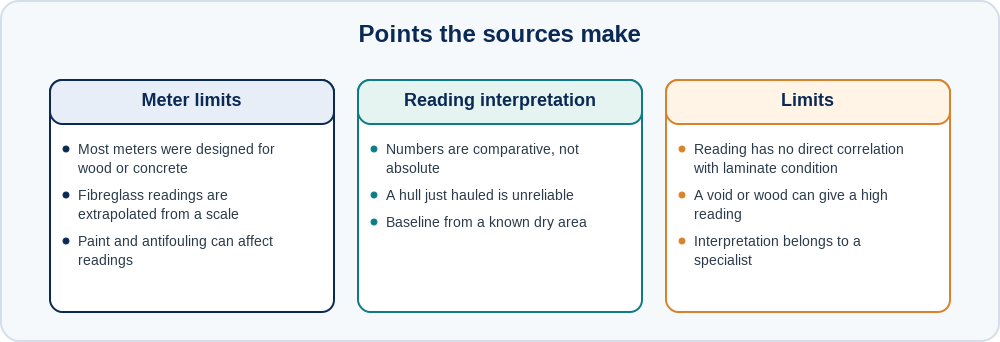
A moisture meter is described in sources as the most common tool for indicating moisture in a fibreglass hull; but it is stressed that most meters were designed for wood or concrete, that readings are comparative and that interpretation needs experience. This article summarises the accounts with their limits; it is not survey advice and gives no thresholds.
Short answer
A sailing magazine writes that all fibreglass hulls absorb moisture over time, small amounts not being of great concern and even higher amounts not necessarily indicating a hull will blister, but that a prudent buyer and surveyor will want some indication of wetness and the most common tool is the moisture meter; it adds that readings are extrapolated from a scale designed for wood or concrete, the first clue that the meter is an imperfect device for determining moisture levels in a fibreglass hull. The same magazine says testing a hull just hauled from the water is highly unreliable. This article recommends no threshold or meter; a qualified specialist governs.
Key points
- Most moisture meters were originally designed for wood or concrete; fibreglass readings are extrapolated from a scale (magazine).
- Readings are comparative; the numbers themselves may carry no absolute meaning (survey account).
- Testing a hull just hauled is unreliable; taking a baseline from a known dry area is described.
- A void or wood can give a high reading; antifouling can also affect readings.
- For interpretation and decisions a qualified specialist governs.
1. Why is a moisture meter used?#
A sailing magazine writes that over time all fibreglass hulls absorb moisture, small amounts not being of great concern, even higher amounts not necessarily indicating the hull has or ever will blister, but the prudent buyer and surveyor will want some indication of a hull’s wetness and the most common tool is the moisture meter. This article is a general summary; it gives no diagnosis, survey, threshold or time and is not advice. Sources are magazine, survey, organisation and user accounts and may differ; maker and seller statements are labelled.

2. Limits of the meter#
The same magazine says most moisture meters were not originally intended for testing fibreglass boat hulls but for wood in buildings or lumber yards, concrete, plaster, grain and so on, so readings from a fibreglass hull must be extrapolated from a scale designed for wood or concrete, the first clue that the meter is an imperfect device for determining moisture levels in a fibreglass hull. It reports a reader survey in which 60 percent said they trusted readings most of the time while the same number admitted readings had proved wrong. A survey writer says the fibreglass scale does not give an actual moisture percentage and that readings are comparable from one spot to the next and from one meter to another.
| Topic | Sources’ general account | Caution |
|---|---|---|
| Meter | Designed for wood or concrete | Fibreglass scale is extrapolation |
| Reading | Comparative | Not an absolute number |
| Conditions | Surface and ambient effects | Baseline |
3. Interpreting readings and limits#
A user-site author writes that copper in bottom paint can read as moisture so the meter cannot be used over bottom paint, that any hull recently hauled will read rather high, that if the hull is cored and about three-quarters of an inch thick readings can be taken from inside, so going around through-hulls from the inside is better; with consistently high readings on gelcoat he describes taking a baseline on a known dry area for comparison. That is a user experience and may not hold for every meter and boat.
A sailing magazine writes that testing a hull just hauled is highly unreliable and prone to false readings and that never-been-outside laminate samples read different percentages depending on thickness, layup and materials; that is a test-publication account and depends on the meter. A survey writer says a meter can also give a high reading because of a void in the laminate or wood in the transom, that it is valuable around through-hulls to judge whether the fitting is bedded properly, but that it is a tool that only indicates possible moisture.
A UK surveying organisation’s document says there is no direct correlation between hull moisture content and laminate condition, that ambient conditions affect readings and that interpreting readings is a separate matter; that is an organisation account. A sailing publication writes that a fully saturated fibreglass hull will have no more than 2.5 to 3.5 percent moisture; that is a publication account and this article gives no thresholds.
A marine publication says moisture meters can detect otherwise invisible moisture and its side effects, that in osmosis repair the meter lets a specialist determine how deeply moisture has penetrated and that for topsides taking readings from inside the hull may be useful. A boat-buying article writes that on a boat older than about ten years there is a very good chance readings will be higher than when factory fresh and what that means depends on one’s comfort level.
A test publication records readings as a percentage of full scale in its comparison; on user forums people say none of the meter’s settings say fibreglass, or ask whether a 20 percent reading on a two-scale meter means about 2 percent moisture; those are user questions and experiences and this article does not answer them.
A forum user writes that cheap building-materials meters may not give the same result on fibreglass and that surveyors often use technology that scans beyond the surface; that is a user account and meter prices vary.
Shared points: readings are comparative, ambient and surface conditions affect them and interpretation needs experience. The difference lies in which reading is worrying, which meter is suitable and how a reading relates to blisters or laminate condition.
Keeping records helps too: date, place, meter and setting, ambient conditions and baseline readings ease later comparison.
4. A practical frame#
- Learn from the maker what material the meter was designed for and what its scale means.
- Plan measurement with a qualified surveyor or craftsman; avoid a hull just hauled.
- Take a baseline from a known dry area and record comparative points.
- Note factors that affect readings such as bottom paint, voids, wood and ambient conditions.
- For a high reading establish the cause with a surveyor and specialist.
- Separate maker, seller and user accounts.
- Keep records.
5. Limits#
Sources overlap that most meters were designed for wood or concrete, that readings are comparative and that interpretation needs experience; they differ on which reading is worrying, which meter suits and how a reading relates to laminate condition. Organisation and user accounts are specific to their contexts. So there is no single right answer; a qualified specialist governs. This article is not survey, engineering or repair advice.
5b. Where sources differ#
The sailing magazine calls the meter imperfect; the survey piece says readings are comparative; the organisation’s document says there is no direct correlation between moisture and laminate condition; the user site describes baselines and inside readings; publications mention percentage limits. These are sources speaking in different contexts and with different interests. The difference means consulting a qualified specialist for your own boat.
This article is general information; it recommends no product, method, ratio, number of coats or time. The maker’s data sheet and a qualified yard govern.
5c. A practical frame for reading the sources#
The sources are magazines, makers, sellers and forums; each writes in its own context. None knows the meaning of a reading, the meter or a threshold of your boat. So taking the shared message and consulting the maker and a qualified yard for detail is reasonable.
Damp or weakened laminate can carry structural weakness risk; inspection can carry injury risk from confined spaces and working at height. This article describes no method or personal protection; consult a qualified specialist and follow the relevant safety rules. For safety-critical matters such as hull integrity apply to a qualified specialist.
Seller and maker statements are the firm’s own account of its product and have not been independently verified. A product’s compatibility with another coating should always be checked in the product’s technical document; where a document and a guide conflict, the maker’s document and a qualified yard’s assessment should be used. Recording decisions and product details helps later maintenance.
6. Common mistakes#
- Treating a reading as an absolute moisture percentage.
- Measuring a hull just hauled.
- Trusting a reading over bottom paint.
- Not taking a baseline.
- Treating a high reading alone as blisters or laminate damage.
- Not consulting a specialist.
- Keeping no records.
7. Checklist#
8. Conclusion#
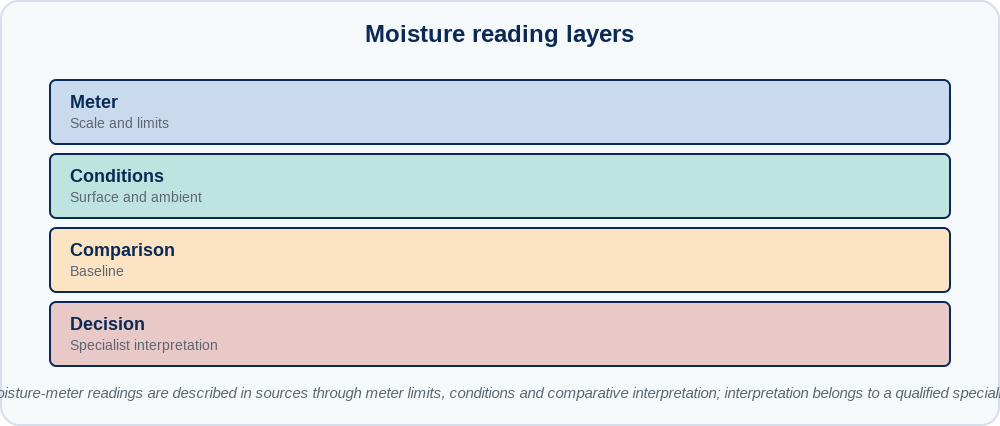
Moisture-meter readings are described in sources through meter limits, conditions and comparative interpretation; interpretation belongs to a qualified specialist. This article is general information; it gives no threshold, survey or time.
Frequently asked questions#
Does a moisture meter give an exact result on fibreglass?
Sources say most meters were designed for wood or concrete, readings are comparative and interpretation needs experience.
What does a high reading mean?
Sources say a high reading can come from voids, wood or ambient effects as well as moisture; interpretation belongs to a specialist.
When should I measure?
A magazine writes testing a hull just hauled is unreliable; this article gives no time or period.
What is a baseline?
A user describes taking a baseline reading on a known dry area and comparing others against it; that is a user account.
Is there a threshold?
This article gives no threshold; readings depend on meter and context and interpretation belongs to a qualified specialist.
Was this guide helpful?
Thank you! Your feedback has been saved.
Guide content is for general information; in practice, the current technical data sheet of the product applies.
Keep reading
Related guides
Boat Colour Selection and Solar Reflectance: Effect of Heat Absorption on Surfaces
A study of the effect of boat paint colour on solar reflectance and surface temperature.
2 min read Paint and CoatingsCauses and Diagnosis of Paint Blistering
A study of the sources, types and diagnostic approach to blistering on boat paints.
2 min read Paint and CoatingsNumber of Coats in Epoxy Coating Systems
A study of the effect of the number of coats in epoxy coating systems on protective performance and thickness.
2 min read