
Paint and Coatings
Balsa-Cored Decks and Water Ingress
Balsa-cored decks are described in sources as light, inexpensive cores with good compressive strength; but water ingress, mostly through failed hardware sealing, can lead to soft spots and rot. This article summarises the accounts with their limits; it is not survey or repair advice.
Short answer
A sailing magazine writes that balsa is inexpensive, lightweight and has very good compressive strength, the most common core material, its downside being that it absorbs water quickly and degrades faster than plywood. A cruising magazine says the downfall of balsa-cored decks is water finding its way under the fibreglass skin, most commonly when deck hardware is improperly sealed or the sealant breaks down, balsa absorbing a lot of water before it begins to rot. A boat-test website writes that balsa sealed between skins does not readily transmit water, the real-world failure being loss of the skin-to-core bond more than balsa turning to mush. This article recommends no method or repair; a qualified specialist governs.
Key points
- Balsa is described as light, inexpensive and strong in compression; its downside is quick water absorption (magazine).
- Ingress mostly comes through failure of hardware sealing.
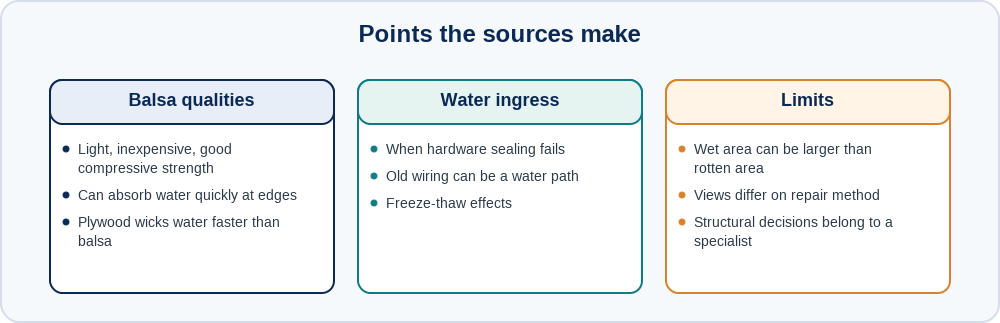
- Balsa can absorb a lot of water before rotting; soft spots may be a sign.
- The wet area can be larger than the rotten area; sources differ on repair approach.
- For inspection and repair decisions a qualified specialist governs.
1. Why is balsa core used?#
A sailing magazine writes that if your sailboat has a cabin you can be 99 percent sure the deck is cored, many production sailboats also using a core in the hull for performance, balsa being the most common core material because it is inexpensive, lightweight and has very good compressive strength. The same publication says that with its grain sealed against the skins balsa does not readily transmit moisture and exhibits excellent shear strength, perhaps the best of common core materials. This article is a general summary; it gives no diagnosis, survey, repair method or time and is not advice. Sources are magazine, organisation, maker and user accounts and may differ; maker and seller statements are labelled.
2. How does water get in?#
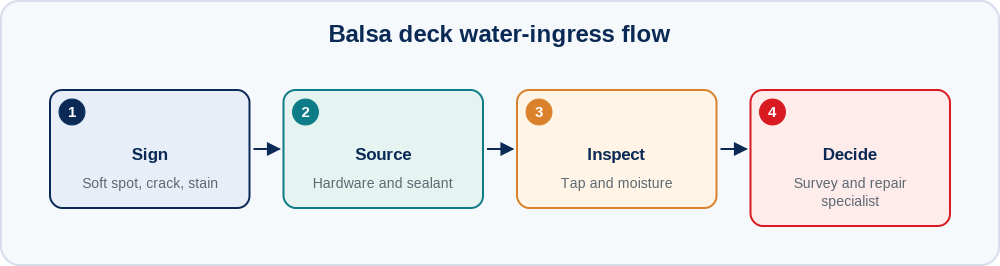
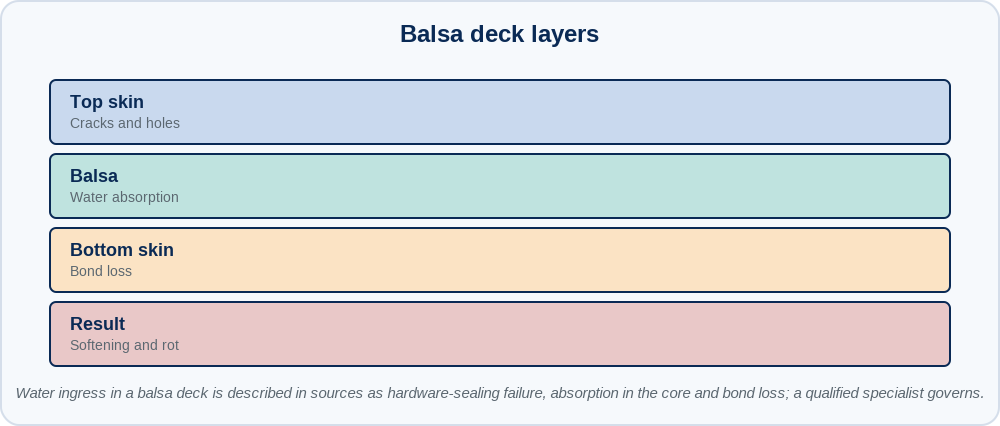
A cruising magazine says the downfall of balsa-cored decks is water finding its way below the fibreglass skin, most commonly when deck hardware is improperly sealed or the sealant breaks down, balsa being able to absorb a lot of water before it begins to rot, resulting in a soft spot. The same article describes old defunct electrical wiring left embedded in the deck providing a conduit for moisture to flow through the balsa; that is an author’s experience and may not hold for every boat.
| Topic | Sources’ general account | Caution |
|---|---|---|
| Balsa | Light, inexpensive, good strength | Absorption can be quick |
| Ingress | Hardware sealing | Old wiring can be a path |
| Result | Soft spot, bond loss | Structural decision to specialist |
3. Signs, differing views and limits#
A sailing publication says balsa, plywood and foam are all susceptible to water intrusion, balsa being the most common core but absorbing water very quickly and degrading faster than plywood, and that once moisture enters the core it starts to degrade, compromising the integrity of the deck or hull. A cruising publication describes signs such as an ominous creaking when walking forward, cracks in the deck with dirty brown water seeping out, and dirty brown streaks down the inside of the hull.
An epoxy maker’s technical advisor writes that replacing damaged balsa core involves removing the fibreglass skin to expose the core, from topside or below deck, and that many folks have the misconception that balsa will act like a sponge and disintegrate quickly, which is not the case; that is an account from a maker’s advisor, specific to its own system. A boat-test website writes that the most common real-world failure is the adhesive bond letting go and the panel delaminating, after which water migrates laterally and the affected area grows.
A sailing publication says that in properly installed balsa the kerfs are well sealed with epoxy, preventing water from spreading through the laminate, that plywood wicks water even faster than balsa, and that isolated sections are often undamaged, sealed off by epoxy that saturated the kerfs, and can be left in place if sound. A sailing magazine and a maintenance writer describe that the wet area can be larger than the rotten area, that unrotted wood can be dried, and that tapping and small drilled holes are used to establish the extent; this article gives no method.
Views on repair differ: some sources describe drying the core and filling it with epoxy, some removing the wet core entirely and fitting new core, and some injection only in small areas. A test publication writes that injecting epoxy and similar products is probably not the best method for larger areas of extensive damage, that the repair material does not need to be as strong as epoxy, only as strong as the original core, and that it reviewed a professional repair with critical errors that left it far weaker than what it started with. A forum user writes that when you have one skin off it is hard to know whether the other side of the balsa is dry and it may be wiser to replace it; these are opinions and experiences.
A class-association website writes that the vast majority of water intrusion into deck core comes from holes through the outer skin into the core and describes removing hardware, filling with epoxy and rebedding with sealant as a prevention approach; that is a user-site account specific to its own boats and this article recommends no method.
A sailing magazine calls core rot, particularly in foredecks and side decks, the cancer of aging sailboats; that is a magazine view. Another source says a few soft spots in the balsa-cored deck of a 50-plus-year-old boat are neither uncommon nor all that concerning; that is also an author’s view and may not hold for every boat.
Shared points: balsa is light and strong but can absorb water quickly, ingress mostly comes from hardware sealing and the wet area can be larger than the rotten one. The difference lies in repair method, how much wet core to replace and the suitability of injection.
Keeping records helps too: when hardware was refitted, when sealant was replaced and where soft spots were found eases later comparison.
4. A practical frame#
- Note signs (soft spot, crack, stain, creaking) by eye and tapping.
- Review ingress sources (fitting connections, cracks, embedded old wiring) with a qualified craftsman.
- Consult a surveyor or specialist on moisture measurement and core inspection.
- Plan to renew hardware sealing per the maker’s instruction.
- For core damage decide the repair approach with a qualified repair specialist.
- Separate maker, seller and user accounts.
- Keep records.
5. Limits#
Sources overlap that balsa is light and strong but can absorb water quickly, that ingress mostly comes from hardware sealing and that the wet area can be larger than the rotten area; they differ on repair method, how much wet core to replace and whether injection suits. Maker and user accounts are specific to their contexts. So there is no single right answer; a qualified specialist governs. This article is not survey, engineering or repair advice.
5b. Where sources differ#
One magazine says balsa absorbs water quickly; a test website writes that the real failure is bond loss; an epoxy advisor says balsa does not disintegrate like a sponge; a test publication does not favour injection for extensive damage; a user suggests replacing wet balsa. These are sources speaking in different contexts and with different interests. The difference means consulting a qualified specialist for your own boat.
This article is general information; it recommends no product, method, ratio, number of coats or time. The maker’s data sheet and a qualified yard govern.
5c. A practical frame for reading the sources#
The sources are magazines, makers, sellers and forums; each writes in its own context. None knows the source of moisture, the core condition or the repair method of your boat. So taking the shared message and consulting the maker and a qualified yard for detail is reasonable.
Damp or rotten cored decks can carry structural weakness risk; inspection and repair can carry injury and irritation risk from confined spaces, chemicals and dust. This article describes no method or personal protection; read the safety data sheets of products and consult a qualified specialist. For safety-critical matters such as deck integrity apply to a qualified specialist.
Seller and maker statements are the firm’s own account of its product and have not been independently verified. A product’s compatibility with another coating should always be checked in the product’s technical document; where a document and a guide conflict, the maker’s document and a qualified yard’s assessment should be used. Recording decisions and product details helps later maintenance.
6. Common mistakes#
- Ignoring soft spots.
- Repairing without renewing hardware sealing.
- Missing embedded old wiring.
- Not allowing for the wet area being larger than the rotten area.
- Treating a user or maker claim as independent verification.
- Not consulting a specialist on core damage.
- Keeping no records.
7. Checklist#
8. Conclusion#
Water ingress in balsa-cored decks is described in sources as hardware-sealing failure, absorption in the core and bond loss; repair approaches differ. This article is general information; it gives no survey, repair or time and a qualified specialist governs.
Frequently asked questions#
Why does balsa rot?
Sources describe water getting under the fibreglass skin, mostly through failed hardware sealing; balsa can absorb a lot of water before rotting.
What does a soft spot mean?
A magazine writes soft spots can indicate balsa core deterioration; consult a qualified specialist for diagnosis.
Does wet balsa always rot?
A boat-test website writes the most common real-world failure is loss of the skin-to-core bond more than balsa turning to mush.
How is it repaired?
Sources differ on method; this article describes none and a qualified repair specialist should be consulted.
Should I repair it myself?
Core repair is structural work; apply to a qualified specialist.
Was this guide helpful?
Thank you! Your feedback has been saved.
Guide content is for general information; in practice, the current technical data sheet of the product applies.
Keep reading
Related guides
Boat Colour Selection and Solar Reflectance: Effect of Heat Absorption on Surfaces
A study of the effect of boat paint colour on solar reflectance and surface temperature.
2 min read Paint and CoatingsCauses and Diagnosis of Paint Blistering
A study of the sources, types and diagnostic approach to blistering on boat paints.
2 min read Paint and CoatingsNumber of Coats in Epoxy Coating Systems
A study of the effect of the number of coats in epoxy coating systems on protective performance and thickness.
2 min read