
Paint and Coatings
Old Paint Removal Methods: Chemical, Heat and Mechanical
When paint layers get thick or adhesion fails, removing old paint may be necessary. This article compares chemical, heat and mechanical removal methods, blasting options and safety topics, based on sources.
Short answer
The main ways to remove old boat paint are chemical stripper, mechanical sanding and scraping and abrasive methods such as soda, ice or wet blasting; heat is also used on wooden boats. Cruising World says soda blasting stands out as a less abrasive option for fibreglass, sandblasting can be used on steel and aluminium hulls and chemical stripper produces no dust or noise but its compatibility with the hull material must be verified. Practical Sailor warns that with heat guns resin damage starts at relatively low temperatures and control is difficult. In method choice hull material, paint layers and safety decide. This article is general information.
Key points
- Main methods: chemical stripper, mechanical sanding and scraping, soda, ice or wet blasting; heat on wood.
- Chemical stripper makes no dust or noise but compatibility with the hull material must be verified and several applications may be needed.
- On fibreglass overly aggressive sanding can gouge the gelcoat.
- With heat guns resin damage can start at relatively low temperatures; consult the maker.
- Every method needs protective equipment and a disposal plan for dust, fumes and waste.
1. When is removing old paint necessary?#
Not every repaint requires stripping. The West Marine guide treats the cases where stripping is not necessary under its own heading: a sound, well-bonded paint system can be recoated with proper preparation and compatible product. Typical cases that lead to stripping are thickened, cracking paint layers, films that have lost adhesion, an incompatible system change and bare-hull inspection. Cruising World writes that whether you need to remove old bottom paint to improve boat speed is uncertain, since even 20 years’ worth of residue adds only a marginal amount to the boat’s weight; so the decision mostly depends on paint condition and the new system’s requirements.
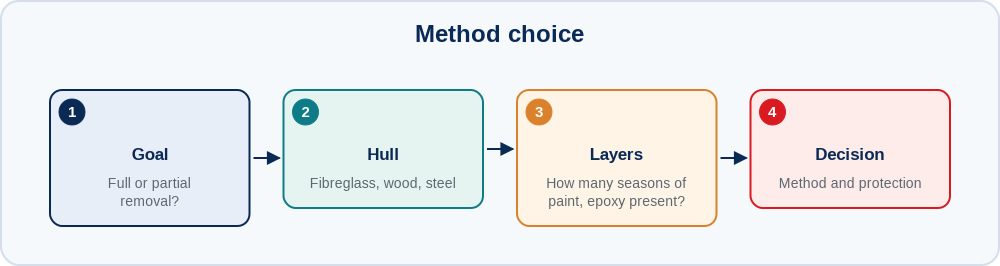
Before deciding to strip, film thickness, adhesion and the underlying layers (especially an epoxy barrier coat) should be assessed. If the barrier coat is to be stripped the scope of the job grows; so make clear from the start the difference between taking off only the antifouling layer and going down to the barrier.
2. Three main methods#
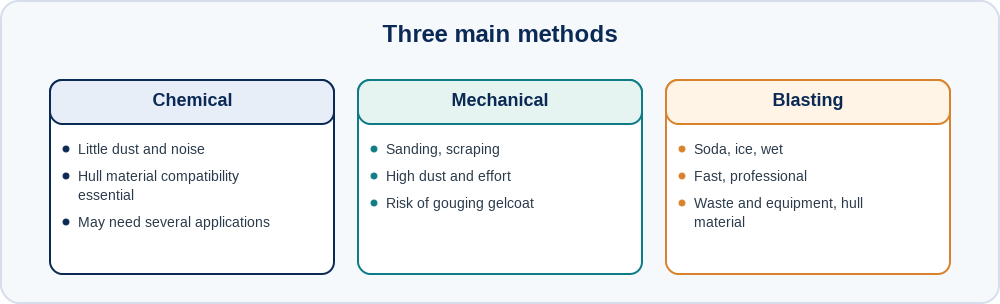
Cruising World writes that three approaches dominate bottom-paint removal: soda blasting, chemical stripping and mechanical sanding. Wooden-boat owners have the added option of heat, while aluminium and steel hulls can stand up to sandblasting. Better Boat lists four main approaches as chemical stripping, mechanical sanding, media blasting and heat gun, calls media blasting the “gold standard” for speed and efficiency and mentions the heat gun as a niche technique that is not common for stripping entire hulls. These are sources with commentary; before deciding for your hull and paint seek maker and expert opinion.
| Method | Advantage | Risk and limit |
|---|---|---|
| Chemical stripper | No dust or noise, waste can be contained | Hull material compatibility, multiple applications, epoxy hard |
| Mechanical sanding, scraping | Simple equipment | Much dust, effort, risk of gouging gelcoat |
| Soda blasting | Less abrasive for fibreglass | Equipment, setup, waste |
| Sand blasting | For steel, aluminium | Too aggressive on fibreglass |
| Heat gun + scraping | Used on wood | Resin damage, fumes, hard to control |
3. Chemical stripper#
Cruising World cites chemical stripper as the method of choice for some boatyards because there is no dust or noise and the residue is easily contained. The same source says that in choosing a stripper you should confirm it can be used on your hull material and expect to use 5 to 6 gallons for a 45-foot sailboat. The NY Sea Grant marina guide says chemical strippers can eliminate the paint chips and dust associated with sanding, scraping and blasting and that less toxic alternatives exist to products using methylene chloride and other organic solvents. The West Marine guide says several applications are typically needed for paint buildup of five or more seasons.
On application, the sequence Yachting Magazine describes is to apply the stripper per the maker’s instructions, scrape off the softened paint with a putty knife or scraper, cover the area for falling stripper and paint and tape off the gelcoat next to the stripped area to protect it. Practical Sailor suggests rolling on with a thick-nap roller and wide dabbing brush, using masking tape to hold covering paper or plastic over the stripper and first dry-scraping blistered and flaking paint before attacking more stubborn areas with stripper. The same magazine writes that modern, eco-friendly strippers do a wonderful job of removing antifouling, one-part enamels and varnish, but when it comes to epoxy all bets are off.
4. Mechanical methods and heat#
Mechanical removal covers sanding and scraping. Practical Sailor notes that overzealous sanding can lead to dings and divots in the gelcoat; so on fibreglass hulls gelcoat thickness must be watched when choosing a method. Hand scraping is done with tools from a thin, sharpened scraper to the wide scrapers called a “slick”; the choice of drag or push scraping depends on hull contour and body position. Dust produced in sanding can be toxic, especially with antifouling; see the related article.
The heat gun and scraper method is an option used by wooden-boat owners; heat softens the paint on wood. Practical Sailor does not recommend a heat gun on fibreglass gelcoat: resin damage occurs at relatively low temperatures and surface heat is hard to control; it writes that only the most deft handlers should consider it and recommends consulting the paint maker. Cruising World also advises upgrading the dust mask to an organic-vapour respirator when removing paint with a heat gun. So it makes sense to limit the heat method to wood and maker-approved cases rather than generally recommending it on fibreglass.
5. Blasting: soda, ice, wet#
Cruising World writes that soda blasting is the method many boat owners choose for bottom-paint removal on fibreglass boats because it is less abrasive than other media, while on steel or aluminium hulls sandblasting can generally be used. The same source says soda blasting is rapidly becoming the removal method of choice but is labour-intensive, rental units are scarce and you must still dispose of the old paint properly. 48 North writes that sand, soda, shell or water-based “eco” blasting services are available at most boatyards and are the best option for stripping down to the bare hull.
An equipment maker for vapour or wet abrasive blasting (Graco) describes chemical stripping and hand scraping as time-consuming, with chemical removal of antifouling on an average boat taking up to six days, and says the wet abrasive method shortens it; that is an equipment seller’s claim. In blasting, if hull material, abrasive type and pressure are not chosen correctly the surface can be damaged; so an experienced applicator and the hull maker’s recommendation matter.
6. Safety and waste#
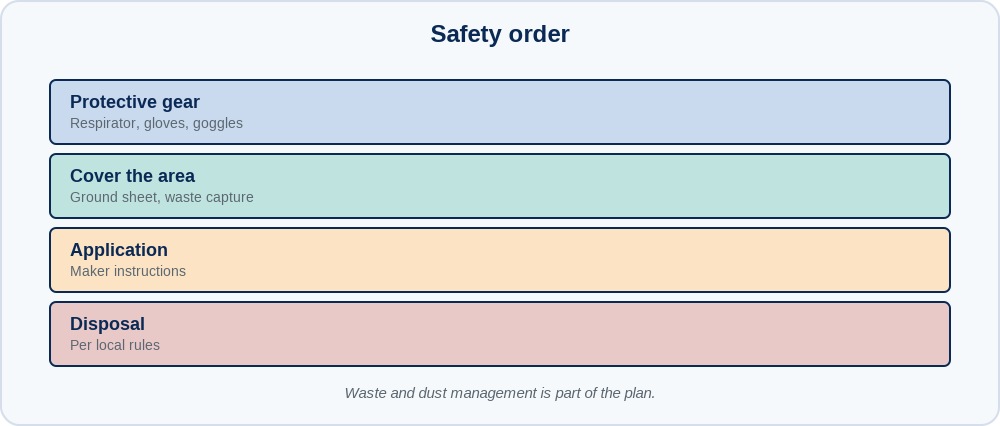
Whichever method is chosen, respiratory, skin and eye protection are needed. Practical Sailor recommends lightweight, back-vented coveralls and says simply “working upwind” of the dust or fumes won’t cut it when you are under the boat and heating the old paint. The West Marine guide treats safety and hazardous-waste requirements under their own heading. Removed paint, especially antifouling, can contain toxic components and must be collected with stripper waste and disposed of under local regulations; for details see the site’s article on safety and waste management.
Covering the area, collecting waste and preventing wind from carrying dust matter for both the environment and marina rules; many marinas and yards restrict stripping methods. Ask marina or yard management before you start.
- Assess whether stripping is really needed; check film thickness and adhesion.
- Identify the hull material and underlying layers (epoxy barrier).
- Choose the method: chemical, mechanical, blasting (heat only in suitable cases).
- Prepare protective equipment; cover the area and plan waste capture.
- Test a small area.
- Apply per maker instructions; do not overdo it.
- Dispose of waste under local rules; clean and prepare the surface.
7. Common mistakes#
- Using chemical stripper without verifying compatibility with the hull material.
- Sanding overly aggressively on fibreglass.
- Using a heat gun uncontrolled on gelcoat.
- Breathing antifouling dust unprotected.
- Working without collecting waste.
- Not asking about marina rules.
- Stripping an epoxy barrier without realising it.
8. Checklist#
9. Conclusion#
To remove old paint there are chemical stripper, mechanical sanding and scraping, soda or wet blasting and, on wood, heat; the right method depends on hull material, paint layers and safety conditions. On fibreglass heat guns and aggressive sanding are risky; a chemical stripper’s compatibility must be verified. A safety and waste plan is an integral part of the job. This article is general information; the data sheet and expert opinion come first.
Frequently asked questions#
Which method suits fibreglass?
Cruising World writes that soda blasting is chosen on fibreglass boats because it is less abrasive than other media; chemical stripper and mechanical sanding are also used.
Can chemical stripper be used on any hull?
No; sources stress checking the stripper’s compatibility with your hull material before use.
Is a heat gun safe?
Practical Sailor says resin damage can occur at low temperatures and heat is hard to control; it recommends consulting the paint maker.
Does stripper remove an epoxy barrier coat?
Practical Sailor writes that modern strippers remove antifouling, one-part enamel and varnish well but with epoxy all bets are off.
What to do with the waste?
Removed paint and stripper waste must be collected and disposed of under local rules; antifouling in particular can be toxic.
Was this guide helpful?
Thank you! Your feedback has been saved.
Guide content is for general information; in practice, the current technical data sheet of the product applies.
Keep reading
Related guides
Boat Colour Selection and Solar Reflectance: Effect of Heat Absorption on Surfaces
A study of the effect of boat paint colour on solar reflectance and surface temperature.
2 min read Paint and CoatingsCauses and Diagnosis of Paint Blistering
A study of the sources, types and diagnostic approach to blistering on boat paints.
2 min read Paint and CoatingsNumber of Coats in Epoxy Coating Systems
A study of the effect of the number of coats in epoxy coating systems on protective performance and thickness.
2 min read