
Paint and Coatings
Paint Adhesion Test: How to Do the Cross-Cut Method
Testing adhesion on a small area before applying a new paint system to the whole hull can prevent an expensive mistake. This article explains the cross-cut tape test, the two methods in ASTM D3359 and their limits.
Short answer
In the cross-cut test cuts in an X or lattice pattern are made through the paint film to the substrate, pressure-sensitive tape is applied and pulled off quickly, and the amount of coating detached is rated against a standard scale. ASTM D3359 defines Method A (X-cut) for use primarily in the field and Method B (cross-hatch) for shop and laboratory settings. The standard evaluates adhesion of relatively ductile coatings to metallic substrates and does not distinguish higher adhesion levels. On boats the result is an indicative guide; for a firm decision ask the maker. This article is general information.
Key points
- The cross-cut test is a simple adhesion check: cut through to the substrate, apply tape and rate how much coating lifts.
- In ASTM D3359 Method A (X-cut) is for the field and Method B (cross-hatch) for shop and laboratory.
- The standard is written for ductile coatings on metal; on fibreglass and wood the result is only an indication.
- In multi-coat systems failure may be between coats; note this.
- Test a hidden area and document the result with photos.
1. What is the cross-cut test?#
The cross-cut test is a tape-based method for judging how well a paint or coating adheres to its substrate or underlying coat. A cutting tool makes a right-angle lattice or X pattern through the film to the substrate; pressure-sensitive tape is applied and pulled off. The amount of coating that lifts with the tape or flakes at the cut edges is rated against a visual standard scale. Wikipedia and standard summaries list this test among methods for measuring the resistance of paints and coatings to separation from substrates, alongside more quantitative methods such as the pull-off test.
In boat painting the test is useful in two situations in particular: before applying a new system over old paint, to make sure the old film is bonded to the substrate, and after a new system has cured, to verify adhesion quality. The test is simple but interpreting it correctly requires knowing its limits.
2. ASTM D3359: Method A and Method B#
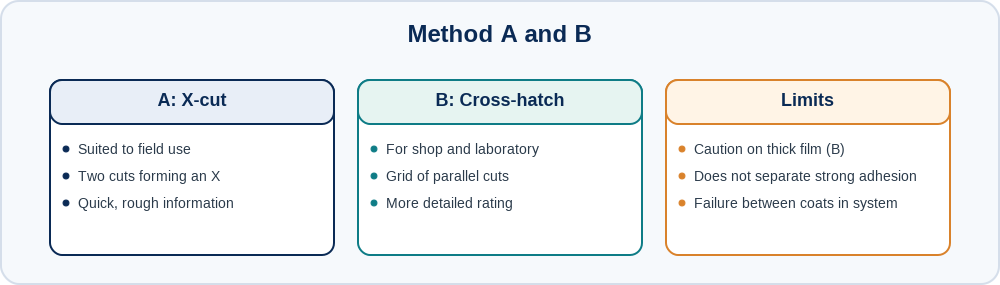
The standard most often cited for the test is ASTM D3359. Its scope section says the methods assess the adhesion of relatively ductile coating films to metallic substrates by applying and removing pressure-sensitive tape over cuts made in the film. It states Method A is primarily intended for use in the field while Method B is more suitable for shop or laboratory settings, and that Method B is not considered suitable for films thicker than 125 µm (5 mils) unless wider spaced cuts are used and there is an explicit agreement between purchaser and seller.
In Method A an X-shaped cut is made through the film to the substrate with a carbide-tipped tool; tape is placed over the cut, smoothed into place with something like a pencil eraser and pulled off. In Method B a lattice of parallel cuts is made, the cut area is brushed clean of loose debris, tape is applied and pressed down and pulled off at roughly a right angle with a medium, even motion. Results are given on a 0 to 5 scale or with 0B to 5B notation; one patent example prefers 3B and higher and 4B and higher more, but that is one source’s criterion and your product’s requirement may differ. The standard itself notes it is similar to ISO 2409 but not technically equivalent.
| Feature | Method A (X-cut) | Method B (cross-hatch) |
|---|---|---|
| Where used | Primarily field | Shop and laboratory |
| Cut shape | X with two cuts to the substrate | Lattice of parallel cuts |
| Film thickness | More flexible use | Limited above 125 µm (5 mils) |
| Information level | Rough, quick indicator | More detailed rating |
| Ratings | 0–5 scale | 0B–5B or 0–5 scale |
3. Doing it on a boat: step by step#
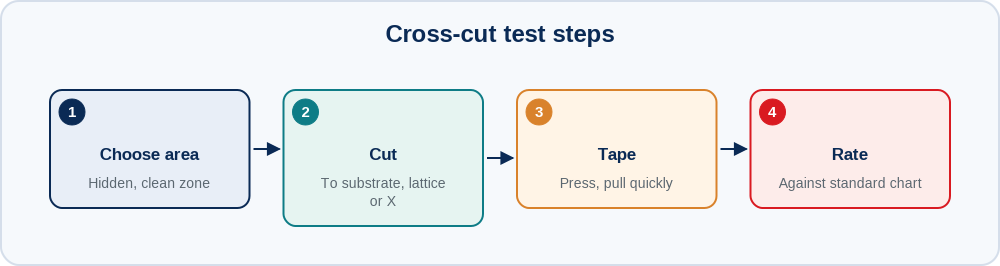
Do the test on a hidden part of the boat (for example near the bilge, the lower edge of the hull or a zone that will be outside the painted area) and on a clean, dry surface. With a sharp blade or lattice cutter cut the film through to the substrate; check that the cuts really reach it. Brush away loose pieces with a soft brush, then apply a suitable tape over the cut area, press it down well and pull it off in a quick, even motion. Examine the tape and cut area in light; rate by comparing the percentage of coating detached with the standard chart.
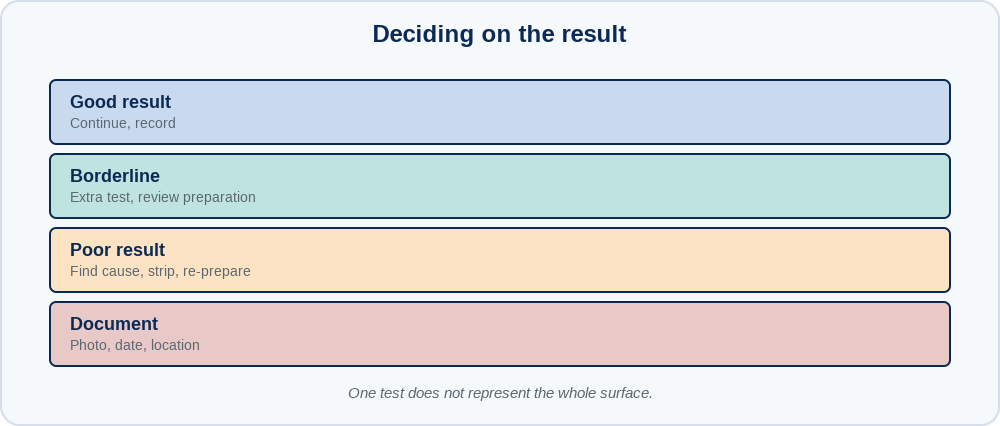
Photograph the result; note the date, location, paint system, temperature and surface condition. These records are valuable when talking to a maker or an expert later. The tape, blade and method used should match the conditions defined in the standard; any tape you have at home will not give a standard result, only a rough idea.
4. How to interpret the result#
A good result means negligible coating detaching at the cut edges and on the tape; it points to adequate adhesion at that point and under those conditions. However, the standard states these methods evaluate whether adhesion is adequate for the user’s application, do not distinguish higher adhesion levels and, in multi-coat systems, failure may occur between coats. So observing where on the tape the coating came from (from the substrate, from the primer, or between two coats) is as important as the rating.
A poor result alone does not mean “bad paint”; causes such as surface preparation, contamination, incompatible primer, insufficient cure or moisture should be investigated. On a borderline result it makes sense to test a second spot, review preparation steps and ask the maker for support. On substrates such as fibreglass, wood and aluminium and with elastic systems, the result should be read only as an indication because of the standard’s focus on metallic substrates.
5. Limits and alternatives#
The cross-cut test is destructive: the cut you make must be repaired. It also does not represent the whole surface; a good result at one point does not guarantee that a dirty or unprepared area elsewhere is good. As Wikipedia summarises, for more quantitative results there are methods such as the pull-off test, where a test dolly is glued to the film and force is applied gradually until the film detaches. These methods need equipment and are often done as part of professional inspection.
A realistic approach is this: use the cross-cut test as a quick verification tool for surface preparation and compatibility, and never substitute it for the preparation steps in the data sheet and the maker’s recommendations. In a warranted system (such as an osmosis barrier) where the maker has its own test and approval procedure, comply with that first.
- Choose a hidden, clean, dry test area.
- Cut the film to the substrate (X or lattice).
- Brush away loose pieces.
- Apply suitable tape, press it down, pull off quickly.
- Examine the tape and cut area; rate.
- Take photos; note conditions.
- Interpret the result against your preparation plan and the maker.
6. Common mistakes#
- Continuing with cuts that do not reach the substrate.
- Applying tape without clearing loose pieces.
- Treating any tape as equivalent to standard tape.
- Generalising the result to the entire surface.
- Using Method B on very thick films without knowing its restrictions.
- Not noting which coat the failure occurred in.
- Forgetting to repair the test area.
7. Checklist#
8. Conclusion#
The cross-cut test is a quick way to check paint adhesion with simple tools; in ASTM D3359 Method A is defined for field use and Method B for the shop. On boat hulls the result is an indicative guide; interpret it knowing its limits and together with the maker’s recommendations. This article is general information; the data sheet and expert opinion come first.
Frequently asked questions#
What is the cross-cut test?
A method that cuts through the paint film to the substrate, applies and pulls off tape and rates adhesion by how much coating comes away.
What is the difference between X-cut and cross-hatch?
Per ASTM D3359 Method A (X-cut) is primarily for the field, Method B (cross-hatch) for shop and laboratory settings.
Can it be used on thick films?
The standard says Method B is not considered suitable for films thicker than 125 µm (5 mils) unless wider-spaced cuts are used and there is an explicit agreement between the parties.
How much can I trust the result on a boat hull?
The standard is written for metallic substrates; on fibreglass, wood and multi-coat systems the result is an indication, so ask the maker for a firm decision.
What if the test fails?
Investigate the cause (preparation, incompatibility, contamination); strip and re-prepare if needed.
Was this guide helpful?
Thank you! Your feedback has been saved.
Guide content is for general information; in practice, the current technical data sheet of the product applies.
Keep reading
Related guides
Boat Colour Selection and Solar Reflectance: Effect of Heat Absorption on Surfaces
A study of the effect of boat paint colour on solar reflectance and surface temperature.
2 min read Paint and CoatingsCauses and Diagnosis of Paint Blistering
A study of the sources, types and diagnostic approach to blistering on boat paints.
2 min read Paint and CoatingsNumber of Coats in Epoxy Coating Systems
A study of the effect of the number of coats in epoxy coating systems on protective performance and thickness.
2 min read