
Paint and Coatings
Plywood Boat Parts Edge Protection
On plywood boat parts cut edges are the most water-exposed area because of end grain; sources usually describe edge protection on dry wood with compatible products from the maker’s system. This article summarises the accounts with their limits; it is not a product, method or time recommendation.
Short answer
Plywood is a layered material and cut edges leave the end grain exposed, so water enters far more easily than through the face; sources therefore describe coating the edges and assessing the moisture source separately. Edge protection is usually described with epoxy or a maker’s system on a dry, clean edge; a coating does not fix a leak, it may only slow new moisture entry. User accounts say rounding edges helps coating adhesion; these are not independently verified. This article recommends no product; the maker and a qualified yard govern.
Key points
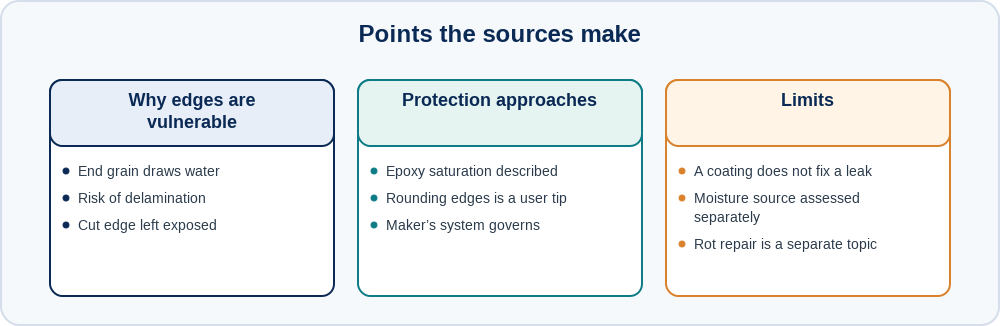
- Cut plywood edges expose end grain and water enters most easily there.
- Edge protection is usually described on dry, clean edges with the maker’s system.
- A coating does not fix a leak; the moisture source must be assessed separately.
- Tips such as rounding edges are user accounts and unverified.
- For product, coats and time the maker and a qualified yard govern.
1. Why is a plywood edge a weak point?#
Plywood is made of thin wood plies glued together; when cut, the plies’ ends are exposed at the edge. This end-grain surface absorbs water far more easily than the face; once water enters, delamination and rot risk is described. This article is a general summary; it gives no product, number of coats or time and is not application advice. Sources are magazine, maker and forum accounts and may differ; user accounts are labelled.
2. Edge protection approaches#
Sources describe not leaving edges exposed but coating them with a protective system on a dry, clean surface. Epoxy saturation is a frequently described approach because liquid epoxy can penetrate end grain and harden the edge. However, product, mix and order depend on the maker; this article gives no method or ratio. Maker systems may describe separate primers for edges; compatibility should be confirmed from the data sheet.
| Topic | General account | Caution |
|---|---|---|
| End grain | Water enters most easily here | Not left exposed |
| Epoxy saturation | Frequently described | Product and method per maker |
| Rounding | User tip | Unverified |
3. Limits and differences#
Edge coating does not fix a leak; sources describe finding and repairing the moisture source (fastener, seam, deck leak) separately. Sealing wet wood is said to be able to hide the problem and rot repair is a separate topic. Forum users relay different habits: one writes rounding the edges and applying several coats, another using only the maker’s system. These are user accounts, not independently verified, and vary with product.
Seller or maker accounts may describe good results for their own products; they are not independent tests. So for your own plywood part consult the maker and a qualified yard.
In edge protection the wood’s own moisture state is described as an important precondition: sources say that applying a coating over a damp edge may trap moisture inside, hiding the problem and letting rot progress over time. The edge’s existing condition, that is discolouration, softening, opening between plies or signs of mould, should therefore be observed carefully before any work. This observation is not a diagnosis; if in doubt a qualified specialist should be consulted.
The part’s position on the boat also shapes the accounts. A plywood part at a deck edge, around a hatch, at the bottom of a cabin locker or near the bilge meets different moisture and cleaning conditions. Sources therefore describe thinking about the part’s role, accessibility and water contact rather than one uniform approach. On a structural part, for example a bulkhead or a load-bearing panel, any decision to intervene should be left to a qualified specialist.
Among user accounts there is a common tendency that edge protection should not be done once and forgotten but reviewed at intervals; yet there is no firm shared view on interval or method. This article too gives no time or number of coats. What matters is investigating the cause when cracking, peeling or blistering appears in the coating and keeping records.
Finally, compatibility of edge products with other coatings matters. A paint or varnish applied over an edge system may have a different chemistry and incompatibility can cause adhesion problems. Sources describe compatibility as verifiable only from the maker’s data sheet. Recording the labels and dates of earlier and later systems therefore makes future upkeep easier.
4. A practical frame#
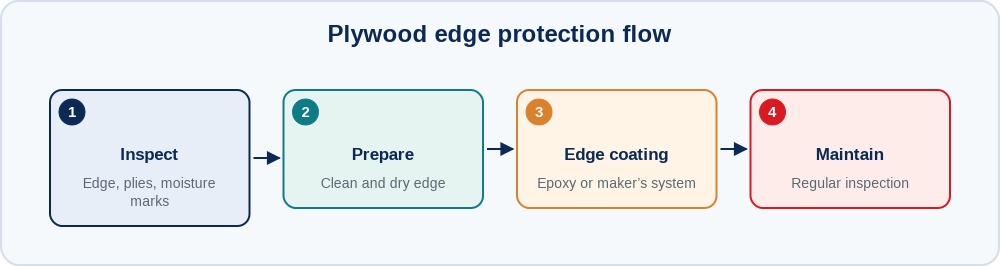
- Inspect: look at the edge, ply separation, moisture marks and old coating condition.
- Assess the moisture source (leak, fastener) separately.
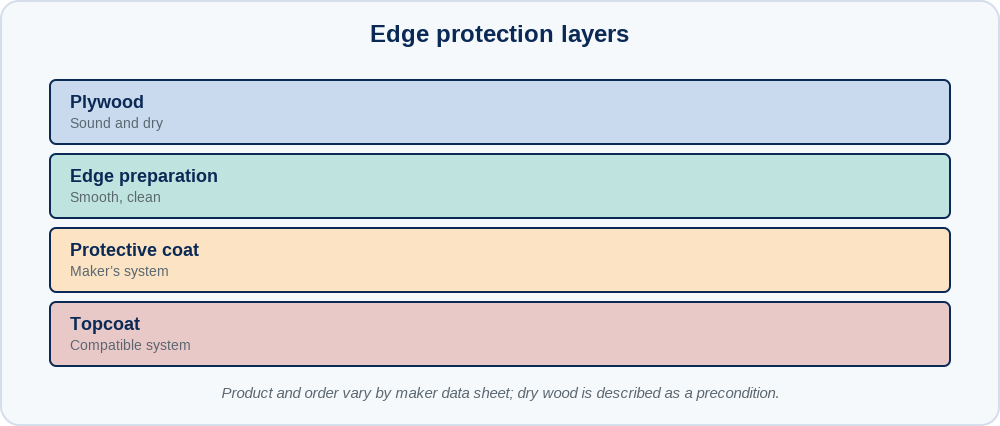
- Make the edge clean and dry; dry wood is described as a precondition.
- Apply the protective system per the maker’s data sheet.
- Confirm topcoat compatibility.
- Plan regular inspection.
- Keep records; read the safety data sheet.
5. Limits#
Sources overlap on end-grain vulnerability and the dry-wood precondition; they differ on product and method. User tips may conflict with makers. So there is no single right answer; the wood, moisture state and the maker’s instruction govern. This article is not application advice.
5b. Where sources differ#
Maker accounts describe their own systems, magazines epoxy saturation, users habits such as rounding. These are sources speaking in different contexts and with different interests. The difference means consulting the maker and a qualified yard for your own part.
This article is general information; it recommends no product, method, ratio, number of coats or time. The maker’s data sheet and a qualified yard govern.
5c. A practical frame for reading the sources#
The sources are magazines, makers, sellers and forums; each writes in its own context. None knows the plywood type, moisture state or the part’s structural role of your boat. So taking the shared message and consulting the maker and a qualified yard for detail is reasonable.
Epoxy and solvent vapours, sanding dust and reactive materials can carry health, skin-sensitisation and fire risks. This article describes no personal protection, ventilation or waste method; read the product’s safety data sheet, consult a qualified yard and follow the relevant safety rules. If structural plywood shows rot or delamination apply to a qualified specialist.
Seller and maker statements are the firm’s own account of its product and have not been independently verified. A product’s compatibility with another coating should always be checked in the product’s technical document; where a document and a guide conflict, the maker’s document and a qualified yard’s assessment should be used. Recording decisions and product details helps later maintenance.
6. Common mistakes#
- Leaving edges exposed.
- Sealing wet wood.
- Coating the edge without finding the moisture source.
- Not confirming topcoat compatibility.
- Treating a user tip as a firm rule.
- Not reading the safety data sheet.
- Keeping no records.
7. Checklist#
8. Conclusion#
For plywood boat parts sources describe the cut edge as vulnerable because of end grain, protected on dry wood with the maker’s system, with the moisture source handled separately. This article is general information; it gives no product or time and the maker and a qualified yard govern.
Frequently asked questions#
Why are plywood edges vulnerable?
Cut edges expose end grain and water enters far more easily than through the face; sources describe coating this area.
Are edges protected with epoxy?
Many sources describe epoxy saturation; product and method depend on the maker and this article is not a recommendation.
Does a coating stop a leak?
No; sources describe finding the moisture source separately, a coating only possibly slowing new entry.
Can I coat wet plywood?
Sources describe dry wood as a precondition; sealing wet wood may hide the problem. See the product instruction.
Should edges be rounded?
That is a user tip; sharp corners are said to leave thin coating. Not independently verified.
Was this guide helpful?
Thank you! Your feedback has been saved.
Guide content is for general information; in practice, the current technical data sheet of the product applies.
Keep reading
Related guides
Boat Colour Selection and Solar Reflectance: Effect of Heat Absorption on Surfaces
A study of the effect of boat paint colour on solar reflectance and surface temperature.
2 min read Paint and CoatingsCauses and Diagnosis of Paint Blistering
A study of the sources, types and diagnostic approach to blistering on boat paints.
2 min read Paint and CoatingsNumber of Coats in Epoxy Coating Systems
A study of the effect of the number of coats in epoxy coating systems on protective performance and thickness.
2 min read