
Paint and Coatings
Boat Furniture and Cabin Interior Wood Polish Care
Cabin interior wood and furniture face far less UV and weather than exterior brightwork; but moisture, mould and grime are issues. This article summarises cleaning and polish accounts with their limits; it is not a product, method or time recommendation.
Short answer
A test publication says that typically only the most expensive boats have varnished interior teak, usually in satin for a hand-rubbed effect, and that such a finish should last for years if not abused or allowed to get wet; it also writes that wax complicates future varnishing. An insurer’s guide writes that most teak dies an early death not from neglect but from improper cleaning by well-meaning owners, harsh chemicals and overaggressive methods being able to damage it. A boating magazine says some teak oils may promote mildew. User accounts relay habits such as lemon oil and teak oil. This article recommends no product; the maker governs.
Key points
- Interior teak is typically varnished only on the most expensive boats, usually in satin for a hand-rubbed effect (test publication).
- Wax complicates later varnishing; all traces must be sanded or washed off.
- Most teak suffers early from improper cleaning rather than neglect; harsh chemicals and aggressive methods can damage it (insurer guide).
- Some teak oils may promote mildew; care is needed in damp surroundings (magazine).
- User habits (lemon oil, vinegar, teak oil) are unverified; the maker and a qualified yard govern.
1. Why is interior wood different?#
Cabin interior wood and furniture meet far less UV, rain and salt than exterior brightwork; but moisture, mould, galley and hand grime and old finish residues can be issues. A test publication writes that builders use teak for interior decor for its simplicity of finishing, the economy of one wood in inventory and acceptance by buyers. This article is a general summary; it gives no product, number of coats or time and is not application advice. Sources are test publication, insurer, magazine, blog and forum accounts and may differ; blog and user accounts are labelled.
2. Cleaning#
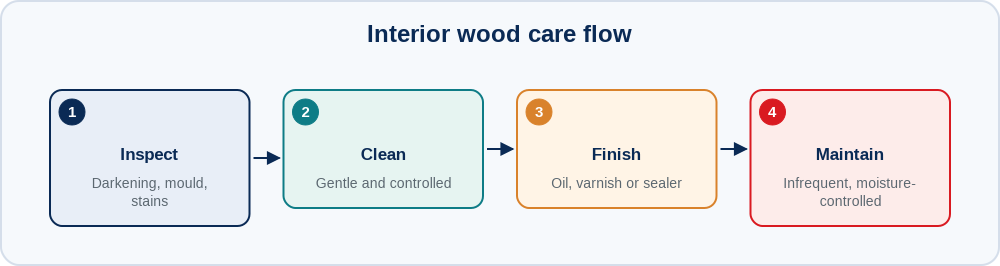
An insurer’s guide writes that whichever maintenance philosophy you choose, at some point a reason will arise to give teak a thorough cleaning, whether spring commissioning, selling or readying for oiling or varnishing; ironically cleaning is when teak is most likely to sustain damage from harsh chemicals and overaggressive or incorrect methods, and most teak dies early not from neglect but from improper cleaning by well-meaning owners. That is a guide account; the maker determines method and product.
A blogger renovating a boat’s interior writes of teak darkened by years of oil and in places black with mould being redone with a sponsoring maker’s cleaner and finish; that the first coat of finish should go on within 24 hours of cleaning, not cleaning more than can be finished the next day, because the wood’s natural oils can rise to the surface and let mould start again; and that if the teak has a finish other than oil it must be removed before cleaning. That is a blog account with product sponsorship and specific to that maker’s instruction; it cannot be generalised.
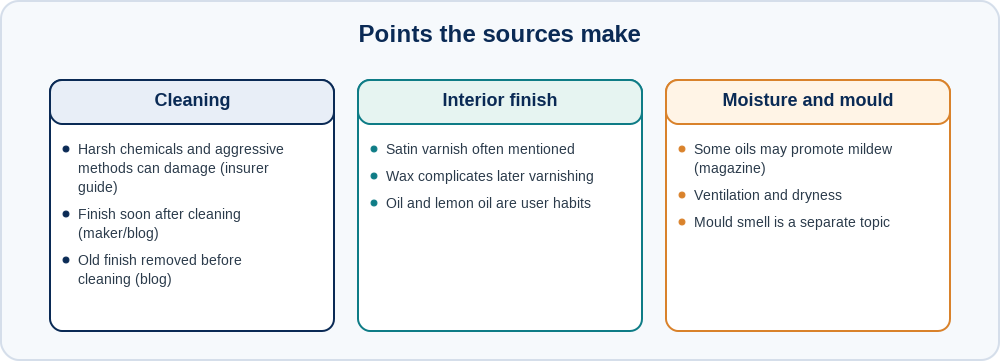
| Topic | General account | Caution |
|---|---|---|
| Cleaning | Harsh chemicals and aggressive methods can damage | Product and method per maker |
| Interior finish | Satin varnish often mentioned; wax complicates later varnish | Depends on wood and existing finish |
| Moisture and mould | Some oils may promote mildew | Ventilation |
3. Finish: oil, varnish and habits#
The same test publication describes interior teak as varnished only on the most expensive boats, usually in satin for a hand-rubbed effect, such a finish being expected to last years if not abused or allowed to get wet; it adds that aesthetically a varnished interior has much to recommend it. It writes that builder quality varies, some leaving teak rough and bare, others rough and oiled and still others sanding it smooth and oiling carefully, and says preparation is more than half the work of an oiled finish. That is a publication account and generalises.
The same publication says wax complicates future varnishing since all traces must be sanded or washed off in preparation, and that with a thick enough varnish finish only a damp cloth should be needed for routine care. A boating magazine writes some teak oils will promote mildew growth, probably not wanted if the boat sits a long time without regular maintenance. A blogger says that because the interior gets far less UV the finish only needs treating every few years when it shows haze, with no sanding or deep cleaning beforehand, just washing with soap and water; that is a blog and maker-product account.
User habits vary: a reader writes he wipes the interior teak with pure lemon oil twice a year; a forum user says lemon oil looks beautiful but lasts only a few months; another reports wiping with white vinegar then applying two coats of teak oil each spring for thirty years, wiping off the excess, and that it lasts a season. These are user accounts, not independently verified, and vary with product, wood and conditions.
4. A practical frame#
- Inspect: look at darkening, mould, stains, old wax or oil build-up and moisture marks.
- Establish the existing finish; varnish, wax or oil affects preparation.
- Clean gently and in a controlled way; remember harsh chemicals and aggressive methods can damage.
- Apply the finish within the window in the maker’s instruction, soon after cleaning.
- If there is a mould or moisture problem assess the source and ventilation.
- Plan infrequent, gentle upkeep; consider wax’s effect on later varnish first.
- Keep records; read the safety data sheet.
5. Limits#
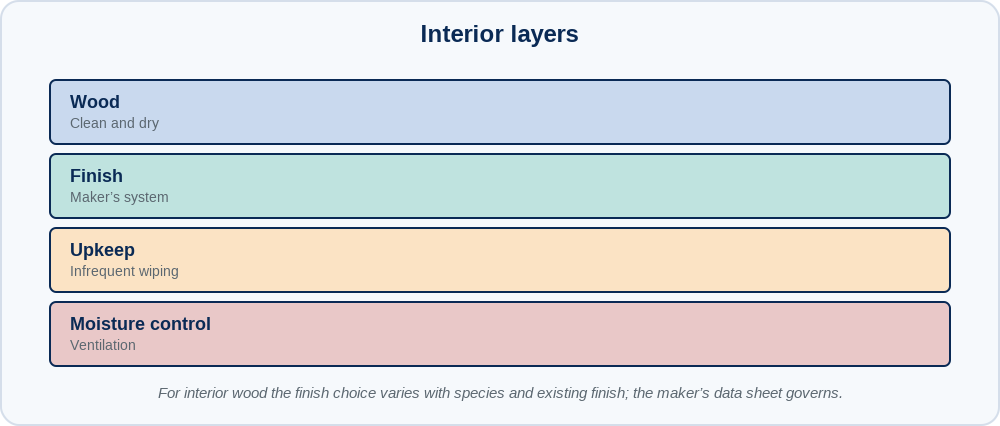
Sources overlap that gentle cleaning and moisture control matter for interior wood; they differ on finish choice and upkeep frequency. A test publication describes satin varnish, a magazine suggests avoiding some oils because of mould, users describe lemon oil and teak oil. So there is no single right answer; the wood, existing finish, moisture conditions and the maker’s instruction govern. This article is not application advice.
5b. Where sources differ#
The test publication describes satin varnish and wax complicating varnish; a magazine says some oils may promote mildew; a blog describes finishing within 24 hours of cleaning with a maker product; users relay different habits such as lemon oil, vinegar and teak oil. These are sources speaking in different contexts and with different interests. The difference means consulting the maker and a qualified yard for your own wood.
This article is general information; it recommends no product, method, ratio, number of coats or time. The maker’s data sheet and a qualified yard govern.
5c. A practical frame for reading the sources#
The sources are magazines, makers, sellers and forums; each writes in its own context. None knows the wood species, existing finish or moisture conditions in the cabin of your boat. So taking the shared message and consulting the maker and a qualified yard for detail is reasonable.
Cleaning chemicals, solvents and finish vapours can carry health and fire risks; oil- and varnish-soaked rags can self-heat; ventilation matters especially in a tight interior. This article describes no personal protection, ventilation or waste method; read the product’s safety data sheet, consult a qualified yard and follow the relevant safety rules. If mould is heavy and there is a health concern apply to a qualified specialist.
Seller and maker statements are the firm’s own account of its product and have not been independently verified. A product’s compatibility with another coating should always be checked in the product’s technical document; where a document and a guide conflict, the maker’s document and a qualified yard’s assessment should be used. Recording decisions and product details helps later maintenance.
6. Common mistakes#
- Cleaning with harsh chemicals and aggressive methods.
- Varnishing without knowing the existing finish.
- Using wax without considering later varnish.
- Choosing mildew-promoting products in a damp, unventilated cabin.
- Treating a user habit as a firm rule.
- Not reading the safety data sheet.
- Keeping no records.
7. Checklist#
8. Conclusion#
For cabin interior wood and furniture polish sources stress gentle cleaning, moisture control and care in finish choice; they differ among satin varnish, oil, wax and user habits. This article is general information; it gives no product or time and the maker and a qualified yard govern.
Frequently asked questions#
Is interior teak varnished?
A test publication says typically only the most expensive boats have varnished interior teak, usually in satin; other boats may be left bare or oiled.
Is wax used?
The same publication writes wax complicates future varnishing, all traces needing to be sanded or washed off.
What should I watch when cleaning?
An insurer guide writes most teak is damaged early by improper cleaning; harsh chemicals and aggressive methods can damage it.
Does teak oil cause mould?
A boating magazine writes some teak oils may promote mildew and may be unsuitable where the boat sits long without regular upkeep.
Do lemon oil or vinegar work?
These are user habits; one user writes lemon oil looks beautiful but lasts a few months, another wipes with vinegar then applies teak oil each spring. Not independently verified.
Was this guide helpful?
Thank you! Your feedback has been saved.
Guide content is for general information; in practice, the current technical data sheet of the product applies.
Keep reading
Related guides
Boat Colour Selection and Solar Reflectance: Effect of Heat Absorption on Surfaces
A study of the effect of boat paint colour on solar reflectance and surface temperature.
2 min read Paint and CoatingsCauses and Diagnosis of Paint Blistering
A study of the sources, types and diagnostic approach to blistering on boat paints.
2 min read Paint and CoatingsNumber of Coats in Epoxy Coating Systems
A study of the effect of the number of coats in epoxy coating systems on protective performance and thickness.
2 min read