
Paint and Coatings
Post-Impact Hull Repair Checklist
After an impact the sources describe crew safety and watertight integrity first, then documentation and inspection of the hull, keel and connections. This article summarises the accounts with their limits; it is not insurance, survey or repair advice.
Short answer
A boating magazine says that after even a minor collision the watertight integrity of the vessel and the crew should be checked first; an insurance organisation describes documenting damage, taking the other party’s details if another vessel was struck and involving the insurer early. A coastal publication says after a grounding the structure that spreads keel loads through the hull should be checked. A boat-maintenance writer says damage can go deeper than the surface and the hull, through-hulls and propshaft should be examined. This article offers a framework only; a qualified specialist and the insurer govern.
Key points
- After an impact the crew and watertight integrity are checked first (magazine).
- Damage is documented and the insurer is informed early (insurance organisation).
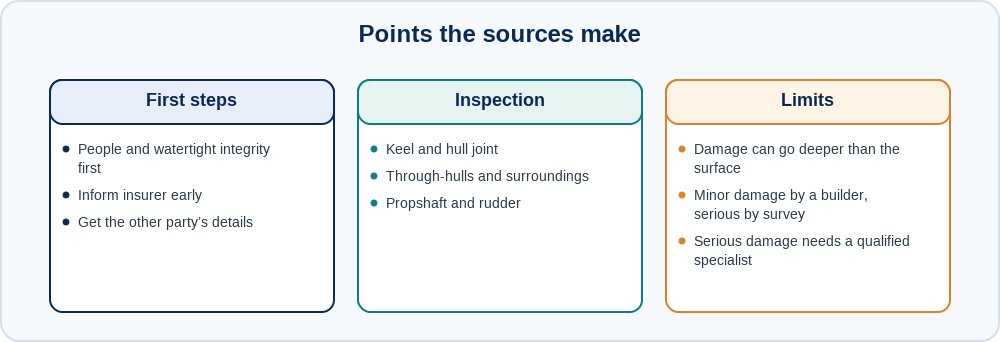
- The keel, hull joint, through-hulls and propshaft are among the areas inspected.
- Damage can go deeper than the surface; minor damage can be assessed by a builder, serious damage by survey.
- For repair and insurance decisions a qualified specialist governs.
1. Why does order matter after an impact?#
What to do in the first moments after a collision, grounding or strike on a submerged object is a different matter from later repair decisions. A boating magazine lists causes of damage on the water and ashore, such as striking a submerged object, running aground and colliding with another vessel. This article is a general summary; it gives no insurance, survey, repair method or time and is not advice. Sources are magazine, organisation, insurance organisation and repair-shop accounts and may differ; maker and seller statements are labelled.
2. First steps and documentation#
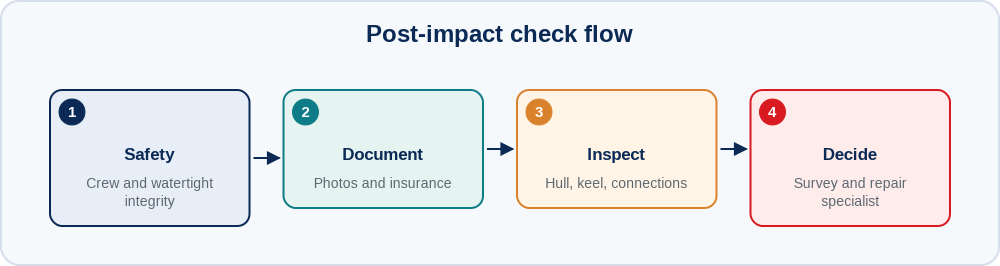
A boating magazine writes that after a minor collision the general rule of checking the vessel’s watertight integrity and that there are no injuries among the crew still holds even if damage looks superficial; after a serious collision it may be possible to stay afloat by staying on the tack that lifts the hole above the waterline. An insurance organisation says to document the damage, take the other vessel’s and party’s details if another vessel was struck, and include the insurer early when approaching a professional repair company or marina.
| Topic | Sources’ general account | Caution |
|---|---|---|
| Safety | Crew and watertight integrity | People first |
| Documentation | Photos, notes, insurer | Policy terms |
| Inspection | Keel, hull, connections | Damage can be deep |
3. Inspection points and limits#
A boating magazine says that in a grounding it is important to check the structure designed to spread keel loads through the hull and that a collision with an underwater object should be treated much the same; relatively minor damage can generally be repaired by a boat builder without a survey while more serious problems call for one. A Canadian boating publication says that when examining the hull out of the water the keel and the joint where the keel meets the hull should be checked and that damage near or on a through-hull could let water in.
A boat-maintenance writer says damage can go deeper than the surface and the hull, through-hulls and their bedding, anodes and the propshaft should be examined; that is the view of a maintenance-firm owner and may not hold for every boat. A British boating magazine writes of an impact where the hull appeared to pop back into shape but the main bulkhead was badly damaged, the true extent appearing only inside.
In a British magazine a surveyor writes that the point at which a damaged boat becomes a write-off depends largely on the boat’s value and estimated repair cost; that is an expert view and does not hold for every case. A boat-repair writer says trust issues can arise with repaired damaged boats in sales and that a pre-purchase survey uses non-destructive tests and visual inspection.
An epoxy maker describes a serious structural impact that cracked the outer hull and delaminated the inner fibreglass, preferring a two-sided repair and using several layers of fabric to match hull thickness; that is a maker and applicator account, specific to its own system.
A boat-maintenance article says a repair is ninety percent diagnosis and that assessing damage correctly makes the difference between a lasting repair and a temporary patch; that is an author’s view. The hull should be cleaned thoroughly first so that damage can be seen.
On user forums people report leaks or connection problems that appeared sometimes weeks after an impact; these are experiences not independently verified. Sources suggest monitoring for a while after an impact because symptoms can emerge over time; this article gives no period.
Shared points: safety and watertight integrity first, then documentation and inspection, and a qualified specialist for serious damage. The difference lies in the point at which damage needs survey, the write-off decision and the repair method; this article decides none of these.
On insurance, policy terms vary between companies; this article gives no information on cover or notification periods and the insurer should be consulted.
Keeping records matters too: date, place and conditions of the event, photos, checks made and people spoken to can help in both the insurance and repair stages.
4. A practical frame#
- Check crew safety and watertight integrity first; in an emergency contact the competent authorities.
- Document the damage with photos and notes; consult the insurer early.
- Inspect the keel, hull joint, through-hulls, propshaft and rudder with a qualified craftsman.
- For serious damage apply to a surveyor and repair specialist.
- Decide the repair plan (layers, resin, paint) with the specialist per the maker’s instruction.
- Separate maker, seller and user accounts.
- Keep records.
5. Limits#
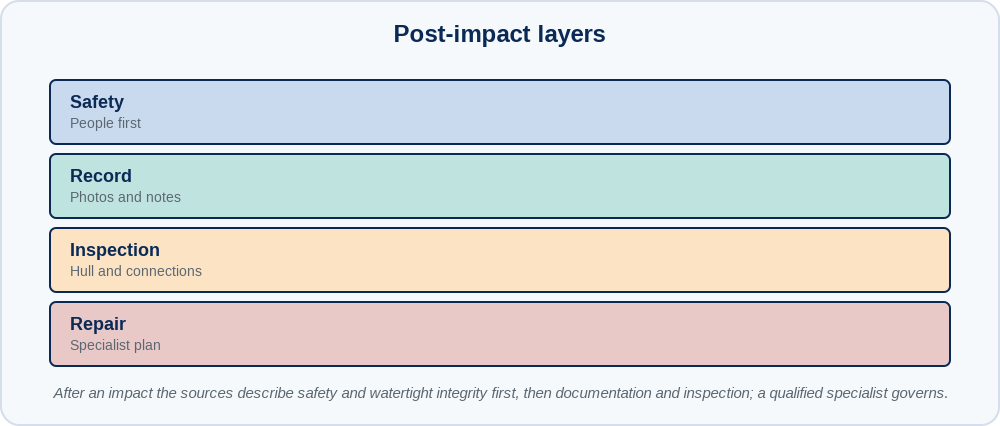
Sources overlap on safety and watertight integrity first, then documentation and inspection, and a specialist for serious damage; they differ on the point at which damage needs survey, the write-off decision and the repair method. Maker and user accounts are specific to their contexts. So there is no single right answer; a qualified specialist and the insurance terms govern. This article is not legal, insurance or engineering advice.
5b. Where sources differ#
The magazine describes watertight integrity first; the insurance organisation describes documentation and early notice; the maintenance firm lists keel, through-hulls and propshaft; the surveyor describes the write-off criterion; the maker describes two-sided repair. These are sources speaking in different contexts and with different interests. The difference means consulting a qualified specialist and the insurer for your own situation.
This article is general information; it recommends no product, method, ratio, number of coats or time. The maker’s data sheet and a qualified yard govern.
5c. A practical frame for reading the sources#
The sources are magazines, makers, sellers and forums; each writes in its own context. None knows the depth of damage, insurance terms or repair method of your boat. So taking the shared message and consulting the maker and a qualified yard for detail is reasonable.
A damaged boat can carry risks of flooding, structural weakness and injury; repair materials and sanding can carry skin and respiratory irritation risk. This article describes no emergency or personal protection method; in an emergency contact the competent authorities, read the product’s safety data sheet and consult a qualified specialist. For safety-critical matters such as hull integrity apply to a qualified specialist.
Seller and maker statements are the firm’s own account of its product and have not been independently verified. A product’s compatibility with another coating should always be checked in the product’s technical document; where a document and a guide conflict, the maker’s document and a qualified yard’s assessment should be used. Recording decisions and product details helps later maintenance.
6. Common mistakes#
- Not checking safety and watertight integrity first.
- Not documenting the damage.
- Informing the insurer late.
- Looking only at the surface and missing deep damage.
- Not inspecting the keel and connections.
- Not consulting a specialist on serious damage.
- Keeping no records.
7. Checklist#
8. Conclusion#
After an impact the sources describe safety and watertight integrity first, then documentation and inspection. This article is general information; it is not insurance, survey or repair advice and a qualified specialist governs.
Frequently asked questions#
What is done first after an impact?
A magazine describes checking the crew and the watertight integrity of the hull first.
When should the insurer be told?
An insurance organisation describes involving the insurer early in the repair process; consult the insurer on policy terms.
Which areas are checked?
Sources describe the keel and hull joint, through-hulls and surroundings, propshaft and rudder.
How do I tell whether damage is superficial or deep?
Sources say damage can go deeper than the surface; this article gives no diagnostic method and a qualified specialist should be consulted.
Should I repair it myself?
Hull repair is safety-related; for serious damage apply to a qualified specialist.
Was this guide helpful?
Thank you! Your feedback has been saved.
Guide content is for general information; in practice, the current technical data sheet of the product applies.
Keep reading
Related guides
Boat Colour Selection and Solar Reflectance: Effect of Heat Absorption on Surfaces
A study of the effect of boat paint colour on solar reflectance and surface temperature.
2 min read Paint and CoatingsCauses and Diagnosis of Paint Blistering
A study of the sources, types and diagnostic approach to blistering on boat paints.
2 min read Paint and CoatingsNumber of Coats in Epoxy Coating Systems
A study of the effect of the number of coats in epoxy coating systems on protective performance and thickness.
2 min read