
Underwater
Propeller, Shaft and Drive Paint: Antifouling, Foul-Release and Primer Choice
The propeller and shaft are the fastest-moving and, for paint, the hardest surfaces of the boat. Even so, a little fouling affects speed and fuel. This guide explains the approaches to painting the propeller and drive and what to watch.
Short answer
For propeller, shaft and drive paint there are three approaches: biocidal antifouling, foul-release (slick, biocide-free) coating and leaving it unpainted and cleaning often. You can paint a bronze propeller with conventional copper-based bottom paint, but according to a test publication it does little good because the more noble metals in the bronze eventually waste away the copper biocide. An aluminium drive needs an antifouling specially formulated for aluminium; copper paint is considered risky. Anodes are not painted. Preparation, primer and the manufacturer’s times are decisive. This article is a general guide; the product maker’s and drive maker’s advice comes first.
Key points
- For propeller paint there are three approaches: biocidal antifouling, foul-release and unpainted cleaning.
- On a bronze propeller conventional copper paint may do little good; the noble metals in bronze use up the copper biocide.
- An aluminium drive needs an antifouling specially for aluminium; copper paint is considered risky.
- Anodes are not painted; if painted their effectiveness drops seriously.
- Preparation (cleaning, abrading), primer and manufacturer times decide success; over-abrading can upset balance.
1. Why is the propeller a difficult surface?#
The propeller, shaft and drive are the fastest-moving parts of the boat, those that meet the most turbulence and are surrounded by the greatest variety of metals. For paint this means two difficulties: high speed and turbulence wear the paint away and getting paint to adhere to metals such as bronze, stainless or aluminium is harder than on the hull. One expert says propeller speed creates considerable erosion in the water and therefore calls for specific antifouling paints.
Even so a clean propeller matters. A marine retailer says even moderate fouling on a propeller can reduce top-end speed, increase fuel burn and create additional strain on engines and driveline. A magazine says barnacles are not just unsightly but affect propeller performance. This guide explains in general terms the approaches to painting the propeller, shaft and drive and what to watch; the product maker’s and drive maker’s advice always comes first.
2. Three approaches: biocide, foul-release, cleaning#
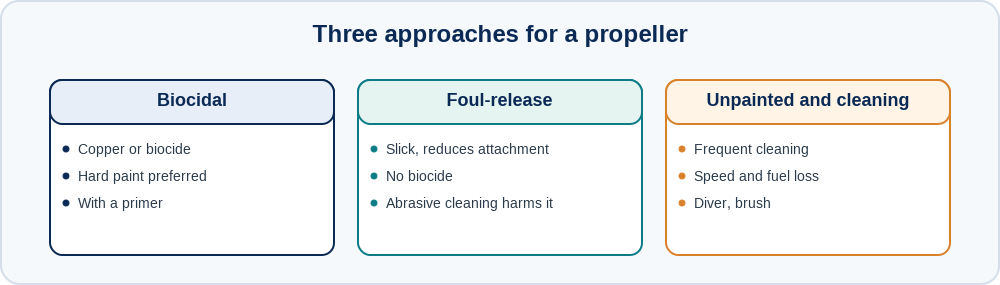
There are three general approaches for the propeller and drive. The first is to use a biocidal (mostly copper-based) antifouling. The second is to apply a slick, biocide-free foul-release coating. The third is to leave it unpainted and clean often, that is to remove fouling regularly by diver or brush. A marine retailer explains the difference: antifouling paint uses biocides or copper to discourage marine growth; a foul-release coating creates a slick, non-stick surface that prevents strong adhesion.
One foul-release coating is presented by a maker as not harming marine life because it is not a biocide, an ultra-slick surface that growth cannot grip. The same maker states that water-blasting, scraping and other abrasive cleaning will damage the top coat. These maker claims concern their own product; compare them with independent tests as well. A marine retailer notes that such a coating does not replace sacrificial anodes or eliminate galvanic corrosion risk entirely.
| Approach | Strength | Watch for |
|---|---|---|
| Biocidal antifouling | Familiar; discourages growth | Propeller speed wears paint; copper used up on bronze; risk on aluminium |
| Foul-release | No biocide; slick surface | Abrasive cleaning harms it; does not replace anodes |
| Unpainted + frequent cleaning | No paint problem | Regular cleaning; risk of speed and fuel loss |
3. Bronze propeller: does copper paint work?#
A test publication says you can paint a bronze propeller with conventional copper-based hull paint but it will not do much good, since the more noble metals in the bronze will eventually waste away the copper biocide. A sailing-magazine expert likewise writes that you can paint a bronze prop but, if there is an aluminium saildrive leg, not with paint that contains copper. A copper-free coating can also be applied to the propeller provided the bronze is first primed with an epoxy-based barrier coat.
By contrast a user on a technical forum describes painting his bronze props with copper antifouling, two coats each time, for more than forty years with no bad results. This is one person’s experience and cannot be generalised to every condition; but it shows propeller paint can give different results with the mooring environment, boat use and paint system. What matters is to follow your own system manufacturer’s advice.
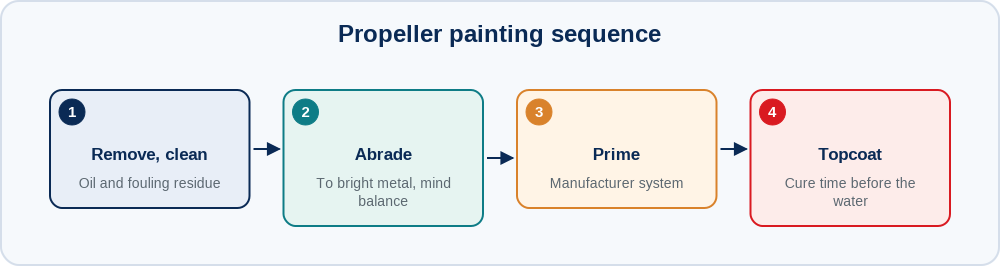
A paint maker’s guide says that the preparation of the bronze surface is essential: it should be meticulously cleaned and abraded to bright metal before priming and applying the antifouling. The same guide adds that because of the severe turbulence and adhesion problems relating to bronze it does not recommend any specific primer at this time; so even makers are cautious on this. Another source describes roughening a propeller with 60-grit sandpaper to give a key. But according to the same maker’s warning great care must be taken when abrading any propeller type, as excessive abrading can alter the profile and cause it to go out of balance.
4. Aluminium drive and saildrive#
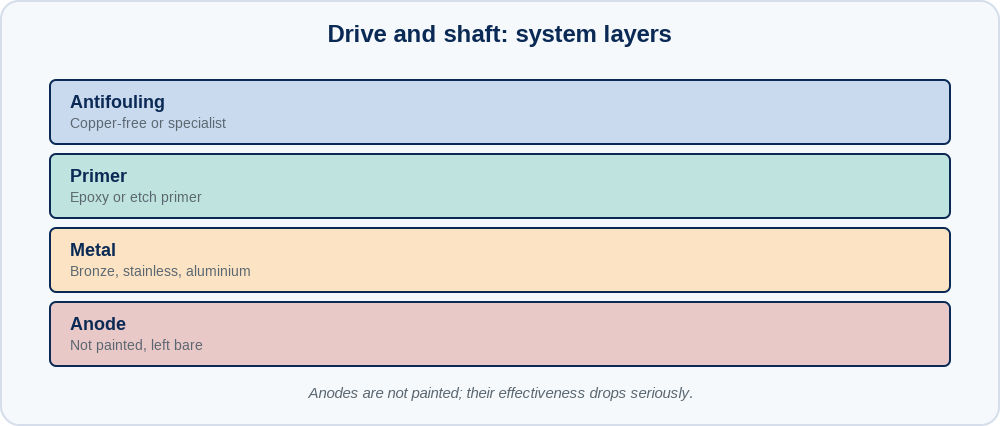
An aluminium drive or saildrive leg is among the most sensitive surfaces for paint. According to a paint maker’s guide aluminium must be coated with an antifouling specially formulated for such surfaces; on other surfaces generally any antifouling, copper-based or copper-free, can be used. The same guide advises applying, with the exception of bronze propellers, either a single or two-pack epoxy primer.
A sailing expert calls painting a barrier-coated drive leg with copper paint high-risk behaviour. As explained in our earlier article, on aluminium the integrity of the epoxy barrier coat plays a critical role in preventing localised galvanic corrosion between paint and metal. For an aluminium drive therefore verify product and primer choice with the drive maker’s written advice.
5. Primer and the “tie coat”#
A sailing magazine suggests, as an approach for propeller and shaft, applying an epoxy primer that acts as a “tie coat” between the bare metal and the antifouling. The same publication advises that for the chemical bond the primer and antifouling should be compatible (ideally from the same manufacturer) and that the paint should be hard rather than ablative so that it will not wash off in the turbulence around a propeller and shaft. It also stresses that primer and antifouling application must follow established time windows for the all-important chemical bond to form.
A test publication reports that for one propeller paint one coat of primer and two or three coats of the active topcoat are suggested, for another product two thin primer coats and one topcoat; both require at least twelve hours to dry before submerging. This illustrates times that vary by product; the times in your own product’s data sheet are decisive.
- Confirm the manufacturer’s system: get a written recommendation for the propeller material, drive metal and chosen product.
- Remove the propeller and shaft or make them accessible; remove oil, fouling and old paint residue.
- Degrease; abrade moderately, on bronze to bright metal, without upsetting profile and balance.
- Apply the recommended primer, keeping to the manufacturer’s time windows.
- Apply the topcoat or antifouling at the data-sheet thickness and recoat interval.
- Wait the cure time; do not paint the anodes; record conditions and products before launch.
6. Anodes: not painted#
Zinc anodes around the shaft are often close by and can easily get painted. A paint maker’s guide says care should be taken not to paint zinc anodes, which are often located next to the prop shafts, as this will seriously reduce their effectiveness. As explained in our earlier articles, a painted anode loses its galvanic protection. When painting the propeller and shaft therefore mask or remove the anodes and verify when finished that they are bare.
7. Common mistakes#
- Painting the anodes.
- Applying copper paint to a bronze propeller without primer or with the wrong system.
- Using an antifouling not specific to aluminium on an aluminium drive.
- Over-abrading and upsetting propeller balance.
- Cleaning a foul-release coating with a stiff brush, pressure water or scraping.
- Missing the manufacturer’s time windows for primer and antifouling.
8. A short case: the same propeller, two approaches#
On two boats the bronze propeller is covered with barnacles every season. The first owner applies the same copper hull paint to the propeller every year; by season end the propeller is covered again. The second owner gets a written system recommendation for propeller and drive from the manufacturer, cleans the propeller carefully and abrades it moderately, applies the recommended primer and topcoat within the time windows and leaves the anodes bare. The outcome is still not guaranteed; but the chance of success rises with the system built correctly.
This is not an experiment but an example of the importance of preparation and system choice. Real results vary with product, use and mooring environment.
9. Checklist#
10. Conclusion#
Painting the propeller, shaft and drive is harder than painting the hull: high speed, turbulence and different metals test the system. Weigh the three approaches (biocidal antifouling, foul-release, unpainted cleaning) against your own use, do preparation and primer carefully, choose an aluminium-suitable product on an aluminium drive and do not paint the anodes. This guide is a general framework; the product maker’s and drive maker’s written advice always comes first.
Frequently asked questions#
Can I paint the propeller with ordinary bottom paint?
You can paint a bronze propeller with copper bottom paint, but according to a test publication it does little good because the more noble metals in the bronze use up the copper biocide. Dedicated propeller paints and primer systems are preferred.
Is copper paint used on an aluminium drive?
Aluminium must be coated with an antifouling specially formulated for such surfaces. One expert calls painting a barrier-coated drive leg with copper paint high-risk behaviour. Manufacturer approval is decisive.
What is foul-release?
A coating type that forms a slick, biocide-free surface and reduces attachment of organisms; it differs from antifouling paint. Abrasive cleaning (water-blasting, scraping) can damage the top coat.
Can I paint the anodes?
No. Painting zinc anodes beside the shaft seriously reduces their effectiveness.
What should I watch when abrading a propeller?
Excessive abrading can alter the propeller’s profile and upset its balance. Bronze must be meticulously cleaned and abraded to bright metal; but it should be done moderately.
Was this guide helpful?
Thank you! Your feedback has been saved.
Guide content is for general information; in practice, the current technical data sheet of the product applies.
Keep reading
Related guides
Protective Systems for Propeller and Rudder Areas
A study of the protective systems used in moving, high-friction areas such as propellers and rudders, and their selection criteria.
2 min read UnderwaterChoosing Antifouling: A Decision Based on Usage Profile
A decision-focused study explaining how the type of antifouling should be chosen according to the frequency of use and water conditions.
2 min read UnderwaterManaging the Waterline Zone with a Paint System
A study of the special conditions around the waterline of a boat and how this zone is managed with a paint system.
2 min read