
Decision Guide
Yacht Paint Safety: Isocyanate, Solvent Vapour, Ventilation and Waste Paint
Yacht paint safety is often the last thing considered; yet solvent vapour, isocyanate in polyurethane and flammable mixtures carry serious health and fire risks. This guide outlines the risks and basic precautions in general terms.
Short answer
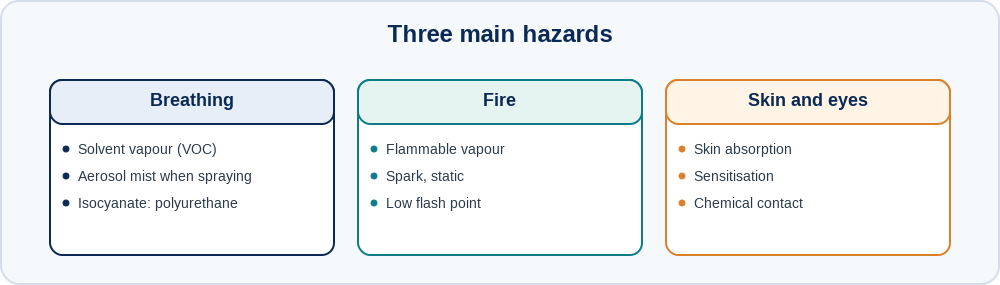
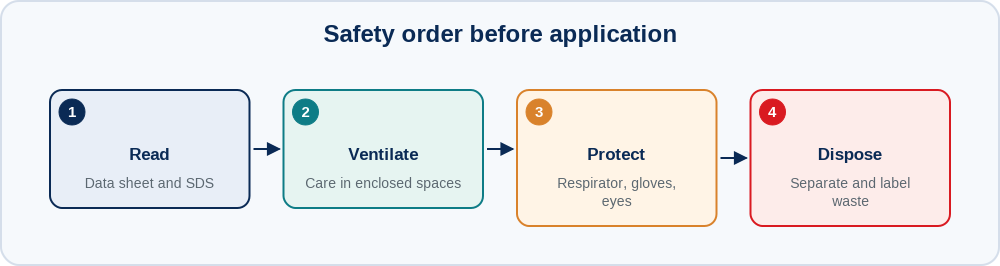
When applying yacht paint there are three main risks: breathing (solvent vapour and spray mist; isocyanate in polyurethane), fire and explosion (flammable vapour, sparks and static) and skin and eye contact. According to sources spray painting carries a higher exposure risk than brush or roller; when spraying polyurethane the main hazard is breathing the droplet mist containing isocyanate. The order of precaution is to read the product’s safety data sheet (SDS), ventilate (especially in enclosed spaces), use suitable respiratory and skin protection and segregate and label waste. This article is general information; your occupational safety regulations and the product SDS come first.
Key points
- There are three main risks: breathing, fire/explosion and skin-eye contact.
- Spray painting carries a higher exposure risk than brush or roller.
- Breathing the droplet mist containing isocyanate is the main hazard in polyurethane.
- In enclosed spaces vapours accumulate in low areas, displace air and lower oxygen.
- Waste paint, brushes and wipes must be segregated and labelled and disposed of as hazardous waste.
1. Why is safety a separate subject?#
Yacht paint is usually treated as a matter of appearance and protection. Yet the same products contain solvents, pigments, resins and additives that can cause serious harm when inhaled, when they touch the skin or when they catch fire. A workplace-safety source explains that these substances can cause health effects with prolonged or repeated exposure and that skin or airways can become sensitised to a substance; the way to prevent sensitisation is to avoid contact in the first place.
This guide is a general framework. The sources used are mostly American shipyard and occupational-health guidance, a UK offshore-sector information sheet, a protective-equipment maker’s technical bulletin and a paint maker’s safety notes. These guides are for shipyard and industrial settings; they are not directly a legal requirement for a yacht workshop or marina. Your country’s regulations, the product’s safety data sheet (SDS) and, if needed, an occupational-safety specialist always come first. The text is not legal or medical advice.
2. Breathing risk: vapour, mist and isocyanate#
A protective-equipment maker’s bulletin says the type of paint and application method determine the operator’s exposure risk to respiratory hazards, and that both water-based and solvent-based paints include some exposure to gases and vapours (VOCs) regardless of application method. Another source says that in spray painting workers are at greater risk of exposure to hazardous substances than when painting with a brush or roller because paint particles are released into the air.
Isocyanates are a class of compounds found in certain solvent-based paints; they react with other chemicals containing alcohol groups to produce polyurethane polymers. The bulletin says isocyanates (including diisocyanates) are the raw materials of all polyurethane products, including polyurethane paints. When spraying polyurethane the main hazard is breathing the aerosol droplets (mist). A paint maker’s safety note explains that the liquid paint coming out of a spray gun is a fine mist, an aerosol, that breathing this aerosol lets the liquid isocyanate be absorbed into the lungs and that this is where health problems can start. The same note says that if there is doubt about the effectiveness of the ventilation, positive-pressure air-supplied respirators must be used.
These notes remind us that there are cases in polyurethane (PU) topcoat application where a filter mask is not enough. Which device is sufficient is determined by the product’s SDS, the application method, the environment and regulations. Make this decision with an occupational health and safety specialist.
| Method | Risk | Note |
|---|---|---|
| Brush / roller | Lower; VOC exposure remains | Good general ventilation; a mask may not be needed but varies with product |
| Spray (solvent-based) | Higher; aerosol and vapour | Suitable respiratory protection and ventilation needed |
| Spray (polyurethane) | High; droplet mist containing isocyanate | Air-supplied devices may be needed; SDS and specialist |
| Water-based | Low, but not zero | VOC exposure remains |
3. Fire and explosion risk#
Paints and solvents are flammable. An occupational-safety agency’s information sheet says a spark from electrical equipment or static discharge can be enough to ignite volatile vapours. The same agency asks that the SDS of all paints and coatings be read to determine flash points and whether other volatile, toxic or flammable substances are in the mixtures. Liquids with a low flash point (below about 27 °C / 80 °F) present greater hazards and require additional controls.
The same sources advise using non-sparking paint buckets, spray guns and tools, keeping electrical connections away from painting operations (about 15 metres in this shipyard rule) and electrically grounding all metallic parts of the paint spraying equipment. A shipyard rule also says sufficient exhaust ventilation must keep solvent vapour concentration below 10 per cent of the lower explosive limit. These are shipyard standards; the logic holds even in a small workshop: keep ignition sources away, ground and ventilate.
4. Enclosed spaces: bilge, tank, cabin#
On yachts paint work is often done in enclosed or semi-enclosed spaces: bilge, fuel or water tank, cabin and engine room. A shipyard-safety source says vapours can accumulate in low-lying areas and enclosed spaces, displacing air and lowering the oxygen content. The same source says ventilation must continue after painting is complete until the space is “gas-free”. It is also a shipyard rule that solvent drums taken into the compartment where painting is done be placed on nonferrous surfaces and grounded to the vessel.
The practical consequence: before painting in an enclosed space write the ventilation plan, arrange for a second person to wait outside, stop hot work (welding, grinding) and sources of sparks in nearby spaces and keep ventilating after painting. This is especially important in single-person workshop conditions.
5. Skin and eye contact#
Paints and solvents can also be absorbed through the skin. A shipyard-safety source says washing facilities such as a quick-drenching shower must be available in case of skin contact with paint and solvents because these substances can be absorbed through the skin. Sensitisation is a separate risk: a person who has become sensitised can react to even a tiny exposure to the substance; the way to prevent it is to avoid contact from the start with the right protective equipment.
- Gloves: of the material stated in the product’s SDS; clean and intact for every job.
- Eye protection: goggles or a full face shield suited to splash and mist risk.
- Clothing: coveralls covering the whole body; no exposed skin.
- Washing: eyewash and clean water; paint on skin is removed with a suitable cleaner, not solvent.
- Hygiene: no eating, drinking or smoking in the painting area.
6. The hierarchy of protection: control at the source first#
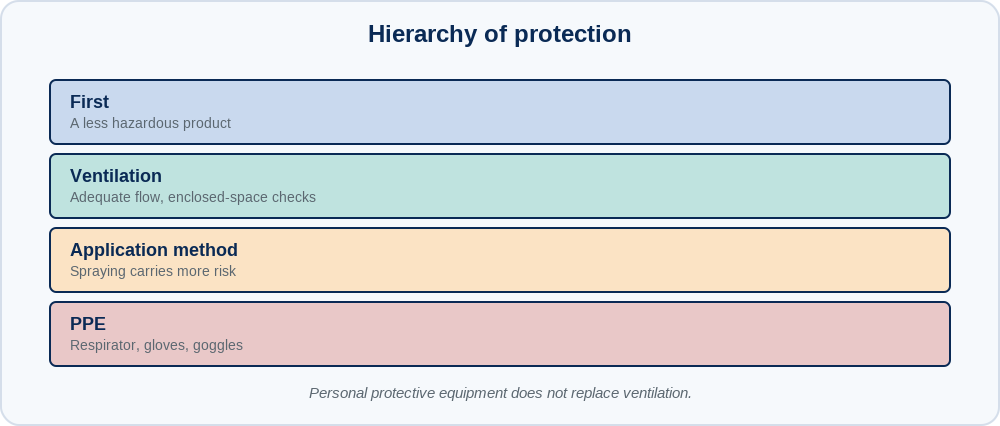
The basic principle in occupational health and safety is to reduce the risk at the source first: choose a less hazardous product, set the right application method, provide ventilation and only after that rely on personal protective equipment (PPE). PPE does not replace ventilation and correct product choice; it is only the last line of defence. Comparing SDS when choosing a product, considering low-VOC or water-based options and choosing the application method by risk are therefore as important as buying equipment.
7. Waste paint, brushes and wipes#
Waste management is part of safety. An occupational-health information sheet advises designating a room for paint mixing and opening cans and mixing in that room, cleaning mixing equipment as soon as possible after use, decontaminating brushes, rollers and wipes before disposal as hazardous waste and segregating and labelling waste. It also says extracted air should be discharged outside the building, away from walkways and air inlets.
Marinas and yards have local rules for waste paint and solvent; throwing waste into the sea, the drain or the bin can bring penalties and environmental harm. Collect waste in a separate container, close the lid, label the contents and hand it to an authorised waste collector. Learn the rules in your own country and marina.
8. A short case: the same job, two preparations#
An owner is going to apply a polyurethane topcoat in a small cabin. In the first approach he wears only a dust mask, leaves one door open and leaves when it is done. In the second he first reads the product’s SDS, asks the applicator whether air-supplied protection is needed, makes a ventilation plan, has a second person wait outside, turns off ignition sources and keeps ventilating after the job.
The second approach takes more preparation; but not knowing whether a dust mask protects against isocyanate mist is not an acceptable risk. If in doubt consult a specialist.
9. Checklist#
10. Common mistakes#
- Starting application without reading the SDS.
- Relying on a simple dust mask when spraying polyurethane.
- Working alone in an enclosed space without ventilation.
- Ignoring spark and static sources.
- Throwing brushes, rollers and wipes in the bin.
- Using PPE instead of ventilation.
11. Conclusion#
Yacht paint safety begins with reading the product, ventilating, using the right protective equipment and managing waste correctly. Spraying and polyurethane are two factors that raise risk; enclosed spaces call for extra precautions. This guide is a general framework and does not cover legal requirements; your country’s regulations, the product SDS and an occupational-safety specialist always come first.
Frequently asked questions#
What is isocyanate?
A class of compounds that are the raw material of polyurethane products; found in certain solvent-based paints. When spraying, the main hazard is breathing the droplet mist containing isocyanate.
Is protection needed when brushing too?
Yes, but the risk is lower than spraying. Both water-based and solvent-based paints involve some exposure to gases and vapours (VOC) regardless of application method.
What is the risk of painting in an enclosed space?
Vapours accumulate in low and enclosed areas, displace air and lower the oxygen level. Ventilation must continue after painting is finished.
How is paint waste disposed of?
Segregate and label waste; decontaminate brushes, rollers and wipes before disposal as hazardous waste. Check local regulations and the product SDS.
Does this article replace legal requirements?
No. The sources are mostly US and UK workplace safety guidance; your country’s regulations and the product SDS come first.
Was this guide helpful?
Thank you! Your feedback has been saved.
Guide content is for general information; in practice, the current technical data sheet of the product applies.
Keep reading
Related guides
Number of Coats in Epoxy Coating Systems
A study of the effect of the number of coats in epoxy coating systems on protective performance and thickness.
2 min read Sealing and SikaflexDetecting Moisture Leaks Before Painting: Finding Hidden Water Paths in the Hull
A study of detecting hidden moisture leaks in the hull and deck before painting and their effect on the paint system.
2 min read UnderwaterChoosing Antifouling: A Decision Based on Usage Profile
A decision-focused study explaining how the type of antifouling should be chosen according to the frequency of use and water conditions.
2 min read