
Paint and Coatings
Rudder Trunk and Rudder Blade Corrosion
The rudder stock is usually stainless steel and can be exposed to corrosion at places such as the trunk, stuffing box and blade joint. This article summarises risk areas, inspection hints and source views with their limits; it is not engineering advice.
Short answer
In Cruising World Steve D’Antonio writes that the place where corrosion on a rudder stock is most likely is at the stuffing box’s packing, where wet packing stays in contact with the stock, which is nearly always a stainless alloy, and that if the vessel remains dormant for long periods the oxygen in the water in the trunk becomes depleted; the junction of stainless steel and fibreglass at the blade is described as a tenuous hold at best. Boating New Zealand says stainless steel, especially type 316, trapped in a wet environment and deprived of oxygen creates an acid that corrodes it. A forum user reports that copper-based antifouling next to the stock may cause electrolytic corrosion and that Jefa Rudders caution against it. This article is general information; the rudder stock is safety-critical, so consult a qualified specialist and the maker.
Key points
- Corrosion is most likely at the stuffing box where wet packing contacts the stainless stock (Cruising World).
- Oxygen-starved, trapped stainless steel corrodes locally; long idleness can raise the risk (Boating NZ, Cruising World).
- At the stock and blade junction look for leak and crack signs; rust oozing from the blade is a warning (Cruising World).
- A forum account says copper antifouling near the stock may be risky; consult the maker.
- Inspecting and repairing a rudder stock is safety-critical; a qualified specialist is needed.
1. Why is the rudder system exposed to corrosion?#
The rudder stock is mostly stainless steel; Boating New Zealand writes that between the 1960s and 1980s keelbolts, rudder shafts and chainplates were nearly all fabricated from 316 stainless. In Cruising World D’Antonio says chromium lets stainless steel form a tough oxide film for as long as it’s exposed to oxygen, and that need for oxygen is also the metal’s Achilles’ heel. This article is a general summary; it is not engineering, safety or diagnostic advice and some sources are user or forum accounts. The rudder stock is safety-critical; for inspection and repair consult a qualified specialist and the maker.
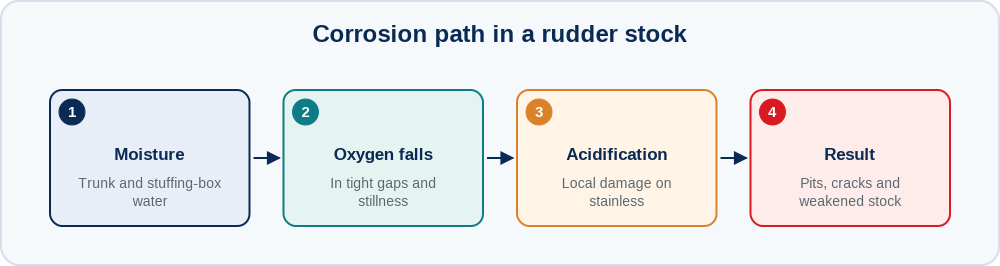
Boating New Zealand writes that most types of stainless steel require a free flow of oxygen to remain corrosion free and that stainless steel, especially type 316, trapped inside a wet environment and deprived of oxygen creates an acid that corrodes it. A rudder trunk, stuffing box and stock-blade junction can hold exactly such tight damp gaps.
2. The stuffing-box area#
In Cruising World D’Antonio writes that depending on design, removing the stuffing box from the trunk may enable inspection of much of the stock, particularly where corrosion is most likely to occur, at the stuffing box’s packing, where wet packing remains in contact with the stock, nearly always a stainless alloy. If the vessel remains dormant for long periods, as far too many do, he adds, the oxygen in the water contained within the trunk becomes depleted. A forum user describes finding extensive pitting of the stock in the region of the stuffing box on a 1980s boat and assuming it is crevice corrosion; another notes damage stopping where the stock enters the lower bearing. These are forum accounts and not firm diagnoses.
Heavy crevice corrosion is also known to occur where it can’t be seen without disassembly (Cruising World’s stainless maintenance article, with deck-hardware and bolt examples). Practical Sailor writes that seemingly harmless rust stains are typical indicators of crevice corrosion but that the stains are not always obvious, sometimes hidden from view. So visual inspection is limited; if in doubt a specialist assessment is needed.
| Area | Sources’ general observation | Caution |
|---|---|---|
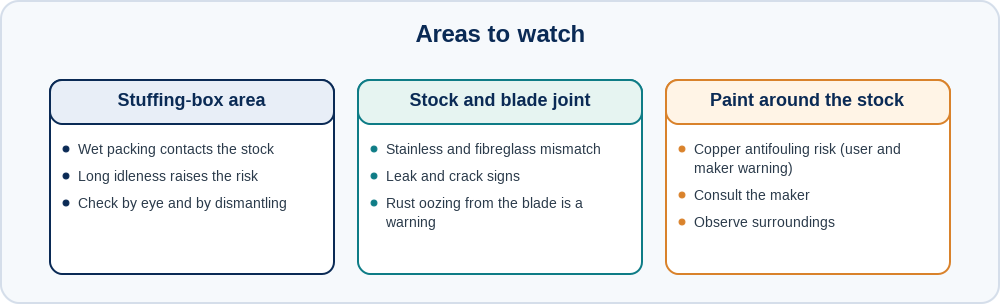
| Stuffing-box area | Wet packing contacts the stock; oxygen falls in long idleness | Inspect by eye and by dismantling |
| Stock and blade joint | Stainless and fibreglass mating is a tenuous hold (Cruising World) | Leak and crack signs |
| Rust oozing from the blade | Not a good sign for the internal support structure (Cruising World) | Specialist assessment |
| Paint around the stock | Copper antifouling risk reported on a forum | Consult the maker |
3. Stock and blade joint#
Cruising World writes that the area where the stock enters the blade is also worthy of close inspection; mating such disparate materials as stainless steel and FRP produces a tenuous hold at best. Rust oozing from a rudder blade is described by the magazine as not boding well for the condition of the foil’s internal support structure. A forum user writes that after failure of the seal between the GRP rudder shell and the shaft, crevice corrosion arises in this location; another reports that cracks in the GRP layup around the top of the shaft were the first sign. These are user accounts.
In Practical Sailor an author describes a boat where a subcontractor changed the plans and welded a mild steel plate to a shortened stainless stock; that is a personal account and cannot be generalised. The same article says a composite FRP stern tube replaced the original and eliminated the problems associated with submerged stainless steel and its tendency to become less noble. That is a particular event told by the source.
4. Copper antifouling and the stock surroundings#
A forum user writes that he found odd damage on a stainless stock which looked to him like electrolytic corrosion caused by copper-based antifouling next to the stock, that Jefa Rudders specifically caution against this and recommend non-copper antifoul in the immediate vicinity of the stock, say for 75-100 mm around it. That is a user account; the maker’s own document has not been verified here. Another user says the same damage could be crevice corrosion. So avoid firm judgement on cause; get the rudder maker’s instruction and a qualified specialist’s assessment.
For antifouling choice and the compatibility of copper paints with aluminium and other metals see the related articles. This article recommends no product.
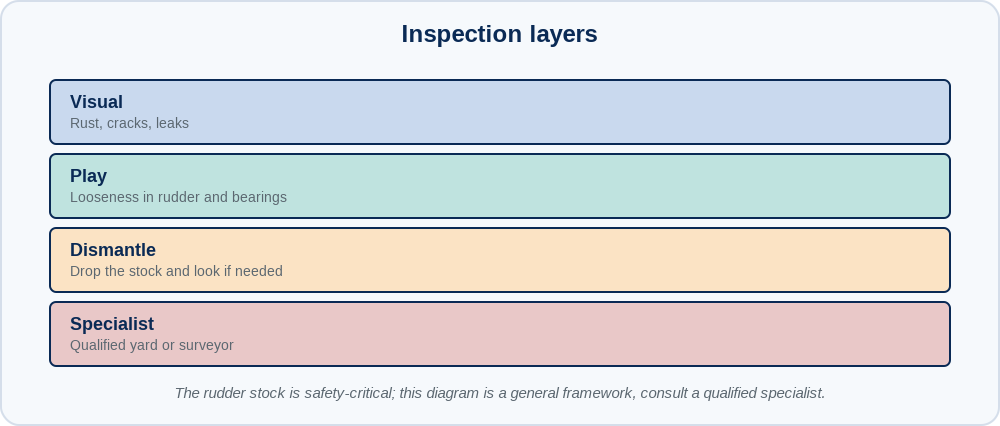
- Inspect the rudder in place by eye: rust, cracks, leaks and play.
- If there is rust oozing from the blade or cracks, consult a specialist.
- If needed examine the stuffing box and stock or drop the rudder.
- Get the maker’s advice on paints around the stock.
- Plan inspection after long idle periods.
- Record inspection results.
- Decide repair and replacement with a qualified specialist.
5. Inspection and repair: limits#
Cruising World writes that there are few hard and fast rules about when to drop a rudder and that a thorough in-place inspection can give clues. A forum thread discusses that a stock may be duplex stainless, which is magnetic, and that weld repair is not simple; that is a forum view. Grinding out crevice corrosion, welding or renewing the stock is an engineering decision; this article recommends no method.
Another approach is changing stock material; a Morgan’s Cloud piece mentions bronze stock and plates and alternatives offering “reduced worries” about crevice corrosion and stress corrosion cracking for stainless. That is a personal refit account. For choice and repair a qualified specialist and the maker are needed.
5b. Where sources differ, and limits#
Sources agree stainless stock corrodes in tight gaps; the difference lies in the cause of a particular damage. In one forum thread the same damage is likened by one user to electrolytic corrosion and by another to crevice corrosion. That shows judging cause from a picture is hard; a specialist’s assessment is needed. Forum accounts also report problems for particular build types (for example the rudder shafts of a particular boat model); those reports cannot be generalised.
This article is not diagnosis, engineering or safety advice. Loss of a rudder can have serious consequences; in a suspect case use the boat safely and consult a qualified surveyor or yard for inspection.
6. Common mistakes#
- Ignoring rust oozing from the blade.
- Not inspecting the rudder after long idleness.
- Looking only from outside and missing the stuffing-box area.
- Treating a forum account as a firm diagnosis.
- Putting copper-based paint around the stock without consulting the maker.
- Leaving repair to unqualified people.
- Not recording the inspection.
7. Checklist#
8. Conclusion#
The rudder stock and blade are exposed to corrosion especially at the stuffing box and stock-blade joint, in damp oxygen-poor tight gaps; rust oozing from the blade is a warning. A forum account reports that copper antifouling near the stock may be a risk. This article is general information; it is not engineering, safety or diagnostic advice, so consult a qualified specialist and the maker.
Frequently asked questions#
Where does rudder stock corrosion start?
In Cruising World D’Antonio writes it is most likely at the stuffing box, where wet packing contacts the stock, nearly always a stainless alloy; if the boat sits dormant the oxygen in the trunk water can be depleted.
Why does stainless steel corrode in tight gaps?
Boating New Zealand writes that stainless steel trapped in a wet environment and deprived of oxygen, especially 316, creates an acid that corrodes it; most stainless types need a free flow of oxygen to stay corrosion-free.
What does rust oozing from the blade mean?
In Cruising World D’Antonio writes that rust oozing from a rudder blade doesn’t bode well for the condition of the foil’s internal support structure. That is a warning; a qualified specialist is needed for diagnosis.
Which antifouling is used around the stock?
A forum user reports that Jefa Rudders recommend copper-free antifouling around the stock; that is a user account. For your own rudder see the maker’s instruction.
When should I drop the rudder to look?
Cruising World writes that there are few hard and fast rules on when to unship a rudder and that a thorough in-place inspection can give clues. Decide with a qualified specialist.
Was this guide helpful?
Thank you! Your feedback has been saved.
Guide content is for general information; in practice, the current technical data sheet of the product applies.
Keep reading
Related guides
Boat Colour Selection and Solar Reflectance: Effect of Heat Absorption on Surfaces
A study of the effect of boat paint colour on solar reflectance and surface temperature.
2 min read Paint and CoatingsCauses and Diagnosis of Paint Blistering
A study of the sources, types and diagnostic approach to blistering on boat paints.
2 min read Paint and CoatingsNumber of Coats in Epoxy Coating Systems
A study of the effect of the number of coats in epoxy coating systems on protective performance and thickness.
2 min read