
Paint and Coatings
Preventing Corrosion on Yacht Fasteners
Using different metals side by side, such as stainless bolts and aluminium, brings a risk of galvanic corrosion. This article summarises prevention ideas and source views with their limits; it is not fitting or engineering advice.
Short answer
Pantaenius (an insurer) writes that where stainless steel touches aluminium the aluminium corrodes first and describes a dismasting case involving stainless screws in an aluminium mast. Boating New Zealand recommends isolating the metals and writes that Tef-Gel, unlike Duralac, does not harden, making it better for bolts that need removal. Practical Sailor recommends Tef-Gel for stainless in aluminium, says extra torque may be needed and locknuts considered, and that conductive grease is bad in wet conditions. This article is general information; product, torque and method vary by maker and it is not fitting advice.
Key points
- When stainless steel touches aluminium the aluminium corrodes first (Pantaenius).
- Isolating the metals is recommended; Tef-Gel is described as suitable for bolts that need removal because it does not harden (Boating NZ).
- Extra torque may be needed; locknuts are considered (Practical Sailor).
- Conductive grease is described as bad in wet conditions (Practical Sailor).
- Product, torque and method vary by maker; a qualified yard is needed on critical connections.
1. Why do dissimilar metals cause trouble?#
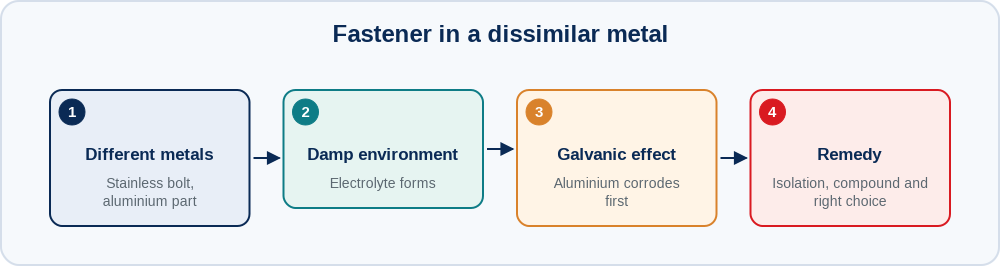
Pantaenius (an insurer) writes that where stainless steel touches aluminium the aluminium corrodes first and gives a dismasting case involving stainless screws in an aluminium mast as an example; solar-panel frames, rod holders and trampoline buttons are also listed among small fittings. This article is a general summary; it gives no product, torque or fitting method and is not engineering advice. Some sources are seller or forum accounts and are labelled as such.
The mechanism is that in a damp environment two different metals are joined by an electrolyte and the less noble one corrodes first; for detail see the galvanic corrosion articles.
2. Isolation and compound#
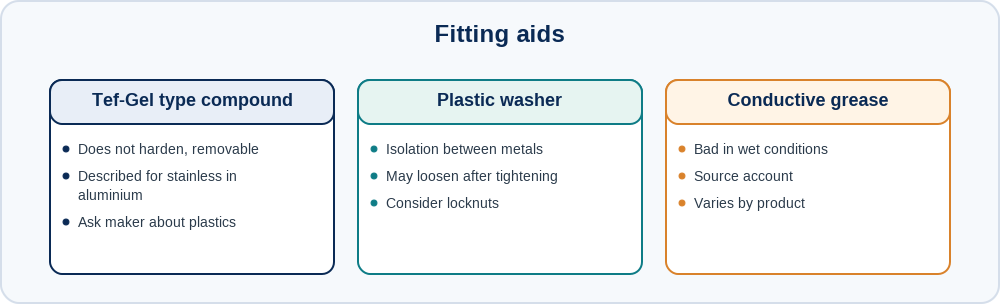
Boating New Zealand recommends isolating the metals from each other and writes that Tef-Gel, unlike Duralac, does not harden, so it is better for bolts that need removal. Practical Sailor recommends Tef-Gel for stainless in aluminium; it says extra torque may be needed and locknuts considered, that Tef-Gel, Lanocote, Green Grease and Loctite LB 8023 held torque, and that conductive grease is bad in wet conditions. A maker note says Tef-Gel is not compatible with plastics, so ask the maker when using it with plastic washers. This article recommends no product.
Passagemaker writes that stainless in aluminium can bubble paint and an effective sealant should be used, and that on wooden boats similar metals and bronze are preferred. TotalBoat (seller) mentions plastic washers and says impressed current on aluminium should not exceed a certain limit; that is a seller claim.
| Aid | Sources’ general observation | Caution |
|---|---|---|
| Tef-Gel type compound | Does not harden; described for bolts to be removed (Boating NZ) | Ask maker about plastic compatibility |
| Plastic washer | Isolation between metals (seller) | Extra torque and locknut |
| Conductive grease | Bad in wet conditions (Practical Sailor) | Varies by product |
3. A practical frame#
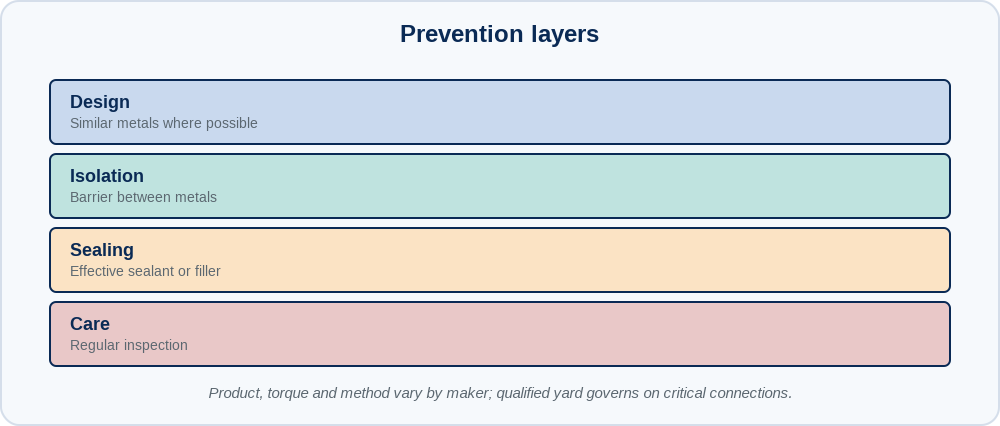
- Identify the metals in the connection.
- Prefer similar metals where possible.
- Discuss isolation or compound with the maker.
- Reduce water entry with an effective sealant.
- Assess the need for extra torque and locknuts.
- Inspect regularly.
- Consult a qualified yard on critical connections.
4. Limits#
Sources agree isolation helps; they differ on product choice. One source recommends Tef-Gel while another implies a hardening compound such as Duralac may suit some cases; there is also a warning about Tef-Gel and plastics. So there is no single right product; the maker and a qualified yard govern. This article is not fitting, torque or engineering advice.
5. Inspection#
As in Pantaenius’s examples, small fasteners are easily overlooked. For solar-panel frames, rod holders and similar additions it helps to consider which metals meet in the connection and where moisture can reach. Paint blistering or white salt deposits may be a warning according to sources; if unsure consult a specialist.
5b. Where sources differ#
Sources agree isolation is needed; they differ on which product to use. Boating New Zealand favours a non-hardening compound for bolts to be removed; Practical Sailor says Tef-Gel, Lanocote, Green Grease and a sealant product held torque. A forum user reports Lanocote and plastic spacers; that is a user account. A maker note says Tef-Gel is not compatible with plastics. This difference means looking at maker information for each connection.
This article summarises the sources’ general accounts; it may not hold for a particular connection. On critical connections a qualified yard and the maker govern.
5c. A practical frame for reading the sources#
The sources here are of different kinds: an insurer (Pantaenius), a marine magazine (Boating New Zealand), an equipment-testing publication (Practical Sailor), a motor-yacht magazine (Passagemaker), a seller (TotalBoat) and a maker note. An insurer draws on claims experience, a seller on selling products and a testing publication on comparison, so each source is best read in its own context. None is advice valid for a particular connection on your boat; the shared message is to isolate dissimilar metals from each other and to inspect connections regularly.
Small fasteners often look unimportant; yet Pantaenius’s example shows stainless screws can cause trouble in an aluminium mast. So when adding new equipment, such as a solar-panel frame or a rod holder, it helps to think beforehand which bolt will enter which metal. Similar metals are chosen where possible; where not, isolation and an effective sealant reduce water entry. This article recommends no particular product, size or method for that; the maker and a qualified yard are decisive.
Finally, a connection that “seems to work” does not mean there is no corrosion. Paint blistering, white salt deposits or a bolt that is hard to remove may be a warning according to the sources’ accounts. When such a sign is seen the connection may need to be taken apart and examined; doing that with a qualified yard is safer, especially on critical places such as mast, rudder and chainplates. Recording inspection results and changes made helps to plan later maintenance.
In addition, seller and maker statements in this article are the firm’s own account of its product and have not been independently verified. A product’s compatibility with another material, such as plastic, paint or a filler, should always be checked in the product’s own technical document. Where a technical document and a magazine account conflict, the maker’s document and a qualified yard’s assessment should be used.
6. Common mistakes#
- Fitting a stainless bolt in aluminium without isolation.
- Using Tef-Gel with a plastic part without asking about compatibility.
- Not thinking about loosening after plastic washers.
- Using conductive grease in a wet environment.
- Leaving small fasteners out of inspection.
- Ignoring paint blistering.
- Keeping no records.
7. Checklist#
8. Conclusion#
Fasteners of dissimilar metals can cause galvanic corrosion in a damp marine environment; when stainless steel touches aluminium the aluminium corrodes first. Sources suggest isolation, suitable compound and effective sealant and differ on product choice. This article is general information; it gives no product, torque or method, and the maker and a qualified yard govern.
Frequently asked questions#
Why does a stainless bolt harm aluminium?
Pantaenius writes that where stainless steel touches aluminium the aluminium corrodes first; a damp marine environment supports this effect.
Why is Tef-Gel mentioned?
Boating New Zealand writes that Tef-Gel, unlike Duralac, does not harden and so suits bolts that need removal. Practical Sailor also recommends Tef-Gel for stainless in aluminium. These are source accounts.
Do plastic washers help?
TotalBoat (seller) mentions isolating materials such as plastic washers; Practical Sailor writes extra torque may be needed and locknuts considered. Ask the maker about suitability.
Is conductive grease used?
Practical Sailor writes that conductive grease is bad in wet conditions. It varies by product; see the maker.
Which metal on a wooden boat?
Passagemaker writes that on wooden boats similar metals are used, with bronze preferred. That is a magazine account.
Was this guide helpful?
Thank you! Your feedback has been saved.
Guide content is for general information; in practice, the current technical data sheet of the product applies.
Keep reading
Related guides
Boat Colour Selection and Solar Reflectance: Effect of Heat Absorption on Surfaces
A study of the effect of boat paint colour on solar reflectance and surface temperature.
2 min read Paint and CoatingsCauses and Diagnosis of Paint Blistering
A study of the sources, types and diagnostic approach to blistering on boat paints.
2 min read Paint and CoatingsNumber of Coats in Epoxy Coating Systems
A study of the effect of the number of coats in epoxy coating systems on protective performance and thickness.
2 min read