
Paint and Coatings
Safety and Waste Management When Using Paint Stripper
Paint strippers are among the most worrisome chemicals boaters encounter. This article explains the hazards of stripper types, safe working principles and waste management, based on information from official bodies and industry publications.
Short answer
Many paint strippers carry respiratory, skin-and-eye and fire hazards; for the most dangerous group, those containing methylene chloride, official bodies have reported serious fatal cases. Safe work calls for choosing a less hazardous (soy or water based) stripper where possible, working outdoors or in a well-ventilated place, using a suitable respirator, gloves and eye protection and reading the product’s safety data sheet (SDS). Stripper, scrapings and wash water can be hazardous waste; collect the waste, make a hazardous waste determination and dispose of it under local rules. This article is general information, not legal advice.
Key points
- Strippers containing methylene chloride are very dangerous; per CDC thirteen bathtub refinishers died 2000–2011 after inhaling it.
- For flammable strippers even a fan spark can be a risk; work outdoors away from ignition sources.
- Use a respirator, gloves and eye protection; read the product SDS.
- Stripper waste, scrapings and wash water can be hazardous waste; collect and assess them.
- Where possible reduce stripping and the most hazardous products; evaluate alternatives.
1. Why does it need care?#
Because paint strippers are designed to soften and dissolve bonded paint, they are by nature strong chemicals. Practical Sailor writes that paint strippers are among the most worrisome chemicals boaters encounter. The US Consumer Product Safety Commission (CPSC) also says that if not properly used paint strippers are hazardous to health and safety and that each product has specific precautions. OSHA’s shipyard resource says strippers can expose workers to fire and explosion, respiratory and contact hazards and limited-access risks.
This article is a general summary and is not legal or professional advice. Take each product’s safety data sheet (SDS), local regulation and the marina or yard’s rules as the basis. For a comparison of removal methods see the related article.
2. Methylene chloride and other components#
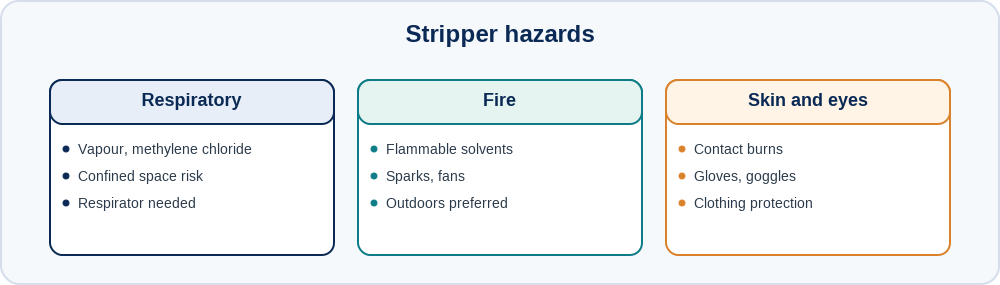
The most common component in traditional paint strippers is methylene chloride (dichloromethane). CPSC explains it comes in two varieties of products, nonflammable and flammable; the flammable strippers contain less methylene chloride but other flammable chemicals including acetone, toluene or methanol. The same publication states methylene chloride causes cancer in laboratory animals. Practical Sailor writes that this chemical, common in old-school strippers, is multi-organ toxic, very volatile, that fatalities have been associated with high vapour concentrations and that it is bad for the environment; it also reports that the EPA has banned methylene chloride and published a proposed risk management rule to prohibit NMP in several commercial and occupational uses.
The warnings from the Washington State Department of Labor & Industries and CDC are striking: between 2000 and 2011 thirteen bathtub refinishers from ten states died after inhaling methylene chloride while stripping residential tubs; the ten related products contained 60 to 100 percent methylene chloride. These cases are in bathtub refinishing, not boats, but the same hazard applies in closed or poorly ventilated spaces; cabins, bilges and tank compartments in boats are examples. Practical Sailor also says one NMP-free stripper tested well among the products it tested; but that is a single test result and product formulations can change.
| Hazard | Detail | Precaution |
|---|---|---|
| Respiratory | Methylene chloride and organic vapours | Outdoors, ventilation, suitable respirator |
| Fire | Flammable strippers, fan sparks | Away from fire and sparks, outdoors |
| Skin and eyes | Contact burns, irritation | Solvent-resistant gloves, goggles, clothing |
| Confined space | Vapour accumulation | Do not use in confined space; SDS and regulation |
| Environment | Waste, wash water | Collect, hazardous waste determination |
3. Safe working principles#
According to CPSC’s general recommendations the steps common to all strippers are: work in a well-ventilated area or outdoors; use flammable strippers away from flame, sparks and high heat; know that a fan’s electrical sparks may increase ignition risk for flammable vapours; and follow the instructions on the label and SDS. OSHA’s shipyard resource says ventilation must keep concentrations below the exposure limit and that where ventilation does not provide adequate safety an airline respirator can be used, with respirators complying with the relevant regulations.
In practice long-sleeved coveralls or clothing, solvent-resistant gloves (the material the product SDS recommends), eye protection and the necessary respirator form a whole. Practical Sailor writes that lightweight, back-vented coveralls balance heat dissipation and skin protection when using stripper. Using only as much stripper as needed is a practice NY Sea Grant recommends; preventing evaporation and correct storage are on its list too. Using stripper in confined spaces (cabin, tank, bilge) is particularly high risk; in that case experts and appropriate safety methods are essential.
4. Alternatives and less hazardous products#
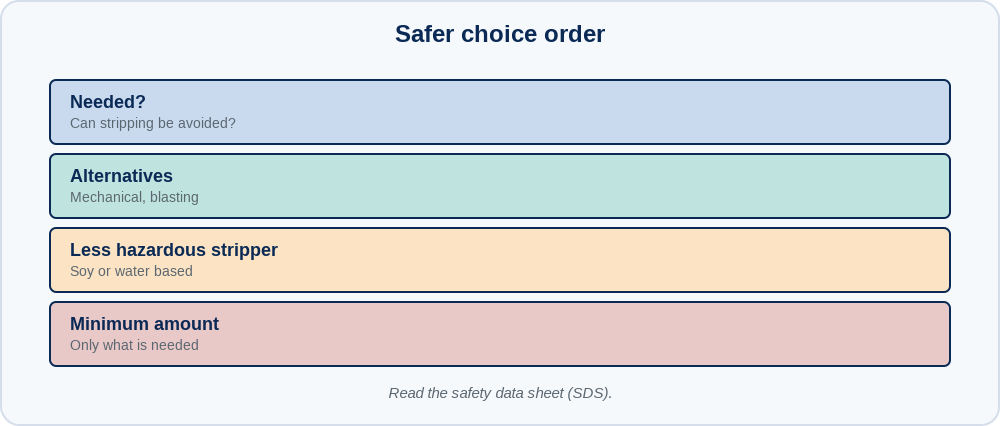
NY Sea Grant recommends comparing chemical stripping with other options and weighing alternatives according to the surface, the type of paint being removed and the volume of waste that will result. If a stripper must be used it says soy-based or water-based products are less hazardous. Even where these less hazardous products can themselves be regarded as non-hazardous, metals and chemicals in the removed paint can be hazardous, so all residue and wash water must be collected and disposed of correctly. Options such as mechanical methods and soda or wet blasting can also reduce the need for stripper; for detail see the method comparison article.
A stripper’s label states which hull materials (fibreglass, wood, steel) it can be used on; verifying this compatibility matters both to avoid damaging the surface and to avoid an unnecessary second application. Limiting evaporation by not leaving the lid off during storage helps both safety and cost.
5. Waste management#
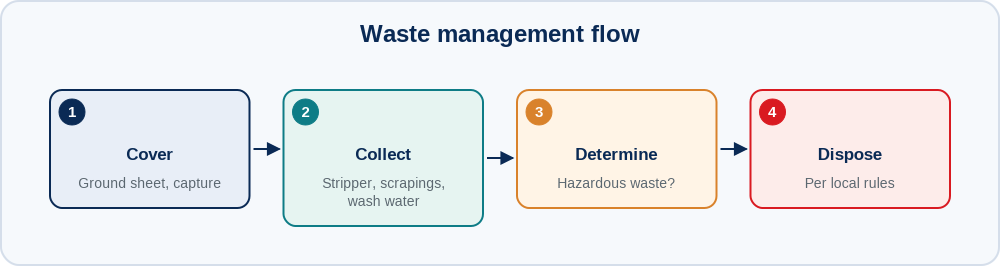
Removed paint, stripper residue and wash water can be hazardous waste because of the metals in the paint (for example antifouling contains copper) and the stripper’s chemicals. NY Sea Grant says these residues and wash water must be collected and disposed of properly; it estimates a 30-foot boat generates about 30 gallons of waste including wash water and notes special machines exist that pressure wash the hull and collect the wash water in one step. The same body says a hazardous waste determination should be made before discarding paint scrapings in a dumpster and that if a stripper containing a listed waste such as methylene chloride was used the scrapings also become hazardous. Practical Sailor also writes that methylene chloride is a listed hazardous waste (F002) and that contaminated paint sludge will be hazardous waste even after it is effectively dry.
NY Sea Grant’s abrasive blasting guide says blasting does not always eliminate waste, since the most commonly used media is sand or grit with a large volume of water, and blast wastewater can constitute the largest single waste stream from many boat repair yards. Whichever method is chosen the waste plan must be made at the start. Your local environmental agency or marina can say what waste must be collected and how; legal requirements vary by country and region and this article is not legal advice.
- Assess whether stripping is really needed and the alternatives.
- Choose a less hazardous stripper; read the SDS.
- Work outdoors or in a well-ventilated place; remove ignition sources.
- Use a respirator, gloves, eye protection and suitable clothing.
- Cover the area; apply only as much stripper as needed.
- Collect scrapings, stripper and wash water.
- Make a hazardous waste determination; dispose under local rules.
6. Common mistakes#
- Using stripper in a confined space.
- Starting work without reading the SDS.
- Working without a respirator.
- Using a fan or ignition source with flammable stripper.
- Working without collecting waste or throwing it in the trash.
- Not checking compatibility with the hull material.
- Applying too much stripper and letting it evaporate.
7. Checklist#
8. Conclusion#
Paint strippers are strong and potentially hazardous chemicals; the riskiest group is those containing methylene chloride. Safe work calls for less hazardous products, good ventilation, suitable protective equipment and compliance with the product SDS. Stripper waste, scrapings and wash water can be hazardous waste and must be collected and disposed of under local rules. This article is general information and not legal advice; the product SDS and local regulation come first.
Frequently asked questions#
Why is methylene chloride dangerous?
Per CDC and state health bodies, inhaling methylene chloride strippers has caused deaths; it is also noted to cause cancer in laboratory animals.
Is there a safer stripper?
NY Sea Grant says soy and water-based strippers are less hazardous; but metals and chemicals from the removed paint can still be hazardous.
What happens to stripper residue and scrapings?
NY Sea Grant says scrapings and wash water may be contaminated by paint and may need to be managed as hazardous waste; a determination must be made before disposal in a dumpster.
Is using a fan safe?
CPSC says a fan is important for fresh air movement but electrical sparks from fans may increase the chance of flammable stripper fumes catching fire.
What protective equipment is needed?
Per the product SDS, a respirator, solvent-resistant gloves, eye protection and suitable clothing; for detail see the SDS and local regulation.
Was this guide helpful?
Thank you! Your feedback has been saved.
Guide content is for general information; in practice, the current technical data sheet of the product applies.
Keep reading
Related guides
Boat Colour Selection and Solar Reflectance: Effect of Heat Absorption on Surfaces
A study of the effect of boat paint colour on solar reflectance and surface temperature.
2 min read Paint and CoatingsCauses and Diagnosis of Paint Blistering
A study of the sources, types and diagnostic approach to blistering on boat paints.
2 min read Paint and CoatingsNumber of Coats in Epoxy Coating Systems
A study of the effect of the number of coats in epoxy coating systems on protective performance and thickness.
2 min read