
Paint and Coatings
Silicone-Based Foul-Release Coatings on the Hull
Silicone-based foul-release coatings aim to make it harder for fouling to hold without releasing biocide. This article summarises the logic, magazine and research findings and the limits of application and upkeep, keeping maker claims apart.
Short answer
Foul-release coatings aim to stop organisms bonding firmly through a smooth, low-surface-energy surface instead of a biocide; PBO describes them as “slippery not poisonous”. A research summary based on Chalmers work reports that silicone coating performed similarly to or better than copper coatings in static conditions; in PBO’s test Hempel Silic One stood out, staying mostly clean even on a static panel. On the other hand yacht.de says sailing yachts with foul-release will hardly avoid intermediate cleaning, that a soft brush or sponge is needed and that stiff brushes would destroy the silicone; most sources advise professional application. This article is general information; it recommends no product and the data sheet and maker govern.
Key points
- Foul-release coatings work by a smooth, low-surface-energy surface rather than biocide (PBO).
- A research summary reports silicone coating performed similarly to or better than copper in static conditions; Silic One stood out in a PBO test.
- Intermediate cleaning may be needed; a soft brush or sponge is advised and stiff brushes harm it (yacht.de).
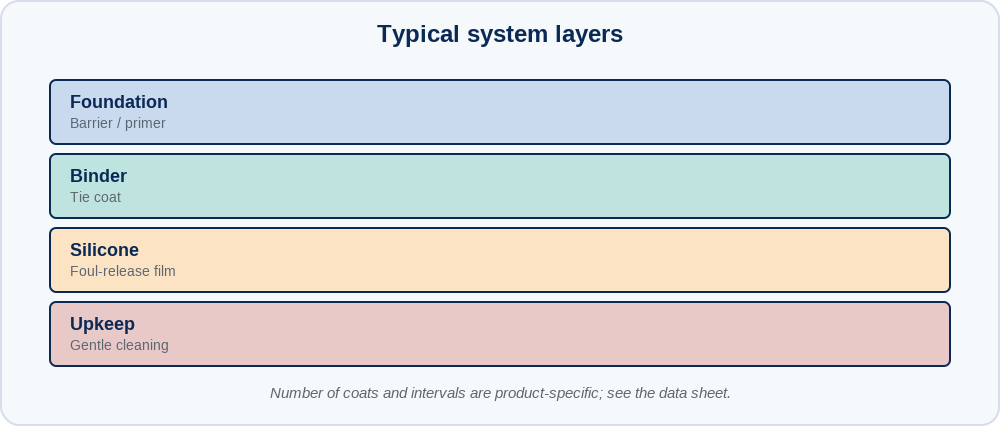
- Application usually comprises primer, tie coat and silicone layers and most sources advise professional application.
- Damaged coating must be repaired; though harmless it may stay in the environment like plastic for a long time (Green Blue).
1. What is a foul-release coating?#
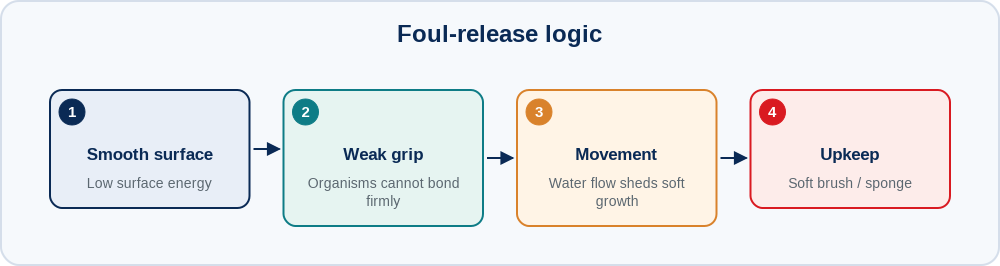
According to PBO’s guide foul-release formulas use silicone instead of biocide; the coating presents a super-smooth surface to any marine life considering taking up residence, so the hull is too slippery for anything more complex than slime to attach. PBO also summarises these coatings as “slippery not poisonous” and writes that silicone coatings have been used on many cargo vessels for decades but have only recently been marketed to recreational sailors. This article is a general summary; it recommends no product and gives no guarantee of performance.
Hempel describes the interface between its coating and seawater as a hydrogel, neither water nor solid; that is a maker description. A user account in PBO says the silicone coating does not shed into the environment during normal use and, unlike ablative copper-based systems, will never need rubbing down to refresh it. However, if the coating is damaged repair is needed (see below).
2. Test and research findings#
In PBO’s long comparative antifouling test Hempel Silic One stood out as “editor’s choice”; the system was applied with Hempel Light Primer and a Silic One tie coat. The magazine writes that it had expected foul-release coatings to struggle on a static panel without movement but that most of the stripe stayed remarkably clean and any slime was easily swept aside with the swipe test. Another PBO article, though, notes that foul-release coatings rely on water movement and that a boat would not normally sit idle and uncleaned for that length of time, which made the test especially challenging for these coatings. MBY’s comparison likewise describes the hull of a boat with Silic-One as free of weed, barnacles and even slime after its test period; these are magazine observations and depend on the particular boat, region and use.
A research summary based on work at Chalmers University says silicone-based foul-release coatings performed similarly or even better than copper coatings under static conditions and that thanks to their self-cleaning property fouling that has attached may be removed as the hull moves through the water. The researchers say that if more vessels in the Baltic region had silicone coatings it would lower emissions of biocides. This is a research summary; it carries no direct value for Mediterranean and Aegean conditions.
| Source | Finding | Caution |
|---|---|---|
| PBO test | Silic One largely clean on a static panel | Magazine test, particular conditions |
| Another PBO article | Relies on water movement; long idleness a hard test | Use matters |
| Chalmers summary | Similar to or better than copper when static | Baltic context |
| Hempel (maker) | Over 10,000 applications (Europe incl. Mediterranean) | Vendor claim |
3. Application: primer, tie coat and professional workmanship#
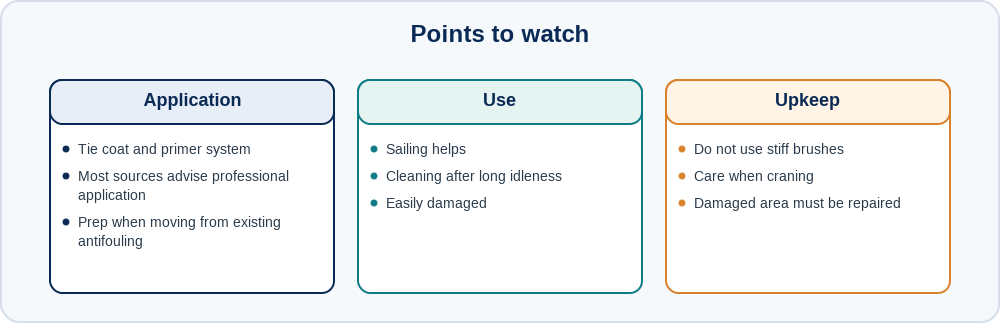
Yacht.de writes that International’s foul-release system consists of an adhesion promoter, called a tie coat, and the actual silicone coating and that a conversion primer is available for switching from conventional coatings; it adds that some systems have a surface significantly more robust than other silicone-based ones, making the coating suitable for dry-falling. Green Blue advises professional application for most foul-release and says it is possible to seal existing antifouling layers but that it is recommended the hull be grit blasted back to the original substrate and applied from there. Hempel Silic One is noted as DIY-applicable. These differences depend on product and maker; the data sheet governs.
Preparation, compatibility with the existing system and coat count are product-specific; this article gives no interval, thickness or coat count. The condition of the existing system matters at transition: if the old system is unsound or unknown, see the related compatibility and stripping articles. When applying a silicone system check conditions of weather and humidity against the maker’s instruction.
4. Upkeep and damage#
Yacht.de writes that sailing yachts with foul-release coatings will hardly be able to avoid intermediate cleaning, that a soft scrubbing brush or sponge are the tools of choice and that the boat washers commonly used in Scandinavia are unsuitable because their brushes would destroy the sensitive silicone coating; it adds that care must be taken when craning so that the coating is not damaged. Green Blue says the coating is harmless to marine life but that if it is damaged it is possible that what is, in effect, a plastic will remain in the environment for a considerable time. So repairing damaged areas and protecting lifting points matter.
Green Blue also notes a high up-front cost but that over a ten-year period costs are comparable to soft coatings; that is an organisation’s view and varies with product, boat and region. This article gives no cost value.
- Read the product data sheet, primer and tie coat requirements.
- Verify the transition route from the existing system with the maker.
- Decide professional or DIY application per product.
- Get a soft brush or sponge; do not use stiff brushes.
- Protect the coating at crane and support points.
- Repair damage promptly.
- Plan inspection and cleaning for idle periods.
5. Who is it suited to, and who not?#
Sources suggest foul-release seems better suited to boats that sail regularly and allow gentle cleaning; but PBO’s test did well even on a static panel. For boats left idle and uncleaned for long periods results may vary by product and region. Makers say their products are designed for different usage patterns; see your product’s data sheet for idle and out-of-water limits.
Results may also differ in high-fouling regions. Hempel reports successful applications in heavy-fouling waters including the Mediterranean (vendor claim); get independent experience from yards and users in your area.
5b. Overcoating and repair#
Putting another paint over a silicone coating is generally difficult and is not advised in many makers’ systems, so product choice is a long-term decision. Repair of damage requires the maker’s repair material and instruction. If you want to move from a silicone system to another, ask the maker in advance about the transition route and hull preparation. That is a general observation and may not hold for a particular product.
In terms of environmental profile, not releasing biocide is an important advantage; but damage and waste management matter in the real world. For local regulation and hull-cleaning rules see the related articles.
6. Common mistakes#
- Assuming foul-release needs no cleaning at all.
- Cleaning with stiff brushes or high pressure.
- Skipping the primer and tie coat system.
- Not protecting the coating at crane and support points.
- Continuing the season without repairing damage.
- Not verifying the maker’s transition instruction.
- Treating a vendor claim as an independent result.
7. Checklist#
8. Conclusion#
Silicone-based foul-release coatings work through a smooth surface rather than biocide; positive results have been reported in a PBO test and a research summary, but intermediate cleaning, use of soft tools, repair of damage and application requirements matter. Most sources advise professional application. This article is general information; it recommends no product and the data sheet and maker govern.
Frequently asked questions#
How does a foul-release coating work?
Instead of biocide it presents a smooth, low-surface-energy surface so organisms cannot bond firmly; PBO says “slippery not poisonous”. Soft growth goes with water flow or gentle cleaning.
Does it work on a boat that does not move?
In PBO’s test Silic One stayed largely clean even on a static panel and slime swept off easily; but another PBO article notes these coatings rely on water movement and that long idleness is a tough test.
How is it maintained?
Yacht.de advises a soft brush or sponge and says the brushes of Scandinavian-style boat washers would destroy the silicone. Care is also needed when craning.
Can I apply it myself?
Green Blue advises professional application for most foul-release; PBO notes Hempel Silic One is DIY-applicable. See the product data sheet.
Can it go over existing antifouling?
It depends on the existing system and product; Green Blue says existing antifouling layers can be sealed but that grit blasting the hull to the original substrate is recommended. See the maker’s instruction.
Was this guide helpful?
Thank you! Your feedback has been saved.
Guide content is for general information; in practice, the current technical data sheet of the product applies.
Keep reading
Related guides
Boat Colour Selection and Solar Reflectance: Effect of Heat Absorption on Surfaces
A study of the effect of boat paint colour on solar reflectance and surface temperature.
2 min read Paint and CoatingsCauses and Diagnosis of Paint Blistering
A study of the sources, types and diagnostic approach to blistering on boat paints.
2 min read Paint and CoatingsNumber of Coats in Epoxy Coating Systems
A study of the effect of the number of coats in epoxy coating systems on protective performance and thickness.
2 min read