
Paint and Coatings
Paint Choice for a Weekly-Use Boat vs a Seasonal Boat
Does the boat go out every week or a few times a season? Frequency of use affects antifouling choice, though sources do not all agree. This article summarises the tendencies and the disagreements.
Short answer
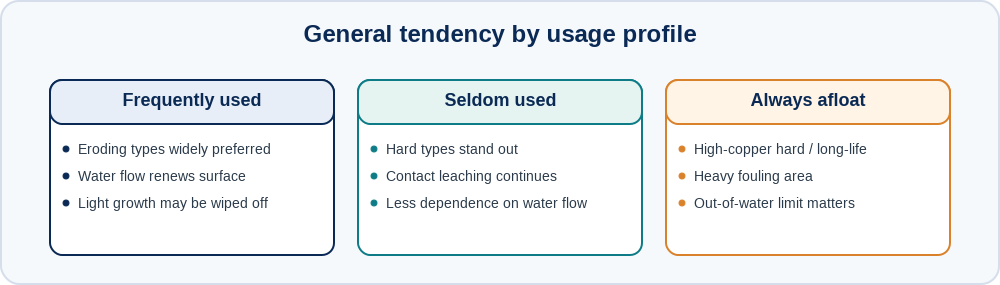
The common tendency in sources: eroding (ablative) paints stand out on frequently used boats, hard contact-leaching paints on seldom-used boats and high-copper hard paints on boats permanently afloat in heavy-fouling areas (West Marine, Yachts and Yachting, Cruising World). There is disagreement, though: West Marine writes that for copolymer ablatives the rate of hydrolysis is relatively consistent regardless of boat speed so a moored boat and a frequently sailed boat lose paint at similar rates, whereas PassageMaker and Sail magazine say eroding paints depend on water washing the surface and are not a good choice for boats left long at a dock or mooring. This article is general information; it recommends no product and the data sheet and maker govern.
Key points
- Eroding paints are a common choice for frequently used boats; hard paints stand out for seldom-used ones (West Marine).
- Sources disagree: copolymer ablatives are also described as depending on hydrolysis rather than speed.
- For boats always afloat in heavy-fouling areas a high-copper hard paint is suggested (Cruising World, West Marine).
- Hard paints may lose effectiveness during time out of water; see data-sheet limits.
- A report from tropical waters says cover on uncleaned moored boats rose by about ten percent in five months (My Sailing).
1. Why does frequency of use matter?#
Antifouling choice depends not only on region and water but on how the boat is used. The boats.com guide writes that the optimum type changes not just for different styles of vessel but also how often the boat is used and its purpose. YBW also says that in the vast majority of cases regular use is more beneficial than lack of use. This article is a general summary; it recommends no product and gives no fouling intensity for a given region.
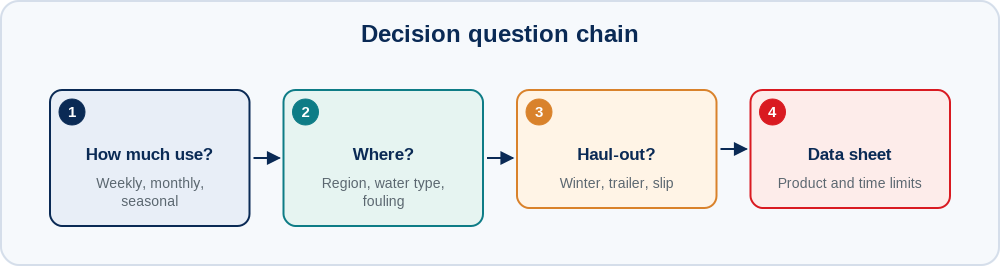
Whether a boat counts as “weekly” or “seasonal” is usually tied in sources to the answers to these questions: how much does the boat move in the water, how much of the year is it afloat, does it haul out in winter and how heavy is fouling pressure locally? Below you will find sources’ tendencies and disagreements on these questions.
2. Frequently used boats#
West Marine’s antifouling buying guide says an ablative paint is a good choice for frequently used boats because the hull surface polishes smoother with use and sheds light growth more effectively. An expert account in Yachts and Yachting says serious antifouling efficiency starts where boats are used at least several times a week and that then softer coatings can do the same work as harder biocides. In the boats.com guide’s 33 ft sailing cruiser example a boat used at least three weekends a month from May to September is described as relatively easy to protect, with a mid-priced eroding product possibly enough. PassageMaker says ablative paints work best with regular use and that if the boat sits at the dock slime may develop but subsequent boat rides will likely wipe it away.
These are magazine and guide views; for the performance of specific products in specific regions local experience and the data sheet govern. A mechanism that depends on water flow may be less effective on boats that do not move, so “frequently used” always depends on actual time underway.
| Profile | Sources’ general tendency | Note |
|---|---|---|
| Frequently used | Eroding types a common choice | West Marine, Y&Y |
| Seldom used | Hard types stand out | Disagreement exists |
| Always afloat | High-copper hard types | Cruising World, West Marine |
| Often hauled | Out-of-water limit matters | Data sheet |
3. Seldom-used boats and the disagreement#
West Marine says that for infrequently used boats a modified epoxy (hard) paint provides better antifouling protection when the boat sits still for extended periods and that hard paints leach biocide on contact with water regardless of whether the boat is moving. The Yachts and Yachting account likewise says for light use “the harder, the better”. Sail magazine says eroding paints depend on water washing away the paint surface and so are not a good choice for a boat that stays at a dock or on a mooring for extended periods. Boote magazin also writes that for boats lying unused in harbour for a very long time paints with an even biocide release make sense and self-polishing products are not the first choice.
By contrast another West Marine guide says that for copolymer ablatives the rate of hydrolysis is relatively consistent regardless of boat speed and that a moored boat and a frequently sailed boat lose paint at similar rates over a season, linking this to the view that these types are the default choice for colder-temperate regions. This difference between sources depends on product chemistry and the maker’s claim; maker statements are product-specific. In your own product’s data sheet check the “idle” and “out of water” limits.
4. Boats always afloat and boats that haul out#
West Marine generally counts a high-copper modified epoxy paint as the best choice for boats that stay in the water year round, saying these contact-leaching paints release biocide at a steadily decreasing rate and leave the full coating thickness at season’s end. In Cruising World an expert says recommendations for a boat on the Great Lakes with a four- to six-month season would differ from a Florida boat that might be in the water for 24 months at a time, that in high-fouling warm salt water a paint with a high loading of copper is the general recommendation and that if the boat is scrubbed often a hard antifouling is recommended. The same source says some paints oxidise and become ineffective if taken out of the water, so they are not a good choice for boats that haul out for the winter.
An Australian article in My Sailing relays that in tropical waters the cover of fouling organisms on boats rises by about ten percent every five months they spend moored and uncleaned. That is a relay of local research and does not give the same value elsewhere; read it as an illustration of the need for an inspection and cleaning plan for a boat permanently afloat.
- Record how many days a month the boat really sails.
- Determine time afloat and the winter haul-out plan.
- Learn your region’s fouling pressure from local users.
- Read the idle and out-of-water limits of eroding and hard types in the data sheet.
- Consult the maker’s technical support if needed.
- Keep regular inspection and records through the season.
- Adjust for next season from your observations.
5. Season plan and records#
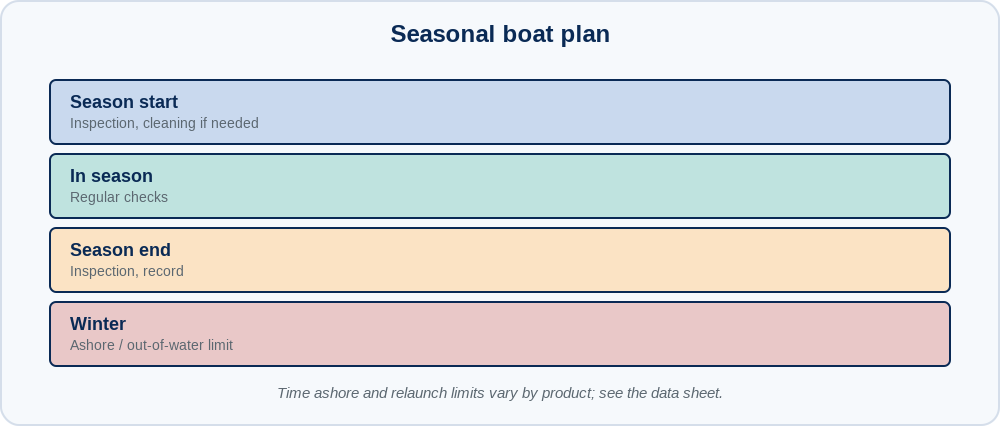
On a seasonal boat the backbone of the plan is inspection and records: surface and paint condition at season start, short checks in season and hull condition and type of growth recorded at season end. This record gives a concrete basis for reconsidering product type next year. For boats not used midweek, a periodic inspection service from the marina or yard may be available.
If the usage profile changes (for example the boat will sit longer in port or stay afloat in winter) review the product choice; for compatibility with the current system and coat plan see the related articles.
5b. How use affects paint life#
The same product can show different life in different usage profiles. An Improve Sailing article says casual sailors and cruisers in areas with a seasonal sailing season can probably antifoul every other year, but that a race boat with hard paint wet sanded and scrubbed weekly will need a new coat each spring; that is a user view. So use affects both product type and renewal interval. Set your own interval from the maker’s recommendation and your observations.
Manner of use matters as much as frequency: racing, trailering, slip use or frequent scrubbing can favour hard paints (Boating magazine, and makers such as Jotun mention hard types for high-speed and often-hauled boats). These maker statements are product-specific.
6. Common mistakes#
- Choosing a product without considering frequency of use.
- Treating a single source’s view as a firm rule.
- Not checking the out-of-water limit for a boat that will winter ashore.
- Ignoring idle time and marina conditions.
- Keeping no inspection and records.
- Not reviewing the product when the usage profile changes.
- Not consulting the maker.
7. Checklist#
8. Conclusion#
The common tendency in sources is eroding paints for frequently used boats and hard paints for seldom-used boats and those permanently afloat in heavy-fouling areas; there are disagreements, such as the view that copolymer ablatives erode at a rate that does not vary with speed. Use, region, wintering and product limits must be weighed together. This article is general information; the data sheet and maker’s instruction govern.
Frequently asked questions#
What type for a boat I use weekly?
Sources point to eroding paints as a common choice for frequent use (West Marine, Yachts and Yachting); it varies by product and region. See the data sheet.
For a boat used a few times a season?
For seldom-used boats hard (modified epoxy) paints are said to stand out because they leach on contact (West Marine); but some sources write that leaching in copolymer ablatives is independent of speed. Compare both views.
For a boat permanently afloat?
Cruising World says a high-copper-loaded paint is the general recommendation in heavy-fouling warm salt water; West Marine suggests a high-copper modified epoxy for boats kept in the water year round.
If I haul out in winter does hard paint lose its effect?
Cruising World and West Marine write that some hard paints may lose effectiveness out of water; see your product’s relaunch limits in the data sheet.
Does this article recommend paint?
No. For product choice see the data sheet, the maker and the experience of yards in your area.
Was this guide helpful?
Thank you! Your feedback has been saved.
Guide content is for general information; in practice, the current technical data sheet of the product applies.
Keep reading
Related guides
Boat Colour Selection and Solar Reflectance: Effect of Heat Absorption on Surfaces
A study of the effect of boat paint colour on solar reflectance and surface temperature.
2 min read Paint and CoatingsCauses and Diagnosis of Paint Blistering
A study of the sources, types and diagnostic approach to blistering on boat paints.
2 min read Paint and CoatingsNumber of Coats in Epoxy Coating Systems
A study of the effect of the number of coats in epoxy coating systems on protective performance and thickness.
2 min read