
Paint and Coatings
Using Magnesium Anodes in Fresh Water
For boats in fresh water most sources recommend magnesium anodes; but the choice carries risk on moving to salt water and on some hulls. This article summarises the rationale, cautions and differing views, keeping seller and maker claims apart.
Short answer
Fresh water has low conductivity; Boating writes that magnesium works better in that environment and is the best choice for fresh water, though aluminium can also work. Yachting Monthly says magnesium alloys react rapidly in seawater and are only suitable for fresh water, and that zinc is inhibited by oxide formation in fresh and brackish water. Over-protection is a risk: Volvo Penta says magnesium should not be used in salt or brackish water and BoatUS says it can damage bottom paint and aluminium in seawater; a seller source also flags over-protection on aluminium and wooden hulls. This article is general information; it recommends no product and the hull and engine maker’s instruction governs.
Key points
- Fresh water is a low-conductivity environment; sources present magnesium as the preferred anode there (Boating, West Marine).
- Zinc can passivate with an oxide crust in fresh water; magnesium does not suffer this (seller claim).
- Magnesium wastes very fast in salt and brackish water and carries over-protection risk (Volvo Penta, BoatUS).
- Magnesium can over-protect aluminium and wooden hulls (seller source); see the maker’s instruction.
- On a freshwater boat that moves to salt water the anode state must be reviewed (Boating).
1. Why magnesium in fresh water?#
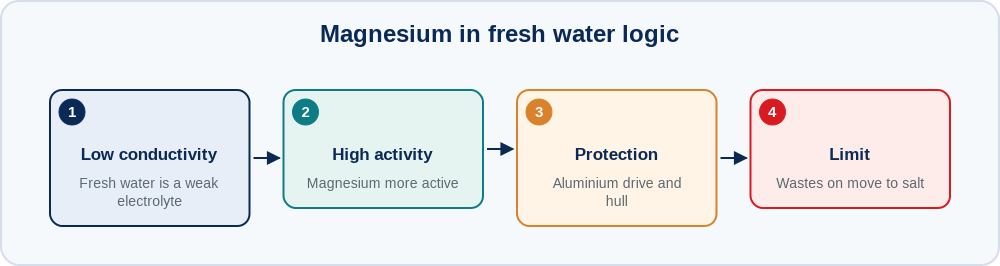
Fresh water conducts electricity far less than salt water, so a more active metal is needed for a sacrificial anode to produce current. Boating magazine writes that magnesium works better in fresh water’s low-conductivity environment, that aluminium anodes may also work well but magnesium is the best choice for fresh water. Yachting Monthly notes that magnesium alloys react rapidly in seawater and are only suitable for fresh water, where their loss rate is reduced by lower open circuit potential. This article is a general summary; it recommends no product and some sources are seller or maker claims.
West Marine’s product page recommends cadmium-free magnesium anodes for boats used only in fresh water and says zinc anodes can passivate and stop working in fresh water; it adds that magnesium anodes should not be used in other water types. Another seller page says magnesium does not build an oxide layer in fresh water like zinc or aluminium. These are seller claims.
2. Aluminium drives and hulls#
A houseboat magazine article writes that every outdrive casing is aluminium yet has stainless steel components or propellers, and that magnesium anodes are the best choice for protecting aluminium outdrives and hulls operating in fresh water; if a stainless propeller is used it recommends replacing the shaft nut with a magnesium one. That is one author’s recommendation. Practical Sailor likewise notes magnesium alloys are just the thing for an aluminium-hulled boat in fresh water but wrong for everyone else; magnesium was skipped in its test for that reason.
A Yamaha blog article writes that if the motor is likely to spend its life in fresh water switching to a pure magnesium anode may be considered; it adds that anodes are usually an aluminium/zinc alloy that works well in most waters. That is a maker’s account. On any boat look first at the engine and drive maker’s manual.
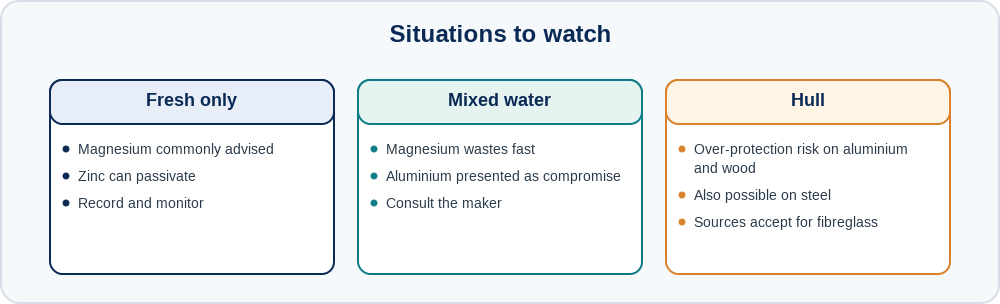
| Situation | Sources’ general observation | Caution |
|---|---|---|
| Fresh water only | Magnesium commonly advised | Maker instruction |
| Moving between fresh and salt | Aluminium presented as compromise | Magnesium wastes fast |
| Aluminium / wooden hull | Over-protection risk with magnesium (seller source) | Consult the maker |
| Fibreglass hull | Magnesium accepted in fresh water (seller source) | Consult the maker |
3. Moving to salt water and over-protection#
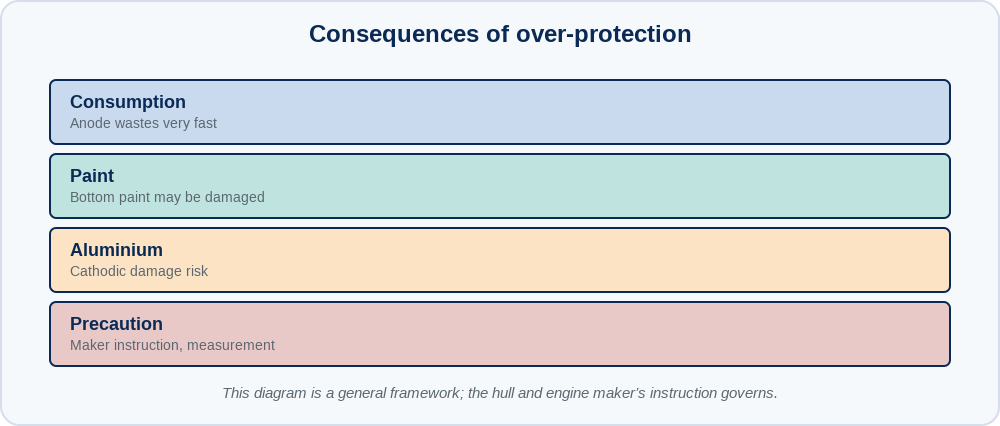
Boating writes that taking a freshwater boat protected by magnesium to the coast and putting it in a slip for a week could be a “catastrophe”, because magnesium is highly reactive in salt water and once it is gone the outdrive or lower unit is left exposed to galvanic corrosion. Volvo Penta says magnesium anodes should not be used in salt or brackish water because of the risk of over-protection and extremely high anode consumption. BoatUS says magnesium can damage bottom paint in seawater and cause cathodic corrosion damage to aluminium. This also means conductive water is not just seawater: Boating writes that polluted fresh water can be conductive too.
A seller document says care is needed with magnesium on aluminium or wooden hulls because they can be over-protected and that steel hulls can also be over-protected; the same document gives relative capacity as 100 for zinc and 30 for magnesium. These values are indicative and vary by maker.
4. Options for mixed waters#
For boats using fresh and salt water together, sources offer different routes. West Marine points to aluminium as the best all-round choice for trailered boats used in various waters. A BoatTest article says magnesium is recommended for boats operating only in fresh water and that for better fresh water protection a supplemental magnesium anode called a “grouper” can be hung over the side; that is an article quotation and the practice depends on the hull and electrical system. This article gives no detail of the method; consult the maker.
- Establish whether the boat is used only in fresh water or in mixed water.
- Learn the hull and drive material and the maker’s instruction.
- Record the type and condition of current anodes.
- On moving to salt water assess the magnesium anode’s state and the need to change it.
- Watch for over-protection signs (very fast wastage, paint damage).
- Keep anode contact surfaces clean.
- For mixed water discuss options such as aluminium with the maker.
5. Records, monitoring and measurement#
Sources recommend regular anode monitoring; Axopar’s owner manual says to inspect anodes monthly and replace them when roughly fifty percent has deteriorated (maker). This article gives no detail; see the anode life and replacement article. A BoatTest article says protection level can be measured with a reference cell and that more anode mass gives longer replacement intervals but can also lead to over-protection. Measurement matters particularly for magnesium users because both under- and over-protection may occur.
Note in your records how long you stayed in which water and the anode’s state. That lets you assess the effect of events such as moving to salt water afterwards.
5b. Where sources differ#
Sources largely agree that magnesium is preferred in fresh water; the difference lies in whether aluminium is acceptable in fresh water. Boating writes that aluminium can also work but magnesium is best; West Marine reserves fresh water for magnesium and some sellers present aluminium for “all waters”. A PBO piece notes that at a sailing club there were many different views and disagreements on the subject. So on your own boat the maker’s written instruction should be the first reference.
Seller claims also exist on cadmium and environmental effects; Fisheries Supply’s page says zinc anodes contain a cadmium activator and that magnesium anodes are only available for recreational applications. These are seller claims and not independently verified.
6. Common mistakes#
- Using zinc on a freshwater boat.
- Not checking the magnesium state on moving to salt water.
- Ignoring over-protection on aluminium or wooden hulls.
- Mixing magnesium with other anode types.
- Fitting an anode without cleaning the contact surface.
- Not reading the maker’s instruction.
- Forgetting that polluted fresh water can also be conductive.
7. Checklist#
8. Conclusion#
Fresh water is a low-conductivity environment and sources present magnesium as the preferred anode there; but fast wastage and over-protection in salt and brackish water, and extra care on some hulls, apply. Maker instruction, water type and hull material govern. This article is general information; it recommends no product or quantity.
Frequently asked questions#
Why is magnesium advised in fresh water?
Boating writes that magnesium works better in fresh water’s low conductivity and is the best choice for fresh water; it adds that aluminium can also work.
Can zinc be used in fresh water?
Yachting Monthly writes that zinc oxide formation inhibits zinc in fresh and brackish water; West Marine’s product page says zinc anodes can passivate and stop working in fresh water.
What if I move into salt water?
Boating writes that taking a freshwater boat protected by magnesium to the coast and putting it in a slip for a week could be a catastrophe; magnesium wastes fast in salt water. For mixed water consult the maker.
Is magnesium suitable for every hull?
A seller source says magnesium can over-protect aluminium and wooden hulls, and steel too, and accepts magnesium on fibreglass hulls in fresh water. See the maker’s instruction.
Why does a magnesium anode go quickly?
Being a more active metal it is spent very fast in a salty environment; one seller document gives relative capacity as 30 for magnesium against 100 for zinc. That is indicative and varies by maker.
Was this guide helpful?
Thank you! Your feedback has been saved.
Guide content is for general information; in practice, the current technical data sheet of the product applies.
Keep reading
Related guides
Boat Colour Selection and Solar Reflectance: Effect of Heat Absorption on Surfaces
A study of the effect of boat paint colour on solar reflectance and surface temperature.
2 min read Paint and CoatingsCauses and Diagnosis of Paint Blistering
A study of the sources, types and diagnostic approach to blistering on boat paints.
2 min read Paint and CoatingsNumber of Coats in Epoxy Coating Systems
A study of the effect of the number of coats in epoxy coating systems on protective performance and thickness.
2 min read