
Paint and Coatings
Ultrasonic Antifouling Systems: Effectiveness and Limits
Ultrasonic antifouling draws interest with the promise of a paint-free or lighter-painted hull. This article summarises how it works, independent magazine tests, maker claims and user accounts, keeping them separate.
Short answer
Ultrasonic antifouling is an electronic system that emits a low-powered pulsed ultrasonic frequency through transducers attached to the inside of the hull (PBO). Makers mostly present it not as a replacement for paint but as a companion that extends the paint’s life. Results are mixed: Practical Sailor’s long-term M20 test in Florida reported the device made no significant improvement in protection (the control boat also fouled heavily), while in SAIL a user writes he saw no growth along the waterline of his aluminium hull in a high-growth area (single-boat account). Maker laboratory results cannot be transferred directly to real boats. This article is general information; it recommends no product and gives no guarantee of effectiveness.
Key points
- An ultrasonic system emits low-power pulsed frequency through transducers bonded inside the hull (PBO).
- Makers generally present it as a companion to paint, not a replacement; cleaning may still be needed.
- Practical Sailor’s M20 test showed no significant improvement; the PBO 2014 test should be read separately.
- User accounts rest on one boat and one season; they cannot be generalised.
- Maker laboratory results cannot be carried directly to a real boat.
1. What is ultrasonic antifouling?#
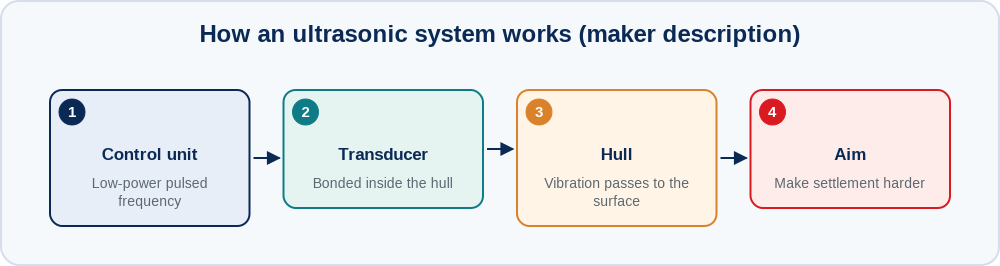
According to PBO’s review, ultrasonic antifouling consists of electronic systems that emit a low-powered, pulsed ultrasonic frequency from a digital control unit through transducers attached to the inside of the hull; the idea is that the emitted sound waves discourage fouling from taking hold. PBO notes the systems are designed for DIY installation, have been in the leisure market for nearly ten years and that by spring 2014 five main companies offered systems of varying price and specification. This article is a general summary; it recommends no product and gives no guarantee of effectiveness.
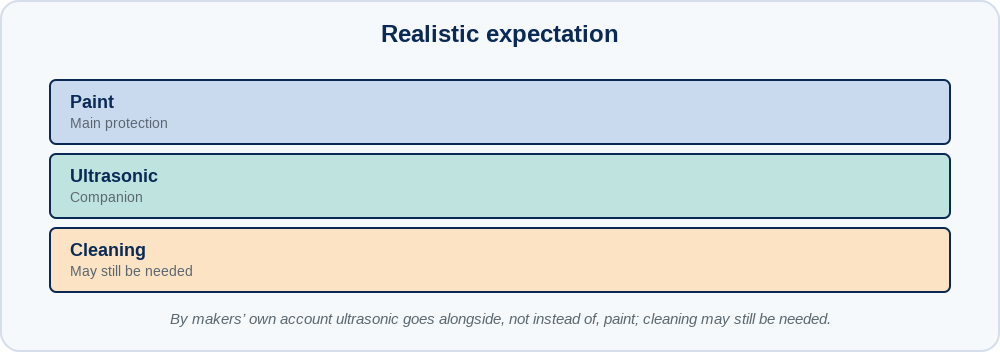
Makers and magazine writers mostly present ultrasonic not as a replacement for paint but as a companion that extends the paint’s life and reduces the fouling that builds up. PBO likewise says ultrasonic is a companion, not a replacement. The maker in the Practical Sailor test also recommended using the device together with an antifouling paint.
2. What do the test results say?#
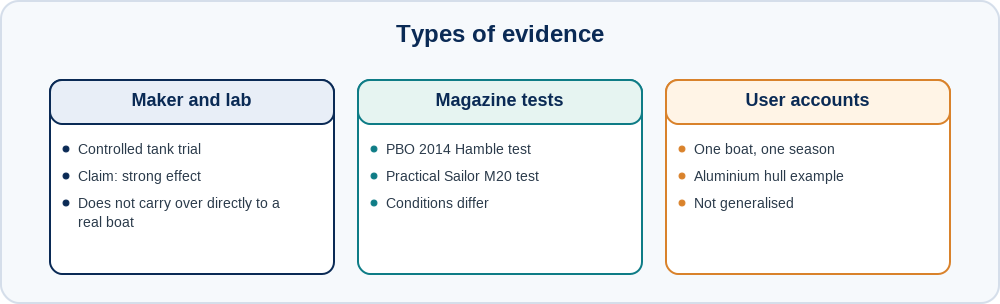
PBO writes that when it last tested ultrasonic antifouling in 2009 there were only two companies on the market but that by spring 2014 there were five main companies, so with the help of the Hamble School of Yachting it tested systems available on the UK leisure market over the summer of 2014. The test year was a bad year for fouling on the Hamble, with hot weather and warm water, described as a tough test for the devices. For which system gave what result, see PBO’s own article; we do not assess the outcome here.
Practical Sailor installed SmartAntifouling’s M20-12-2 on its 1982 Cape Dory 25 test boat in Sarasota, Florida and, in line with the maker’s advice, coated the hull with a metal-free antifouling paint. The magazine reports that when the test began the paint was two months old and the hull freshly cleaned, and that one month later the hull was covered with algae and small to medium barnacles. A control boat in the mooring field also had a disappointing amount of fouling; the magazine says it would not suggest the device caused the early onset of hard growth and slime but that the device made no significant improvement to the fouling protection on its boat. This is one boat and one location; results cannot be transferred directly to other conditions.
| Source type | What it says | Caution |
|---|---|---|
| Maker / laboratory | Claim of strong effect in a controlled tank | Does not carry over directly to a real boat |
| PBO 2014 Hamble test | Several systems tested | See the source for results |
| Practical Sailor M20 test | No significant improvement seen | One boat, one place |
| User account (SAIL) | No growth seen on waterline (aluminium hull) | One boat, one season |
3. Maker claims and user accounts#
An article published in Sail-World in 2013 describes a winter-long laboratory experiment with Ultrasonic Works’ ClearHull system in which Solent water was pumped into control tanks, one tank left unprotected and others protected with different ultrasonic frequencies. That is a maker account, and a laboratory tank may not reflect hull movement, differences in light and nutrients, hull material or vibration transmission on a real boat. The BPS Marine presentation on BoatTest likewise presents the system as a non-toxic alternative using physics rather than chemistry; that too is a promotional text.
In SAIL a writer says that because he did not want to use copper-based paint on his aluminium hull he installed an Ultra 20 system in late 2010 and saw no growth along the waterline at a high-growth mooring in Portland, Maine; he also notes he painted the hull with another zinc-based antifouling at the same time. In Yachting Monthly a writer who keeps a boat on the River Schlei on Germany’s Baltic coast describes adding an ultrasonic system on top of Coppercoat. These are single-boat, single-place accounts of limited duration; it is not possible to separate the effect of paint from ultrasonic and they cannot be generalised.
4. Realistic expectation and limits#
According to Practical Sailor, the maker said that when the M20 is used together with an antifouling paint hull cleaning will still be necessary, but that it should entail only wiping away soft growth rather than scraping off large barnacles; the maker’s representative also said a full and absolute antifouling is not possible and that they expected at least an improvement. These vendor statements show that reasonable expectation is limited: the device is a layer of protection, not a guarantee on its own.
That installation requires transducers to be bonded inside the hull and that factors such as hull material, sandwich construction, bulkheads and bilge can affect transmission of vibration is a general engineering observation and carries no numeric value from a specific source. For your own boat’s construction consult the maker’s instruction and independent tests.
- Read the results of the maker and of independent tests separately.
- Plan the paint system alongside, not instead of, the ultrasonic.
- Verify the installation instruction for hull structure and material.
- Check power consumption and installation requirements.
- After installation inspect and record the hull regularly.
- Judge the results against your region’s fouling pressure.
- If needed seek views from the maker and local users.
5. Questions to ask when deciding#
When considering an ultrasonic system ask: what independent test or field data exist and under what conditions were they made? Is there a difference between the maker’s claim and independent test results? Are your hull material and structure suitable for installation? How are you planning the paint system? How will you meet the need for cleaning? The answers lead not to a product recommendation but to an assessment based on your own conditions.
The experience of users and yards in your area also matters; results may differ in high-fouling regions. Read user accounts as single-boat examples.
5b. Aluminium hulls and copper-free options#
The SAIL writer says he turned to ultrasonic because he did not want to use copper-based paint on his aluminium hull; that copper paints carry galvanic risk on aluminium hulls is stated in other sources too (see the copper-free options and aluminium articles). Ultrasonic can be part of a copper-free route, but the level of evidence is limited; so on metal hulls consider the maker’s approved copper-free system together with, if wished, an ultrasonic companion.
Each copper-free and paint-free option carries a different trade-off; silicone foul-release coatings and cleaning methods are covered in related articles. This article prefers none of them over another.
6. Common mistakes#
- Assuming ultrasonic fully replaces paint.
- Treating a maker’s laboratory result as a real-boat result.
- Making a single-boat account a general rule.
- Comparing without a control boat.
- Not checking hull structure and material.
- Giving up cleaning and inspection.
- Neglecting the paint system.
7. Checklist#
8. Conclusion#
Ultrasonic antifouling is a system emitting low-power pulsed frequency through transducers bonded inside the hull and makers generally say it goes alongside, not instead of, paint. Magazine test results are mixed; in Practical Sailor’s M20 test no significant improvement was seen, and user accounts include positive examples but only single-boat ones. This article is general information; it recommends no product and gives no guarantee of effectiveness.
Frequently asked questions#
Does ultrasonic antifouling replace paint?
Makers generally present it not as a replacement but as a companion that extends paint life (PBO). In the Practical Sailor test the maker also recommended using the device together with paint.
What do the tests show?
Results are mixed. Practical Sailor saw no significant improvement in its M20 test; PBO tested several systems at Hamble in 2014; see the source articles for detail. User accounts can be positive but are single-boat examples.
Is a maker’s laboratory result reliable?
Controlled tank trials may not reflect real-boat conditions (movement, light, nutrients, hull material); read it as a maker claim.
Does it suit every hull material?
Sources say installation uses transducers bonded inside the hull; for hull material and layout see the maker’s instruction.
Does this article recommend a product?
No. For product, installation and expected effect see the maker and independent tests.
Was this guide helpful?
Thank you! Your feedback has been saved.
Guide content is for general information; in practice, the current technical data sheet of the product applies.
Keep reading
Related guides
Boat Colour Selection and Solar Reflectance: Effect of Heat Absorption on Surfaces
A study of the effect of boat paint colour on solar reflectance and surface temperature.
2 min read Paint and CoatingsCauses and Diagnosis of Paint Blistering
A study of the sources, types and diagnostic approach to blistering on boat paints.
2 min read Paint and CoatingsNumber of Coats in Epoxy Coating Systems
A study of the effect of the number of coats in epoxy coating systems on protective performance and thickness.
2 min read