
Paint and Coatings
What Is a Galvanic Isolator and How Does It Work?
Boats on shore power are linked through the grounding wire; a galvanic isolator aims to block the small DC current in that link. This article summarises how it works, selection points and limits, keeping maker claims apart; it is not installation or safety advice.
Short answer
Soundings writes that the galvanic isolator is installed in series with the shore-power AC grounding wire, consists of silicon diodes and a capacitor and blocks small DC galvanic currents while allowing AC fault currents to pass unimpeded. Sail magazine says these devices are 30- or 50-amp and block low-voltage DC currents under 1.2 volts. BoatUS writes that these currents flow between boats via the shore grounding wire forming a galvanic cell and that boats on shore power regularly need an isolator. An isolation transformer is an alternative method. A maker’s manual claims conventional isolators may give reduced protection against negative stray voltages on aluminium hulls. This article is general information; it is not installation or safety advice, so consult a qualified marine electrician.
Key points
- A galvanic isolator is installed in series with the shore-power grounding wire; it blocks small DC current and passes AC fault current (Soundings).
- Devices are rated 30 or 50 amp; a boat with two shore-power inlets needs separate isolators (BoatUS).
- An isolation transformer is the alternative method (Victron, BoatUS).
- Events such as lightning can fail the diodes; periodic diode checks are advised (Boating, Blue Sea Systems).
- An isolator is not the answer to stray-current corrosion or electrical safety problems; a qualified specialist is needed.
1. What is a galvanic isolator?#
Boats on shore power are connected to other boats in the marina through the green wire, the system’s grounding conductor, and that link can let low-voltage DC galvanic currents flow (BoatUS). A galvanic isolator aims to block those currents. A BoatUS article presents the isolator as a low-cost upgrade for boats with an AC power system connected to shore power; Victron writes that the same device blocks low-voltage DC currents entering the boat via the shore-power earth wire (maker). This article is a general summary; it is not installation, electrical or safety advice.
First it is worth understanding how galvanic corrosion and marina electrical leaks arise; see the related article. The isolator cuts only one link of that chain; other electrical and corrosion matters aboard must be assessed separately.
2. How does it work?#
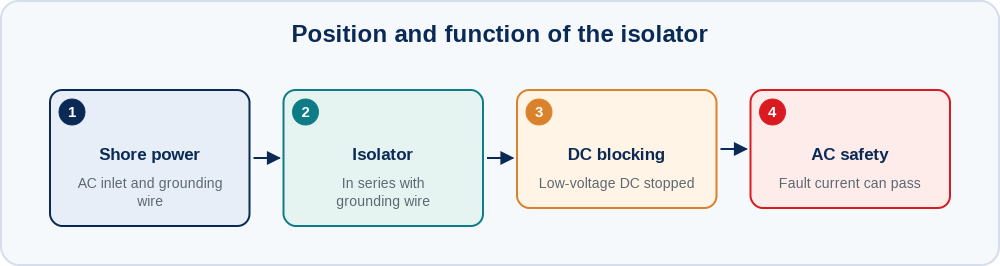
Soundings writes that the isolator is installed in series with the shore-power AC grounding wire, consists of silicon diodes and a capacitor and blocks small DC galvanic currents while allowing AC fault currents to pass unimpeded; as a result continuity of the grounding circuit is preserved. Victron’s book describes the isolator as two diodes connected in antiparallel, connected between the shore earth connection and the central earth point in the boat. Sail magazine writes that these devices are 30- or 50-amp and incorporate a pair of diodes to block low-voltage DC currents under 1.2 volts. A Boating Test article says it is essentially a resistor, that if line voltage is applied the circuit closes and the GFI or breaker trips.
BoatUS writes that the galvanic isolator needs to fulfil multiple roles: eliminating one of the components that make up a galvanic cell is one of them, and it works by introducing a low DC voltage drop in the grounding conductor. These are publication and maker accounts; details vary by product.
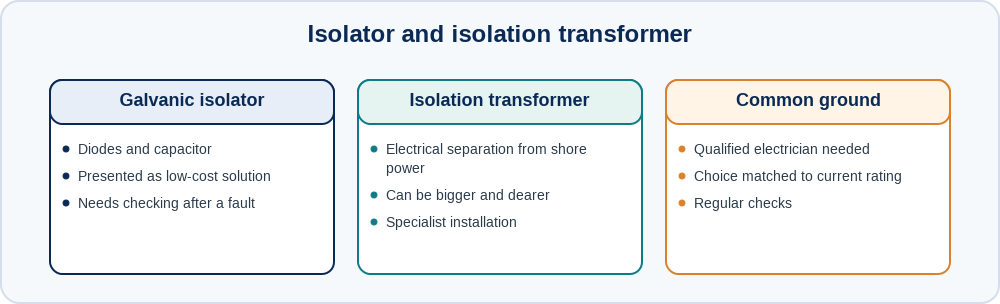
| Method | Sources’ general account | Caution |
|---|---|---|
| Galvanic isolator | In series with grounding wire; blocks DC, passes AC fault current | Diode check after a fault; qualified installation |
| Isolation transformer | Separates the boat electrically from shore power | Can be bigger and dearer; specialist installation |
3. Selection points#
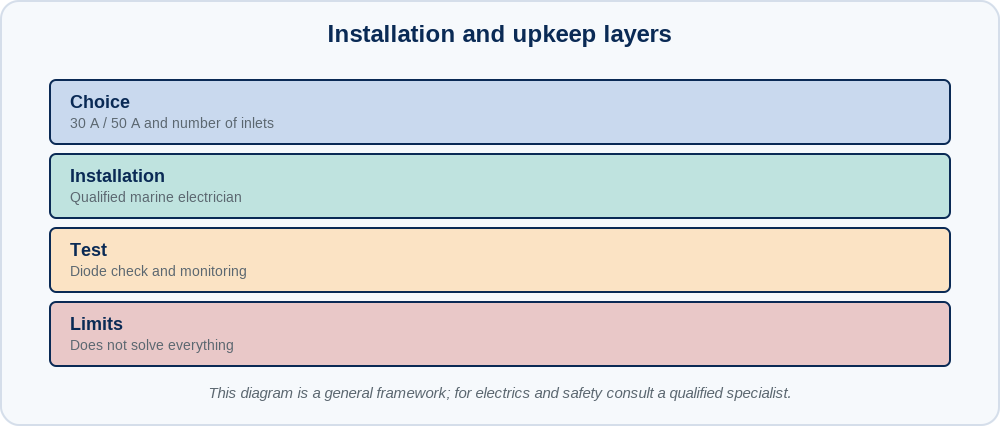
BoatUS writes that isolators are rated in two sizes, 30-amp and 50-amp, that a boat with a 30-amp cable needs a 30-amp isolator and a 50-amp cable a 50-amp one, and that a boat with two shore-power inputs needs separate 30-amp isolators for each. In Cruising World Steve D’Antonio advises that the isolator you buy has a fail-safe UL marine rating. A Boating Test article puts a basic isolator at around 300 dollars; Sail magazine gives a range of 100 to 300 dollars. Those prices are historical and source-specific; for current price and product see the maker and an authorised seller. This article recommends no product.
Isolator choice depends on the boat, the number of inlets and the electrical system; a qualified marine electrician is needed for installation and verification. Values in this article are a source summary, not a selection guide.
4. Fault, test and upkeep#
Boating magazine writes that Wayne Kelsoe, retired senior electrical engineer at Blue Sea Systems, says a lightning strike, not just on your boat but nearby in the marina, can pass massive current that causes the isolator’s diodes to fail. The same article describes a way to check the diodes with a multimeter’s diode-check function with dock and boat breakers off and the dockside end of the shore-power cord brought near the panel. That is a magazine account; any electrical work can be hazardous. This article is not a test instruction; for checking consult a qualified electrician.
Boating Test mentions isolator products with “Fail Safe” in their name; what that wording means varies by product and maker and it is a maker claim. Checking the isolator’s condition regularly and consulting a specialist when a fault is suspected is reasonable.
- Record the boat’s number of shore-power inlets and cable rating (30 or 50 amp).
- Assess the isolator or isolation transformer option with a qualified electrician.
- Discuss a fail-safe rating with the specialist.
- Have installation done only by a qualified marine electrician.
- After events such as lightning have the diodes checked by a specialist.
- Keep monitoring anode wastage.
- Keep records.
5. Limits: what the isolator does not solve#
The isolator targets the small DC galvanic current on the shore-power grounding wire; BoatUS writes that stray-current corrosion is a separate event that can do very rapid damage. An isolator is not claimed to solve stray-current corrosion or electrical danger in water by itself. A maker manual (SmartShore) writes that conventional isolators provide about 1.2 volts of isolation and that protection can be degraded by up to 80 percent against negative stray voltages on aluminium hulls; that is part of a competing product’s pitch and a seller claim. On aluminium hulls consult an electrical specialist.
Also the isolator does not guarantee the boat against electrical danger in the water; BoatUS notes even a few milliamps of AC in the water can endanger a swimmer. This article is not safety advice; if you suspect a hazard do not enter the water and contact a qualified electrician and marina management.
5b. Where sources differ#
Sources agree on the isolator’s basic function; they differ on how “necessary” it is and on alternatives. BoatUS writes that boats plugged into shore power regularly need an isolator; Boating Test presents both isolator and isolation transformer as options and says a basic isolator is a wise investment even for a smaller boat (a publication view). A maker, meanwhile, argues its own product is better than conventional isolators. These are sources with different interests; an independent specialist should decide which suits your boat.
Prices and available products change over time; figures here are accounts published at a date. Regulations and standards vary by country; see local rules and a qualified specialist.
6. Common mistakes#
- Having installation done by unqualified people.
- Choosing the wrong amp rating.
- Assuming one isolator on a boat with two inlets.
- Not having the isolator checked after lightning.
- Treating the isolator as enough for stray current and electrical safety.
- Treating a seller claim as independent result.
- Stopping anode monitoring.
7. Checklist#
8. Conclusion#
A galvanic isolator blocks small DC galvanic currents by being installed in series with the shore-power grounding wire while letting AC fault currents pass; an isolation transformer is the alternative. Current rating, number of inlets, fault condition and limits matter. This article is general information; it is not installation or safety advice, so consult a qualified marine electrician.
Frequently asked questions#
What does a galvanic isolator do?
Soundings writes that installed in series with the grounding conductor it blocks small DC galvanic currents while letting AC fault currents pass, so grounding continuity is preserved.
What current rating is chosen?
BoatUS writes that isolators are rated 30 and 50 amp, that a 30-amp cable needs a 30-amp isolator and that a boat with two shore-power inlets needs separate isolators for each. Consult a qualified electrician for installation.
How does it differ from an isolation transformer?
A galvanic isolator blocks DC current on the grounding wire; an isolation transformer separates the boat electrically from shore power (Victron, BoatTest). A transformer is usually bigger and dearer.
Can an isolator fail?
Boating magazine quotes Wayne Kelsoe, retired senior electrical engineer at Blue Sea Systems, saying lightning striking even nearby in the marina can pass massive current and make the diodes fail; a diode check can be done with a multimeter. Consult a qualified specialist.
Does an isolator solve every problem?
No. It targets galvanic current; it does not by itself solve stray-current corrosion or electrical danger in water. A maker claim says it may be limited on aluminium hulls. Specialist assessment is needed.
Was this guide helpful?
Thank you! Your feedback has been saved.
Guide content is for general information; in practice, the current technical data sheet of the product applies.
Keep reading
Related guides
Boat Colour Selection and Solar Reflectance: Effect of Heat Absorption on Surfaces
A study of the effect of boat paint colour on solar reflectance and surface temperature.
2 min read Paint and CoatingsCauses and Diagnosis of Paint Blistering
A study of the sources, types and diagnostic approach to blistering on boat paints.
2 min read Paint and CoatingsNumber of Coats in Epoxy Coating Systems
A study of the effect of the number of coats in epoxy coating systems on protective performance and thickness.
2 min read