
Paint and Coatings
Wooden Boat Caulking and Seam Compound Care
On a wooden boat seams and caulking play an important role in the watertightness of the hull; but methods vary by tradition, wood species and boat construction. This article summarises the general accounts with their limits; it is not a product, method or time recommendation.
Short answer
Caulking and seam compound on wooden boats are a traditional care area that helps limit water through the seams between planks; because wood swells with moisture and shrinks as it dries, seams move and need regular inspection. Sources describe removing old, loose filler, cleaning the seam and applying new filler by the maker’s or craftsman’s method; the choice between traditional cotton or hemp fibre and modern flexible compounds differs by boat and wood. For product, material, dimension and time the maker and a qualified caulker govern. This article is general information.
Key points
- Because wood swells and shrinks with moisture, seams move and need regular inspection.
- Removing old, loose filler and cleaning the seam is often described.
- The choice between traditional and modern fillers differs by boat and wood.
- Deck seams and end grain are described as where moisture enters most easily.
- For product, dimension and time the maker and a qualified caulker govern.
1. What are caulking and seam compound?#
On wooden boats caulking is the traditional process of filling the seams between planks with filler material and often sealing over it, to help limit water entry. Because wood swells with moisture and shrinks as it dries, seams move, loosen or deteriorate over time; so inspection and care are described as a regular matter. This article is a general summary; it gives no product, material, dimension or time and is not application advice. Sources are magazine, maker, craftsman and forum accounts and may differ from one another.
2. Inspection and the state of old filler#
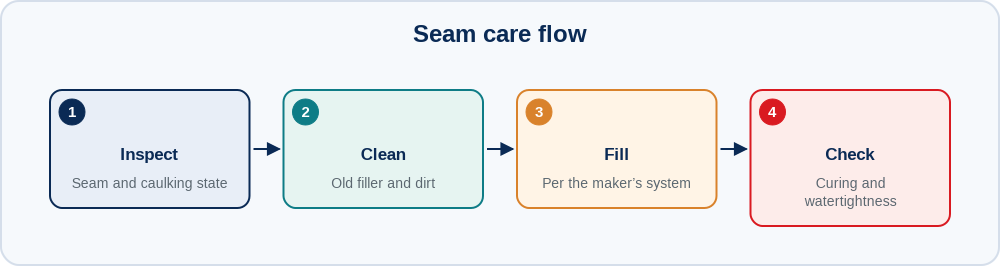
Sources describe seam care as starting with inspection: whether the filler has loosened or cracked and whether the wood at the edges shows discolouration or softening is assessed by eye and touch. Removing loose or deteriorated filler and leaving the seam clean is a commonly described step; whether sound-looking filler is kept is assessed by a craftsman. This article gives no dimension or method.
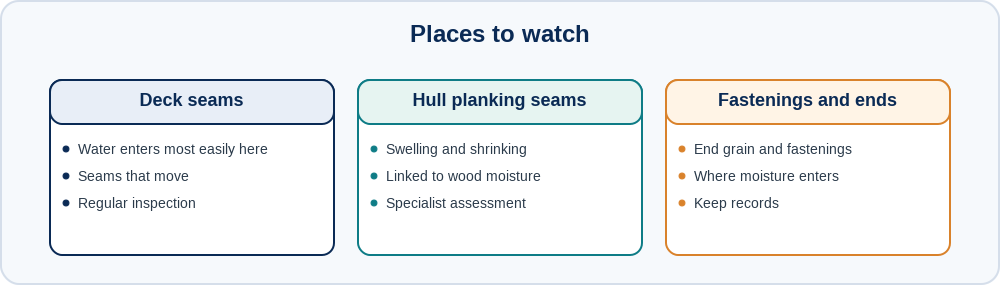
Deck seams and end grain are described as where moisture enters most easily, because these areas are directly exposed to rain and sun and movement can be more marked. The area around fastenings is also often mentioned. So these places are suggested for the regular inspection list and for recording.
| Place | Sources’ general account | Caution |
|---|---|---|
| Deck seams | Water enters most easily here | Regular inspection |
| Hull planking seams | Move with swelling and shrinking | Specialist assessment |
| Fastenings and ends | End grain and area around fastenings | Keep records |
3. Traditional and modern fillers#
In traditional caulking fibrous materials such as cotton or hemp are described as pressed into the seam and sealed over with a seam compound; modern accounts also include flexible seam compounds. Which is suitable varies by construction, wood species, deck or hull and the craftsman’s experience; sources differ on this. No choice is recommended here; the maker and a qualified caulker govern.
Compatibility between the filler and the paint system also matters: some fillers may be incompatible with certain paint or varnish systems, which can cause adhesion problems. Compatibility should always be confirmed from the product’s technical document and the maker.
4. A practical frame#
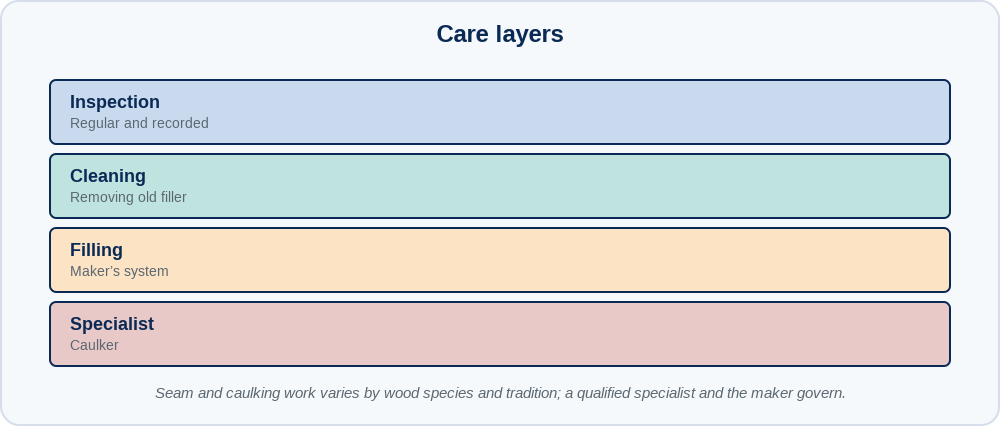
- Inspect deck seams, hull planking seams and the area around fastenings regularly.
- If there is loose or deteriorated filler ask for a craftsman’s assessment.
- Leave the seam clean; consult a craftsman and the maker for dimension and method.
- Confirm compatibility of filler and paint system with the maker.
- Apply within the maker’s window.
- Check curing and watertightness.
- Keep records; read the safety data sheet.
5. Limits#
Sources agree on the importance of regular inspection and timely care; they differ on which filler to choose and when to renew it. So there is no single right answer; the boat’s construction, the wood species and a qualified craftsman’s assessment govern. This article is not application or structural advice.
5b. Where sources differ#
Some accounts treat traditional fibre and seam compound as the right way; some describe modern flexible compounds; some find a modern compound suitable only in certain areas such as the deck. These are magazine, maker, craftsman and forum accounts speaking in different contexts and with different interests. The difference means consulting the maker and a qualified caulker for your own boat’s construction and wood.
This article summarises the general account; it may not hold for a particular boat. For product, method and time the maker’s data sheet and a qualified craftsman govern.
5c. A practical frame for reading the sources#
The sources are magazines, makers, craftsmen and forums; each writes in its own context. None knows your boat’s construction, wood species, age or seam condition. So taking the shared message, the importance of regular inspection and a compatible system, and consulting the maker and a qualified caulker for detail, is reasonable.
Removing old filler and opening seams can carry tool and dust risks, and some filler and compound products can carry health and fire risks. This article describes no personal protection or method; read the product’s safety data sheet, consult a qualified yard and follow the relevant safety rules. For concerns about hull integrity apply to a qualified specialist.
Finally, seam compound does not solve rotten or structurally weakened wood; if there is softening or discolouration around the seam its cause should be assessed first. Recording decisions and keeping the maker’s instruction helps later maintenance.
Wood species also affects the result: some species swell and shrink more with moisture, which changes how much the seam moves. Sources therefore describe stating the species and the age of the boat and asking the craftsman for an assessment accordingly. It is also often described that seams can look different between seasons, so repeating inspection in different seasons can be useful; this is a general account and gives no time.
In addition, seller and maker statements are the firm’s own account of its product and have not been independently verified. A product’s compatibility with another paint or filler should always be checked in the product’s technical document; where a document and a guide conflict, the maker’s document and a qualified craftsman’s assessment should be used.
A practical approach for a boat owner is to tie the seams to a maintenance calendar and to keep photographs and notes at each inspection. That way changes can be followed over time and a concrete record can be relied on when talking to the craftsman. This approach is described as a general maintenance habit, not a firm rule of any source.
6. Common mistakes#
- Not inspecting the seams.
- Painting over loose filler.
- Not confirming filler and paint system compatibility.
- Ignoring softening around the seam.
- Treating one source as a firm rule.
- Not reading the safety data sheet.
- Keeping no records.
7. Checklist#
8. Conclusion#
Caulking and seam compound on wooden boats are a care area that helps limit water entry and needs regular inspection; sources stress inspection and compatibility and differ on filler choice. This article is general information; it gives no product, method or time and the maker and a qualified caulker govern.
Frequently asked questions#
What is caulking?
The traditional process on a wooden boat of filling the seams between planks with filler material to help limit water entry.
Why do seams move?
Wood swells with moisture and shrinks as it dries, so seams can move with season and humidity. Ask about the wood species and a craftsman for detail.
Should old filler be removed?
Sources describe removing loose and deteriorated filler; the state of sound filler should be assessed by a craftsman.
Traditional or modern filler?
Sources differ; the choice depends on the boat, the wood and the craftsman’s experience. Consult the maker and a caulker.
How often is seam care done?
Frequency varies by boat and use; this article gives no time. Regular inspection and records are suggested.
Was this guide helpful?
Thank you! Your feedback has been saved.
Guide content is for general information; in practice, the current technical data sheet of the product applies.
Keep reading
Related guides
Boat Colour Selection and Solar Reflectance: Effect of Heat Absorption on Surfaces
A study of the effect of boat paint colour on solar reflectance and surface temperature.
2 min read Paint and CoatingsCauses and Diagnosis of Paint Blistering
A study of the sources, types and diagnostic approach to blistering on boat paints.
2 min read Paint and CoatingsNumber of Coats in Epoxy Coating Systems
A study of the effect of the number of coats in epoxy coating systems on protective performance and thickness.
2 min read