
Decision Guide
Yacht Paint Glossary: DFT, Pot Life, Flash-Off, Dew Point and Other Terms
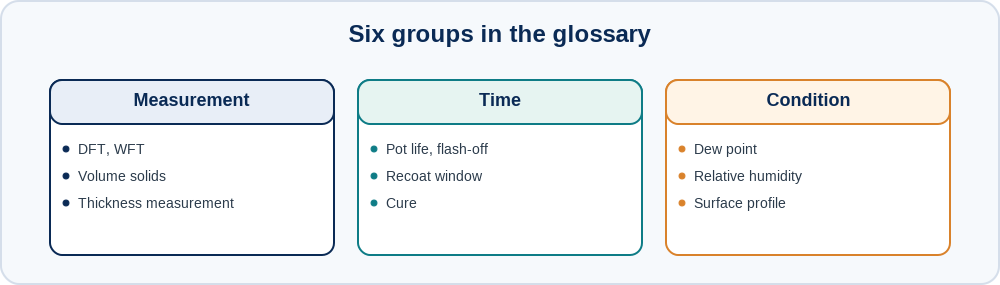
A paint technical data sheet is a clear road map to someone who knows the terms and a foreign language to someone who does not. This glossary explains thirty-five terms common in yacht paint in six groups, with why each matters on a yacht.
Short answer
The yacht paint glossary falls into six groups: measurement and thickness (DFT, WFT, volume solids), time and mixing (pot life, flash-off, recoat window, cure), surface and conditions (dew point, relative humidity, surface profile), paint types and layers (primer, epoxy, polyurethane, antifouling, barrier coat), defects (blistering, fisheye, runs) and records (data sheet, batch number, application log). Definitions rest on general paint glossaries and manufacturer sources; exact values always sit in your product’s data sheet.
Key points
- The glossary falls into six groups: measurement, time, surface and condition, paint types, defects and records.
- DFT is dry film thickness; WFT is the thickness measured while the paint is wet at application.
- Pot life is the time a mixed product stays usable; the recoat window is the time for recoating without sanding.
- The dew point is the threshold the surface temperature must not fall below; condensation is a cause of defects.
- Exact values are always in the product’s data sheet; the glossary is a general guide.
How to use this glossary#
Paint technical data sheets are full of information such as wet and dry film thickness, pot life, recoat interval and temperature limits. To someone who knows the terms this is an application plan; to someone who does not it is a source of error. This glossary explains terms common in yacht paint and says why each matters on a yacht.
The definitions rest on general paint glossaries and manufacturer sources. Exact numeric values (thickness, time, temperature) vary by product and always appear in your product’s data sheet; this glossary is not a product recommendation or application instruction. The terms are collected in six groups; you can jump straight to the group you want.
A. Measurement and thickness#
Dry film thickness (DFT)#
The film thickness measured after the paint has dried and cured. Manufacturers’ data sheets give a target DFT. On a yacht DFT is the basic data for maintenance and renewal decisions; too little film gives little protection, too thick a film raises the risk of cracking and stripping.
Wet film thickness (WFT)#
The thickness measured while the paint is still wet, at the moment of application. It is checked with a wet-film comb during application and, together with volume solids, shows in advance whether the target DFT will be reached.
Volume solids#
The percentage of the wet film that remains as dry film, given in the data sheet. It is determined under laboratory conditions with a specified application method; in real application losses can make it different. It is used in paint quantity and cost calculation.
Film thickness measurement#
Measuring coating thickness with a magnetic, eddy-current or ultrasonic gauge suited to the hull material. Done from fixed points and regularly, it forms the backbone of the paint-history file.
B. Time and mixing#
Pot life#
The time a two-component product stays usable after mixing. When it ends the product begins to gel; it shortens as temperature rises. Applying a product past its pot life is a frequent cause of adhesion and flow defects.
Induction time#
The wait required after mixing the two components before application. In some products it is needed for the chemical reaction to begin; it varies by product and is stated in the data sheet.
Flash-off#
The first stage of drying in which some of the solvents evaporate; also used for the time to wait between successive coats. If left too short, solvent is trapped and bubbles form.
Recoat window#
The maximum time within which the next coat can be applied without sanding. If exceeded the surface may have hardened too much and sanding is needed for mechanical key. It is especially important on epoxy systems.
Touch dry and hard dry#
The stage at which the film has dried at the surface (touch dry) and the stage at which it has dried through its whole thickness (hard dry); standards define test methods. A film that looks dry may not yet be cured.
Cure#
The process in which the film hardens chemically. In two-component systems it happens by reaction, in alkyds by oxygen from the air. Cure depends on temperature; it slows or stops at low temperature.
C. Surface and conditions#
Dew point#
The temperature at which moisture in the air begins to condense. If surface temperature is below the dew point moisture condenses on the paint and a dull, hazy look or blistering can result. Surface temperature should be a few degrees above the dew point.
Relative humidity#
The percentage of the moisture the air can hold that it is holding. High humidity affects drying and cure; during preparation it can carry moisture into fillers and primers.
Surface profile#
The microscopic peaks and valleys left on a surface after sanding or blasting. It is needed for mechanical key; but a very rough surface can leave too little film on high peaks.
Degreasing#
Removal of oil, silicone and release-agent residue from the surface with a suitable solvent. The water test (water spreading on the surface) indicates cleanliness. It is the most common preventer of fisheyes and loss of adhesion.
Salts and soluble contaminants#
Water-soluble salts left on the surface. After painting they can draw water through the film and cause osmotic blistering; washing with fresh water is advised.
D. Paint types and layers#
Primer#
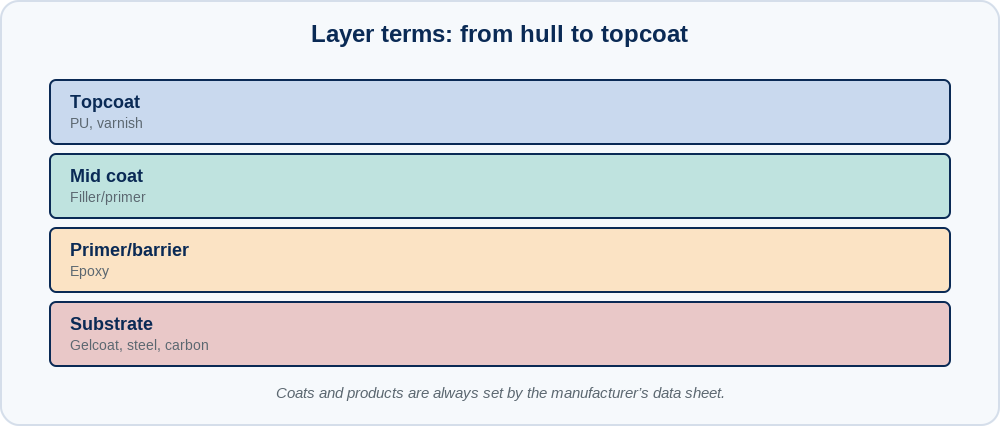
The first coat giving adhesion and protection between the surface and the topcoat. Manufacturers’ guides stress that on bare surfaces it must be applied before filling.
Epoxy#
A resin class with high chemical resistance and durability. On a yacht it is used as barrier coat and primer; it is sensitive to UV, so a UV-resistant topcoat is needed over it.
Polyurethane (PU)#
A usually two-component topcoat type known for gloss and colour stability. Common on above-water hull, topsides and superstructure.
Alkyd#
A long-used, durable resin type that cures by oxidising with oxygen from the air.
Antifouling#
A coating used on the underwater hull to reduce attachment of organisms. It comes in types such as self-polishing, hard and fouling-release; choice depends on usage profile and mooring environment.
Barrier coat#
A usually epoxy-based coat separating metal or laminate from water and oxygen. On aluminium its role between copper-based antifouling and the metal is critical.
Gelcoat#
The protective resin layer on the outer surface of a fibreglass hull. It dulls and can crack over time; its condition is assessed before painting.
Varnish#
A clear protective coat without pigment. Used on wood and bare carbon surfaces; UV-filtering types are preferred.
E. Defects and deterioration#
Blistering#
Dome-shaped blisters in the paint film formed by local loss of adhesion; they may contain liquid, vapour, gas or crystals.
Osmosis#
A blistering process caused by the movement of moisture and water-soluble substances through a film or laminate. On fibreglass hulls it is a separate subject of care and drying.
Runs and sags#
Downward movement of paint on vertical surfaces between application and setting.
Fisheye#
A round, crater-like film defect caused by contaminants such as oil or water residue.
Orange peel#
A wavy texture resulting from the film hardening before it finishes flowing out.
Cracking and alligatoring#
Fine cracks in the dry film from ageing or substrate movement; a deep, network-like pattern resembles crocodile skin, hence the name.
Chalking#
Breakdown of the binder at the surface under UV so that pigment is exposed as a powder; seen as colour fading and loss of gloss.
F. Standards, environment and records#
VOC (volatile organic compound)#
Organic solvent vapours released from paint into the air. Low-VOC and water-based products aim to reduce this release; regulation varies by country.
Batch number#
The number identifying a production batch. It is asked for in a warranty registration and in traceability; writing it into the application log is advised.
Technical data sheet (TDS)#
The document the manufacturer publishes for a product with application conditions, thickness, recoat interval and mixing information. It is the first reference for every decision.
Safety data sheet (SDS)#
The document describing the product’s hazards, protective equipment and emergency response. It should be read before painting.
Application log#
A record of equipment, environmental conditions, product quantity and batch numbers; the basic support for warranty and diagnosis.
| Term | Short meaning |
|---|---|
| DFT | Dry film thickness |
| WFT | Wet film thickness |
| Pot life | Time the mix stays usable |
| Flash-off | First drying stage where solvents evaporate / wait between coats |
| Recoat window | Maximum time to recoat without sanding |
| Dew point | Temperature at which moisture begins to condense |
| Volume solids | Percentage of the wet film left after drying |
| Primer | First coat between surface and topcoat |
| Barrier coat | Coat separating metal or laminate from water |
| TDS | The product’s technical data sheet |
How to combine the terms in practice#
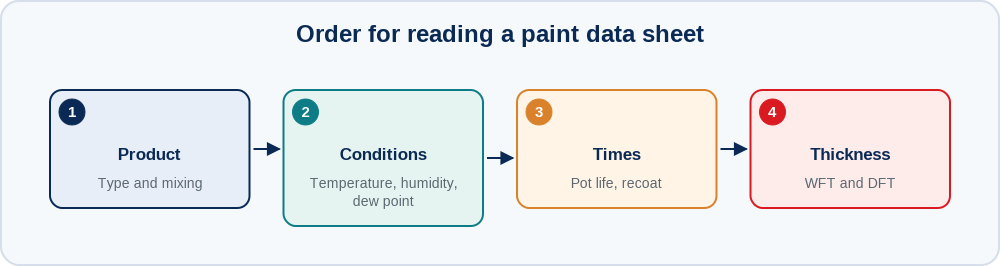
Terms carry meaning singly, but their real value appears when they are used together. For example target DFT and volume solids together tell you how many microns of wet film to apply. Pot life and temperature together set how much paint you can mix at one time. Dew point and surface temperature together show whether you can paint that day. Recoat window and flash-off together say how long to wait between coats.
This approach can be turned into a short checklist at the start of an application: which product, which mix, how many microns of wet film, what temperature and dew-point margin, interval between coats and recoat window. Writing this into the application log both prevents defects and makes it easier to find the cause when a problem arises.
Common terminology mistakes#
- Confusing DFT with WFT and taking wet film as the target thickness.
- Trying to “rescue” a mix past its pot life by adding thinner.
- Counting a film that looks dry as cured.
- Never measuring the dew-point margin.
- Trusting a user’s tip instead of the data sheet.
- Treating different systems such as epoxy and polyurethane with the same coat logic.
Checklist#
Conclusion#
Knowing paint terms is the first step in turning a product’s data sheet into an application plan. Use the measurement, time, condition, layer, defect and record terms together; for exact values always consult your product’s technical data sheet. This glossary is a general guide and can be extended with new terms over time.
Frequently asked questions#
What is the difference between DFT and WFT?
DFT is dry film thickness, the thickness after the paint has dried and cured. WFT is the thickness measured while the paint is wet, at the moment of application.
What is pot life?
The time a two-component product stays usable after mixing. Exceeding it can cause adhesion and flow defects.
What does recoat window mean?
The maximum time within which the next coat can be applied without sanding. If it is exceeded sanding may be needed for mechanical key.
Why does the dew point matter?
If the surface temperature is below the dew point moisture condenses on the paint and a dull look or blistering can result.
What is volume solids used for?
It shows what percentage of the wet film remains after drying; it is used in paint quantity, target DFT and cost calculation.
Was this guide helpful?
Thank you! Your feedback has been saved.
Guide content is for general information; in practice, the current technical data sheet of the product applies.
Keep reading
Related guides
Choosing Antifouling: A Decision Based on Usage Profile
A decision-focused study explaining how the type of antifouling should be chosen according to the frequency of use and water conditions.
2 min read Paint and CoatingsCauses and Diagnosis of Paint Blistering
A study of the sources, types and diagnostic approach to blistering on boat paints.
2 min read Paint and CoatingsNumber of Coats in Epoxy Coating Systems
A study of the effect of the number of coats in epoxy coating systems on protective performance and thickness.
2 min read