
Decision Guide
Annual Yacht Paint Maintenance Calendar: A Step-by-Step Guide for Spring, Summer, Autumn and Winter
What extends the life of paint is not one big service but regular small steps through the year. This guide explains the spring, summer, autumn and winter calendar for yacht paint and gelcoat and the monthly, quarterly and annual rhythm.
Short answer
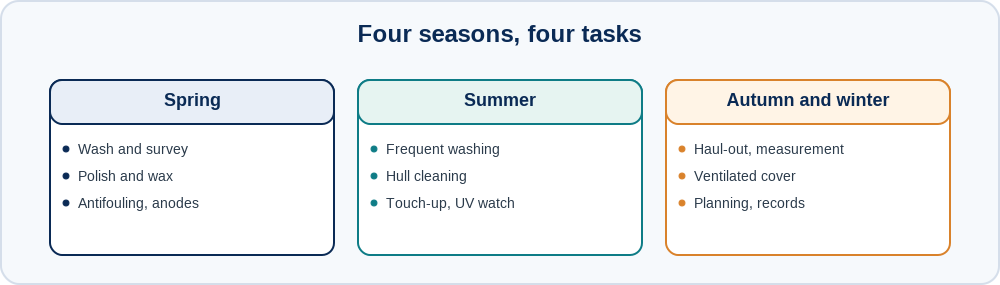
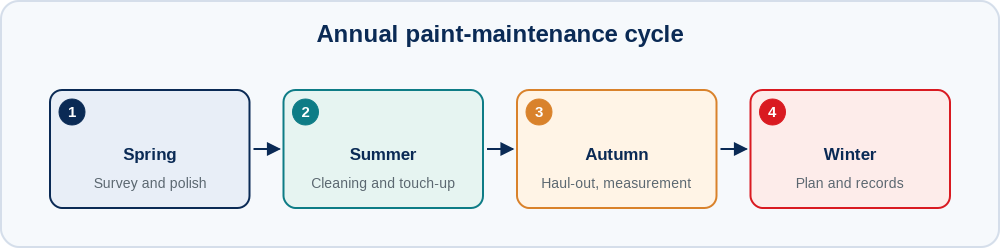
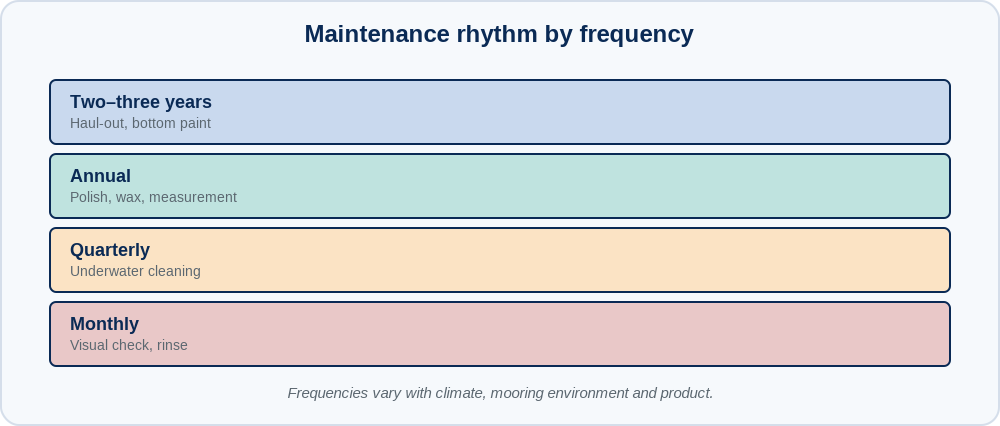
Yacht paint maintenance spreads across the seasons: in spring washing, survey, polish and antifouling; in summer frequent washing, underwater cleaning and touch-up; in autumn haul-out, thickness measurement and a ventilated cover; in winter planning, budget and record updates. As a rhythm, monthly visual checks and rinsing, quarterly underwater cleaning, annual polish and wax, and hauling out to renew bottom paint about every two to three years are suggested; the intervals vary with climate, mooring environment and product. This calendar is a general framework; your product’s data sheet and the manufacturer’s advice come first.
Key points
- Maintenance is cheaper and easier when spread across the seasons.
- Spring: washing, survey, polish and antifouling; summer: frequent washing, hull cleaning and touch-up.
- Autumn: haul-out, thickness measurement and a ventilated cover; winter: planning and records.
- Topsides polishing should come before work below the waterline; wax can foul antifouling.
- Intervals vary with climate, mooring environment and product; the manufacturer’s advice is decisive.
Why a maintenance calendar?#
What determines the life of yacht paint is often not one big intervention but small steps repeated through the year. A boat serviced on a consistent schedule performs better, holds its value longer and is far less likely to cause problems on the water. Small maintenance makes big jobs easier and cheaper; it is therefore advised not to leave everything to the annual service.
This guide offers an annual calendar focused on paint and gelcoat. The calendar is a general framework for the northern hemisphere and temperate climates; in warm, year-round regions spring commissioning and autumn layup tasks can be treated as annual service items done at a convenient interval. Intervals vary with climate, mooring environment and product; your product’s technical data sheet and the manufacturer’s written advice always come first.
1. Spring: commissioning#
Wash and general survey#
First wash the boat from top to keel and remove salt, dirt, fouling residue and moisture built up over winter. On a clean surface blistering, cracks, chalking and loss of adhesion are easier to see. Photograph every finding and enter it in a dated record file.
Topsides and hull polish#
If the gelcoat or painted surface has dulled it is first cleaned and, if needed, revived with polish; wax or a protectant follows. Waxing straight over chalky surface neither looks good nor lasts. An important order rule: topsides cleaning and polishing come before work below the waterline, because wax can foul the antifouling just beneath the waterline.
Antifouling and underwater#
Many owners apply new antifouling as part of the spring commissioning ritual. It is also a good time to check anodes, examine the propeller and look over other underwater gear. Record temperature, humidity, dew point and the product’s recoat intervals.
Metals and appendages#
Inspect the paint and anode condition of propeller, shaft, rudder and thrusters. These are areas of strong corrosion and galvanic effects; if you see blistering or white deposit, look for the root cause.
2. Summer: in-season care#
Frequent washing#
Rinsing the exterior with fresh water, especially after use in salt water, reduces salt build-up and abrasive dirt on the surface. This simple habit extends the life of paint and gelcoat.
Hull cleaning#
Depending on the mooring environment the underwater hull can be cleaned by a diver every three months or more often. Confirm that the cleaning method fits the product’s warranty terms; abrasive methods may be prohibited for some antifouling types.
Touch-up#
Noticing knocks and rubbing marks early and touching them up prevents water getting under the film. Have the product and colour code for touch-up ready at the start of the season.
Sun and UV watch#
On surfaces left long in the sun look for signs of dulling, colour fading and chalking. A chalky surface that no longer beads water is losing its UV protection.
3. Autumn: haul-out and winter preparation#
The haul-out decision#
Haul-out should be treated as a deliberate decision rather than defaulting to whatever the marina does. Plan in advance the effect of time ashore on paint, hull and equipment, and the scope of the annual maintenance.
Hull survey and thickness measurement#
When ashore, wash the hull and measure thickness from fixed points. Record fouling, blistering, cracking and antifouling wear with dated photographs; this record sets the next season’s work list.
Barrier coat and antifouling#
Autumn can be a good time for new antifouling; a barrier coat helps guard against water intrusion and gives new antifouling a solid foundation. Some owners apply in autumn, others in spring; decide by climate and mooring environment.
Cover and ventilation#
Plastic pulled tight against paint or gelcoat traps condensation under it all winter; by spring that moisture can blister or dull a finish that would otherwise have been fine. Use a ventilated cover.
4. Winter: planning and renewal#
Clean and dry storage#
A clean, dry boat fares better in storage. Hauling out, covering well and having systems drained, cleaned and checked is the recommended way to protect over winter.
Renewal work list#
Winter is the best time to plan paint renewal and repair. Gather the touch-up, blistering and adhesion findings accumulated through the season in a work list; ask the manufacturer for a written system recommendation and prepare the application log.
Budget and timing#
When choosing the paint system look beyond the price per litre to life-cycle cost. Reflect the next haul-out date, whether stripping is needed and the measurement results in the budget.
Updating the records#
Winter is when the documentation file is updated: measurements, photographs, batch numbers, warranty correspondence and maintenance records are tidied and gaps filled.
5. The monthly, quarterly, annual and multi-year rhythm#
Monthly#
Check the exterior by eye, rinse after use in salt water and walk round for new damage or blistering. Noting small findings creates small steps rather than one big list at the end of the season.
Quarterly#
Underwater hull cleaning can be done every three months depending on the mooring environment; record the result with photographs. Check anode wear and the area around the waterline.
Annual#
Polishing and waxing the gelcoat once a year keeps the glossy look and protects from sun and salt. The annual hull survey, thickness measurement and record update belong to this rhythm.
Two to three years#
Depending on water conditions, hauling out and repainting the bottom may be needed about every two or three years. This varies with the antifouling type, intensity of use and mooring environment; the manufacturer’s advice is decisive.
| Period | Main task | Note |
|---|---|---|
| Spring | Washing, survey, polish, antifouling, anode and propeller check | Topsides polish before underwater work |
| Summer | Frequent washing, underwater cleaning, touch-up, UV watch | Cleaning method must fit the warranty |
| Autumn | Haul-out, thickness measurement, barrier coat and antifouling, ventilated cover | Plastic cover traps condensation |
| Winter | Planning, budget, record update | Ask for a written system recommendation |
| Monthly | Visual check, rinse | Note findings |
| Quarterly | Underwater hull cleaning | Check anodes and waterline |
| Annual | Polish, wax, measurement | Do not wax straight over chalky surface |
| Two–three years | Haul-out, bottom paint | Varies with product and environment |
Adapting the calendar to your own boat#
To adapt this calendar to your boat ask four questions: where and in what climate is the boat moored, how many hours a year is it used, what paint system is under water, and do the warranty or insurance terms contain any restriction on maintenance? According to the answers you can tighten or loosen the intervals. For example in a harbour with heavy fouling hull cleaning may be needed more often; in a cool, little-used setting less often may be enough.
Turning the calendar into a table and adding date, person, product used and note beside each job organises both you and the applicator. These records are a natural part of the paint-history file described in our earlier articles and are valuable in warranty discussions.
An example year in practice#
To make the calendar concrete consider a hypothetical flow. At the end of March the boat is washed, findings are photographed and polishing is done; underwater work follows. In April antifouling is applied, temperature, humidity and dew point are written in the log and the boat is launched. Between June and September it is rinsed with fresh water after every outing and a diver cleans the hull every three months. In November the boat is hauled out, thickness is measured at fixed points and a ventilated cover is fitted.
Between December and February a work list is drawn up: where touch-up and where renewal will be needed and what the budget should be. A written system recommendation is obtained from the manufacturer or applicator, warranty terms are reviewed and the record file is updated. When March comes the cycle starts again, but now you hold last year’s measurements and photographs. This is the real gain of paint maintenance: going into each year better informed than the last.
Adapting to climate and type of use#
In warm, year-round regions the ideas of “haul-out” and “winter preparation” blur; spring commissioning and autumn tasks can then be treated as annual service items done at a convenient interval. In cool climates winter is a long period with the boat ashore and covered, and managing condensation, frost and moisture becomes decisive. For heavily used charter boats the frequency of cleaning and touch-up rises; for a boat used a few weeks a year measurement and records come to the fore.
In any scenario the skeleton of the calendar is the same: inspect, clean, protect, measure, plan and record. Adjust frequencies and details to your own setting; where you are unsure consult the manufacturer’s written advice.
Checklist#
Common mistakes#
- Leaving all maintenance to the annual service.
- Waxing straight over chalky surface.
- Doing topsides polishing after work below the waterline.
- Pulling plastic tight on paint and covering without ventilation.
- Not checking the warranty terms for the cleaning method.
- Not recording findings and dates.
Conclusion#
Paint maintenance is cheaper and easier when spread across the seasons. Survey and polish in spring, clean and touch up in summer, measure and haul out in autumn, plan and update records in winter. Adapt intervals to your own climate and use and stay within the conditions of your product’s data sheet. This calendar is a general framework.
Frequently asked questions#
When should antifouling be applied?
Many owners apply it in spring commissioning, some in autumn. Decide by climate and mooring environment and follow the product’s conditions and intervals.
How often should the hull be cleaned?
Depending on the mooring environment the underwater hull can be cleaned by a diver every three months or more often. Confirm the method fits the warranty terms.
How often should gelcoat be waxed?
Polishing and waxing once a year keeps the glossy look and protects from sun and salt. Do not wax straight over chalky surface.
What should a winter cover be like?
Use a ventilated cover. Plastic pulled tight against paint traps condensation and can cause blistering or dulling by spring.
How often is bottom paint renewed?
Depending on water conditions hauling out about every two or three years may be needed; the interval varies with antifouling type and use.
Was this guide helpful?
Thank you! Your feedback has been saved.
Guide content is for general information; in practice, the current technical data sheet of the product applies.
Keep reading
Related guides
Choosing Antifouling: A Decision Based on Usage Profile
A decision-focused study explaining how the type of antifouling should be chosen according to the frequency of use and water conditions.
2 min read Paint and CoatingsCauses and Diagnosis of Paint Blistering
A study of the sources, types and diagnostic approach to blistering on boat paints.
2 min read UnderwaterManaging the Waterline Zone with a Paint System
A study of the special conditions around the waterline of a boat and how this zone is managed with a paint system.
2 min read