
Decision Guide
Yacht Paint Warranty Terms and the Documentation File: What Should You Record?
A paint warranty comes into play when a problem appears; but if you have no documents when the problem appears, there is no warranty. This article explains conditions common in yacht paint warranty texts and the documentation file to keep to protect your rights.
Short answer
Yacht paint warranties are usually tied to application as per the manufacturer’s specification, an application log (equipment, climate conditions, product quantity and batch numbers), and timed registration and notification. In manufacturers’ texts the defect criteria often rest on standards such as ISO 4628 (blistering, cracking, peeling; rusting) and ISO 2813 (gloss). Cleaning agents and inspection intervals during maintenance may also be restricted. This article is not legal advice; read your own warranty text and, if needed, consult a lawyer.
Key points
- A warranty usually depends on documents such as specification-compliant application, a log and batch numbers.
- In one manufacturer’s antifouling warranty, registration must be made within 14 days after application.
- Notification within 30 days of first discovery and no repair without written approval may be required.
- Defect criteria can rest on standards such as ISO 4628 and ISO 2813.
- Limits on cleaning agents and inspection intervals can affect the warranty, even unintentionally.
1. A warranty means documents#
When a yacht paint job is finished the owner usually holds two things: an appearance and a promise of warranty. The appearance changes with time; the promise stands only on documents. A warranty is given by the manufacturer or applicator in return for certain conditions being met, and proving that those conditions were met often falls to the owner.
This article explains conditions common in manufacturers’ published warranty texts and the documentation file to keep to meet them. The text is not legal advice; the exact terms of your warranty are written in your own contract and vary from country to country and product to product.
2. The application log: what is recorded?#
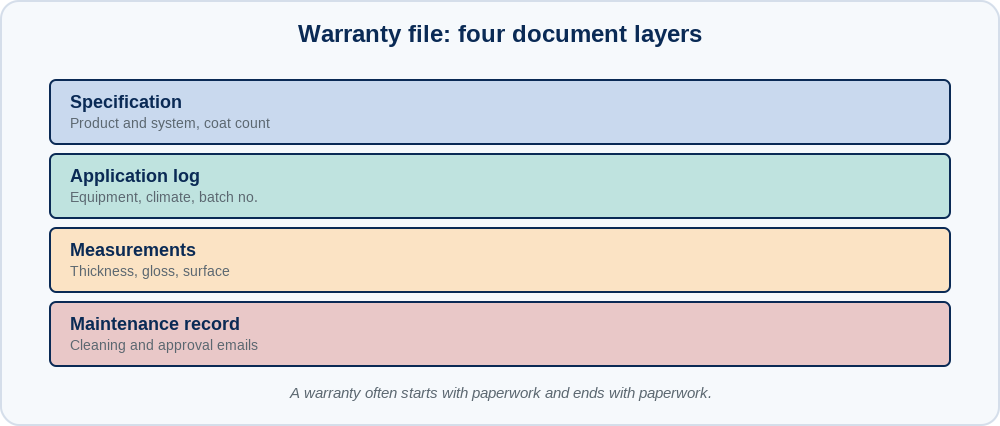
A yacht paint maker’s guarantee terms provide for coatings to be applied according to the coatings specification the maker issued for the yacht in question and for an application log to be kept. The log records the equipment used and its settings, the environmental conditions during application, and the quantity and batch numbers of the products applied. Another maker’s warranty text likewise defines the applicator, the coating system and the warranted area, and says the warranty applies to a professionally applied system.
An expert from the superyacht sector says suppliers sell their products with thorough and well-proven recommendations on climatic conditions, surface preparation and film thickness, and that all the painter has to do is follow the instructions. The same writer notes that many contracts are still signed with only limited acceptance criteria, let alone a thorough paint inspection plan, and that even when a plan exists the formal recording and sharing of information is slack.
| Document | Content | Why it matters |
|---|---|---|
| Coating specification | Products, system, coat count | Shows application matched the specification |
| Application log | Equipment, settings, conditions, quantity, batch no. | Traceability the manufacturer asks for |
| Purchase receipt and invoice | Copies of product and application invoices | Required for registration in some warranties |
| Measurement reports | Thickness, gloss, surface condition | Baseline reference |
| Maintenance and approval correspondence | Cleaning, repairs, written approvals | Proof of compliance with maintenance conditions |
3. Deadlines: registration and notification#
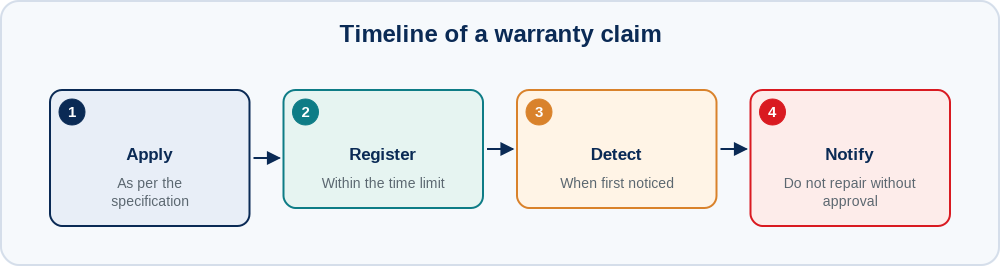
Warranty texts are often tied to deadlines. Under one manufacturer’s antifouling warranty terms, all conditions must be met to obtain a warranty: the warranty must be registered online within fourteen days of completing the paint application and the registration must contain the batch number of the paint used, a copy of the purchase receipt and a copy of the application invoice from an authorised paint centre. The same text allows warranty claims not submitted within thirty days of first discovery and not submitted through the stated online system to be rejected.
The same terms also reserve the right to reject claims that do not provide all required information and claims for repairs performed before the maker’s written approval. In other words: the clock starts when the defect is noticed, documents must be complete and written permission must be obtained before repair. These terms belong to one manufacturer; yours may differ.
4. Defect criteria: standards#
Warranty texts usually define what counts as a “defect” by reference to standards. In one manufacturer’s guarantee conditions a paint system that on visual inspection has blistered, cracked and/or peeled above a given size and density grade defined in ISO 4628/2-4-5 meets the defect criteria. On steel surfaces, rusting more severe than Ri.2 as defined in ISO 4628-3:2003 is a criterion. Another maker’s text defines gloss loss from the original level, measured at sixty degrees as specular gloss under ISO 2813:2014.
This means two things. First, the warranty rests on a measurable criterion rather than a subjective complaint such as “the paint looks bad”. Second, documenting gloss and surface condition as a baseline is valuable for meeting these criteria; the thickness and paint-history file described in the previous article is directly useful here.
5. Maintenance conditions: the quiet trap#
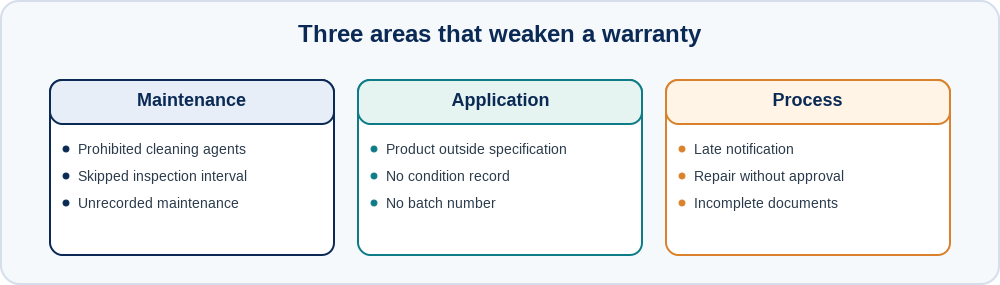
A warranty does not end with application; maintenance can also be tied to conditions. A superyacht-sector publication says many marine coatings warranties now carry strict stipulations on cleaning agents, inspection intervals and restricted maintenance techniques, and that falling outside these terms, even unintentionally, can void protection. The same publication stresses that documentation is especially important under warranty.
- Cleaning agents: only products the manufacturer allows; record product name and date.
- Inspection intervals: inspect and record at the intervals written in the terms.
- Maintenance techniques: limits on abrasive methods and pressure washing.
- Repairs: not without written approval.
- Correspondence: keep all written communication with the manufacturer or applicator.
6. Certification and standards: what exists and what does not#
There is no single “certificate” for yacht paints. One publication says ISO 12944 covers hull and superstructure preparation and used to be only for steel because of larger vessels, and that an ISO standard with criteria for a successful application process was being developed. So when you see “certified” for a paint or application, ask what is certified, to which standard and by whom. On large ships comprehensive documentation requirements arise from the IMO performance standard, such as the coating technical file; this is not directly mandatory on yachts but shows what a good record culture can look like.
7. A short case: the same failure, two outcomes#
On two yachts the antifouling flakes off earlier than expected. The first owner has no application invoice, the batch number is not recorded and the problem is reported three months later; the manufacturer may reject the claim for missing information and late notification. The second owner registered the warranty on time after application, filed the batch number and invoice, photographed the problem when noticed, reported it at once and did not repair before approval.
The second claim is not guaranteed to be accepted; but there is one less reason to reject it. A document does not guarantee the result, but it shifts the ground of the discussion in your favour.
8. Checklist#
9. Common mistakes#
- Not reading the warranty text before application.
- Not keeping batch numbers and invoice copies.
- Registering outside the period.
- Noticing a problem and repairing it without notifying.
- Using prohibited cleaning agents or methods.
- Not asking what “certified” covers.
10. Conclusion#
A yacht paint warranty is not a feeling of security but a matter of documents and process. Keep the specification, application log, batch numbers, invoice and maintenance records complete; watch the deadlines; report problems at once and do not repair without written approval. This is not legal advice; read your own warranty text and, if needed, consult a specialist.
Frequently asked questions#
Which documents does a paint warranty need?
It varies by manufacturer; example texts asked for an application log (equipment, environmental conditions, product quantity and batch numbers), the purchase receipt and the application invoice.
Is there a deadline for a warranty claim?
In one manufacturer’s antifouling warranty registration must be made within 14 days after application and notification is required within 30 days of first discovery of the defect. Check your own warranty text.
Can I do the repair myself?
Under one manufacturer’s terms, warranty claims for repairs carried out before written approval may be rejected. Write to the manufacturer first.
How are blistering and cracking assessed?
In manufacturers’ texts these defects can be defined by ISO 4628 criteria (size and density grade). Rusting on steel is graded by ISO 4628-3.
Is this article legal advice?
No. It is general information; the exact terms of your warranty are in your own contract.
Was this guide helpful?
Thank you! Your feedback has been saved.
Guide content is for general information; in practice, the current technical data sheet of the product applies.
Keep reading
Related guides
Choosing Antifouling: A Decision Based on Usage Profile
A decision-focused study explaining how the type of antifouling should be chosen according to the frequency of use and water conditions.
2 min read Paint and CoatingsCauses and Diagnosis of Paint Blistering
A study of the sources, types and diagnostic approach to blistering on boat paints.
2 min read Sealing and SikaflexDetecting Moisture Leaks Before Painting: Finding Hidden Water Paths in the Hull
A study of detecting hidden moisture leaks in the hull and deck before painting and their effect on the paint system.
2 min read