
Paint and Coatings
Painting Carbon Fibre and Epoxy Composite Yacht Hulls: Preparation, Primer and System Choice
Carbon fibre and epoxy composite hulls stand out for being light and stiff; from a paint point of view surface preparation is the critical stage. This article explains the order followed when painting a bare carbon/epoxy surface and common mistakes.
Short answer
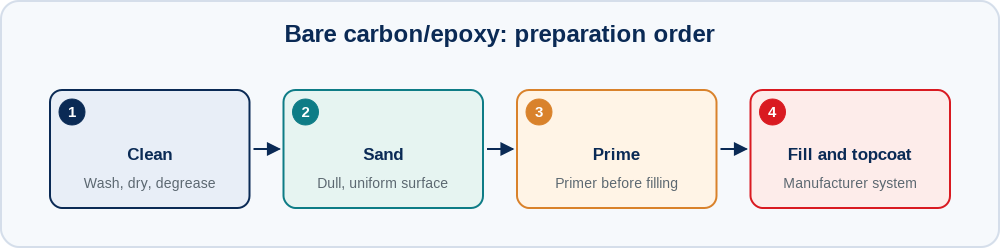
On a bare carbon fibre or epoxy composite surface the paint system proceeds with cleaning, degreasing, dull and uniform sanding, primer before filling and coats approved by the manufacturer. According to a paint maker’s guide a coat of primer must be applied to bare surfaces before any filling or fairing; the sanded surface must be dull and uniform, and even small glossy spots can spoil adhesion. Temperature, humidity and dew point should be watched for quality. This article is a general guide; products and coat count are set by the manufacturer’s data sheet.
Key points
- On bare carbon/epoxy the order is: clean, degrease, sand, prime, then fill and topcoat.
- According to a manufacturer’s guide, primer is mandatory on bare surfaces before filling.
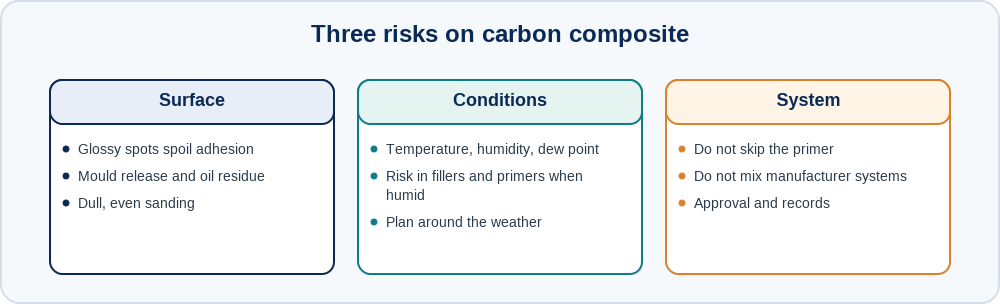
- The sanded surface must be dull and uniform; small glossy spots can spoil adhesion.
- Plan for temperature, humidity and dew point; high humidity can affect fillers and primers.
- Products and coat count are set by the manufacturer’s data sheet; do not mix systems.
1. Why are carbon and epoxy composite a separate paint subject?#
Carbon fibre and epoxy composite hulls are becoming common on high-performance yachts and modern boats. On these materials paint is not merely a cosmetic coat; it protects the laminate from chemical and mechanical effects, sets colour and gloss and shapes how maintenance goes. A bare carbon or epoxy surface is already hard and smooth; for exactly that reason surface preparation becomes decisive for adhesion.
This article explains the general preparation order and common mistakes. The text is not a product recommendation; coat count, thickness, waiting times and product choice must be set by the manufacturer’s data sheet and written system recommendation. Assessing the carbon structure itself (laminate quality, cure state, mould release) from the paint point of view is a job for the boat builder or a specialist applicator.
2. Cleaning and degreasing#
A yacht paint manufacturer’s guide for bare epoxy composite/carbon fibre starts with a clean surface: if needed the surface is rinsed with fresh water and loose dirt removed; a hard sponge can be used. Degreasing with a specialised cleaning product follows. Another guide from the same maker gives a simple test to tell whether the surface is sufficiently degreased: if water spreads across the surface while rinsing it is clean; if small droplets remain, the cleaning must be repeated.
The same guide recommends a slow-evaporating solvent (so there is enough time to wipe) and changing cloths regularly so that dirt is not spread back onto the surface. Mould-release or oil residues are a frequent problem on composite surfaces; the degreasing step should therefore not be skipped and should be repeated before and after sanding.
3. Sanding: a dull, uniform surface#
Sanding creates the surface to which the paint mechanically keys. According to the manufacturer’s guide the surface after sanding must look dull and uniform; even small glossy spots or areas can prevent the paint system from adhering adequately. The grit depends on the laminate; one manufacturer’s guide suggests various sanding grits (for example 120–180 and 320–400) for primer application. Sanding dust must be removed with clean compressed air, a brush, a vacuum or fresh water.
It is important to avoid over-sanding and not to reach the structural layers of the laminate, so as not to damage the carbon fibres. This calls for specialist judgement, especially on thin laminates.
| Step | Aim | Check |
|---|---|---|
| Rinse and clean | Remove dirt and loose particles | Is the surface dry and clean? |
| Degrease | Remove oil and release residue | Does water spread on the surface? |
| Sand | Provide mechanical key | Dull and uniform? |
| Dust removal | Remove remaining dust | Clean by cloth/air? |
| Primer | Seal the surface | Applied before filling? |
4. Primer: before filling#
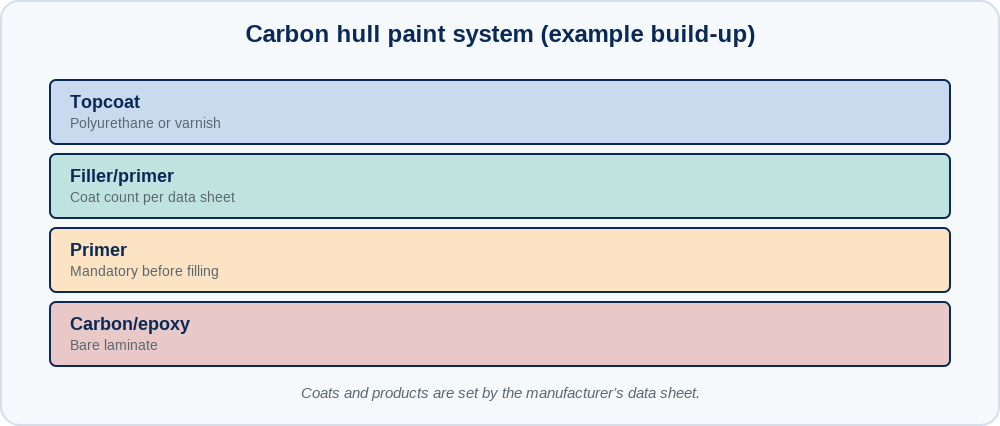
The manufacturer’s guide sets a clear rule: on all bare surfaces a coat of primer MUST be applied before proceeding with any filling and/or fairing. After this work the second and subsequent coats of primer are applied, followed by the rest of the chosen above- or below-waterline system. The same guide also says that if filling is needed it should be done after the first coat of primer. A marine retailer’s guide likewise recommends applying primer to repaired areas as soon as the filler cures to keep moisture out.
The practical consequence: breaking the order on a carbon or epoxy surface (filler first, primer after) puts the whole system at risk. The primer provides both adhesion and the barrier between filler and laminate.
5. Weather and humidity#
The guides advise checking the weather when planning the project: temperature, humidity and dew point affect the quality of the work. A marine retailer’s guide says high humidity during preparation stages can introduce moisture contamination into fillers and primers. Two-component paints cure by a catalytic chemical process, so working conditions should be fairly specific; the same guide suggests applying two-part polyurethane preferably indoors at a constant temperature of 54–77 °F (about 12–25 °C). This range comes from one product advice; the range in your own product’s data sheet is decisive.
6. System: from primer to topcoat#
The choice of topcoat depends on where the hull is used (above water, below water, topsides, deck) and the desired look (gloss, matt, varnish). For those who want to leave the bare carbon visible, manufacturers have published special varnish guides for bare epoxy/carbon fibre; in varnishing the surface is likewise degreased and rinsed. On a painted hull a build-up of primer, filler/primer and topcoat (for example polyurethane) is constructed.
- Ask the manufacturer for a written system recommendation: products, coat count, thickness, waiting times.
- Clean and degrease; verify with the water test.
- Sand: dull and uniform surface; remove the dust.
- Apply primer first; fill after the primer.
- Apply filler/primer and topcoats at the data-sheet intervals.
- Record measurements and conditions.
7. Common mistakes#
- Applying filler straight to a bare surface without primer.
- Degreasing once only and skipping the water test.
- Leaving glossy spots unsanded.
- Working in high humidity or near the dew point.
- Mixing different manufacturers’ products without approval.
- Sanding the laminate more than needed.
8. A short case: the same hull, two preparations#
On two panels of the same laminate the first is only wiped, lightly sanded and filled directly. The second is rinsed, degreased (with the water test), sanded dull and uniform and primed before filling. After a few seasons blistering and peeling begin around the filler on the first panel while the second panel stays sound.
This is not an experiment but an example of why preparation is decisive. Real results vary with product, laminate and conditions.
9. Checklist#
10. Conclusion#
On carbon fibre and epoxy composite hulls the success of the paint depends largely on preparation. Clean and degrease the surface, sand it dull and uniform, prime before filling, watch the weather and stay with the manufacturer’s system. This order is the most reliable way to secure both the look and the life of the paint.
Frequently asked questions#
Can bare carbon fibre be painted directly?
No. According to a manufacturer’s guide a coat of primer must be applied to bare surfaces before any filling or fairing; further primer coats and the chosen system follow.
How should the surface be sanded?
The sanded surface must be dull and uniform. Even small glossy spots can prevent the paint system from adhering. The grit varies with the laminate; follow the manufacturer’s advice.
How do I know the surface is degreased?
According to a guide, if water spreads across the surface while rinsing it is clean; if small droplets remain, repeat the cleaning.
Does humidity affect the paint?
Yes. According to a marine retailer’s guide high humidity during preparation can introduce moisture contamination into fillers and primers. Plan for weather, temperature and dew point.
Which product suits a carbon hull?
It depends on the maker’s system, where the hull is used (above or below water) and the data sheet. Ask the manufacturer for a written system recommendation rather than a product name.
Was this guide helpful?
Thank you! Your feedback has been saved.
Guide content is for general information; in practice, the current technical data sheet of the product applies.
Keep reading
Related guides
Detecting Moisture Leaks Before Painting: Finding Hidden Water Paths in the Hull
A study of detecting hidden moisture leaks in the hull and deck before painting and their effect on the paint system.
2 min read UnderwaterChoosing Antifouling: A Decision Based on Usage Profile
A decision-focused study explaining how the type of antifouling should be chosen according to the frequency of use and water conditions.
2 min read Paint and CoatingsNumber of Coats in Epoxy Coating Systems
A study of the effect of the number of coats in epoxy coating systems on protective performance and thickness.
2 min read