
Paint and Coatings
Advantages of Hybrid Antifouling Paints
“Hybrid” antifouling is presented as a middle path between hard and eroding types. This article summarises the claimed advantages of hybrids, what each source says and where those claims are limited, using general sources.
Short answer
Hybrid or semi-eroding antifoulings are said to combine the durability of a hard type with the slow wear of an eroding type and to build up less than a hard type. Powerboat magazine writes that there are many hybrid products splitting the difference between hard and soft; but most advantage claims are seller and manufacturer statements and vary by product. Yachting Magazine quotes a manufacturer executive saying the terms “hard” and “ablative” are being blurred by new technology. So look at the definition in the data sheet, the use pattern and independent test results rather than the “hybrid” label. This article is general information and recommends no product.
Key points
- Hybrid or semi-eroding products are presented as a middle path between hard and eroding types.
- Claimed advantages: durability from the hard type, slow wear from the eroding type and less build-up.
- Most advantage claims are seller and manufacturer statements; independent verification is needed.
- The terms “hard” and “eroding” have blurred with new technology; “hybrid” can also be a marketing label.
- Data-sheet definition, use pattern, existing system and regulation decide the choice.
1. What does “hybrid” mean?#
In the antifouling world products are traditionally split into hard and eroding. Products called hybrid or semi-eroding are presented as a middle path between the two. Powerboat magazine writes that there are many hybrid or semi-ablative antifoulings splitting the difference between hard and soft. A German retailer says hybrid antifoulings combine the advantages of hard and self-polishing types. We should also note that International Yacht Paint describes a subgroup of hard types containing a fluoro micro-additive aiming for a smoother, faster film than a standard hard type; but that is not a hybrid definition. This article is a general summary; it neither recommends nor praises a specific product.
The most important warning here: the word “hybrid” has no firm, standard technical definition. What is semi-eroding for one maker may be “dual-resin” technology for another. Yachting Magazine quotes a manufacturer executive saying the terms “ablative” and “hard” are starting to get blurred because of new technology. So assess a product not by its name but by the definition and behaviour information in its data sheet.
2. Claimed advantages and their sources#
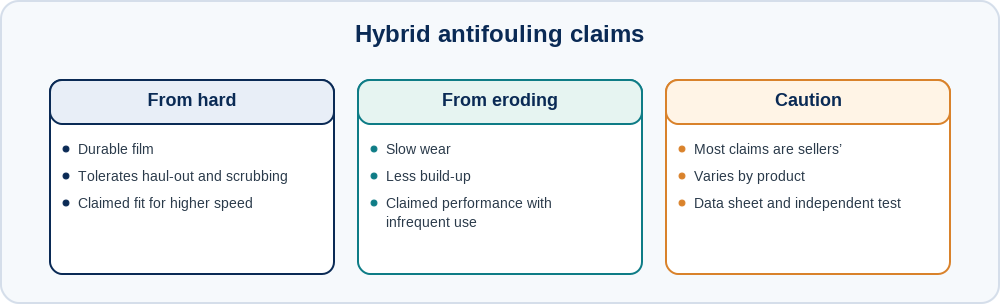
Advantages often listed for hybrids are: the sturdiness of a hard type and its tolerance of scrubbing and haul-out; less layer build-up over the years thanks to the slow wear of an eroding type; a wider range of use for moderate-speed and mixed-use boats. A US retailer presents its own hybrid product as a film combining the structural durability of a hard paint with gradual self-polishing like a seasonal ablative, reducing the layer-on-layer build-up seen with hard paint. Soundings describes a manufacturer’s “dual-resin” technology as combining the advantages of a hard paint with those of an ablative, the hard surface gradually polishing off in use. These accounts come from sellers and manufacturers; they should be read as claims, not as results verified by independent measurement.
Powerboat magazine writes that with a semi-ablative product hauling about once every 18 months and giving a light wet sand with 80 grit can be enough, removing the spent surface and exposing the biocide beneath; the same source says hard or semi-ablative types suit boats used at high speed and regularly hauled. That is one magazine’s practical advice and varies with boat and region.
| Claim | Source type | Caution |
|---|---|---|
| Durability of a hard type | Seller and maker | Varies by product; seek independent verification |
| Less build-up | Seller and maker | Relative to hard types; not absolute |
| Performance with infrequent use | Maker | Must be verified in real conditions |
| Wide range of use | Magazine and seller | Speed and water type set limits |
| Definition of “hybrid” | Marketing | No standard definition |
3. Limits and independent evidence#
When assessing hybrid advantages look at the quality of the evidence. In large comparison tests (for example the 18-month antifouling test published by Practical Boat Owner and Motor Boat & Yachting) different types are tried side by side; but such tests are done in particular water, over a particular time and with particular products and cannot be generalised to every region. This article does not use the results of those tests for or against hybrids; it only notes that independent comparisons exist and are a different kind of evidence from a seller claim.
Product properties stated by the maker also matter: recoat intervals given in the data sheet, out-of-water (haul-out) time, compatible primers and application conditions vary by product. Regulation also differs by region; the product must be legal and approved in yours. The “less build-up than hard types” advantage of hybrids can bring compatibility issues if applied over old hard layers; consult the maker on compatibility.
4. Hybrid, hard or eroding?#
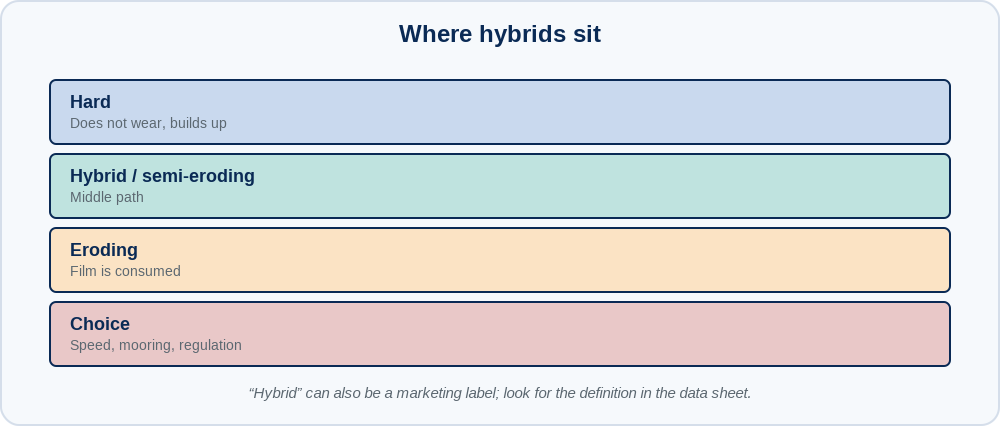
Use pattern decides. Hard types are often recommended for fast, regularly used boats, drying moorings and fresh water; eroding types for boats that stay in the water and sail regularly. Hybrids are mostly marketed for use between these two extremes: moderate speed, mixed use, boats sometimes hauled and sometimes left in the water. But a “middle” product does not always give the best result for a “middle” need; some users find a clearly fitting extreme type more predictable. This article makes no choice; for the difference between hard and eroding see the related article.
Record keeping matters here too: write down the product applied, coat count, consumption and end-of-season observations. The real behaviour of hybrids is understood only by observation on your own boat, in your own water and with your own use pattern.
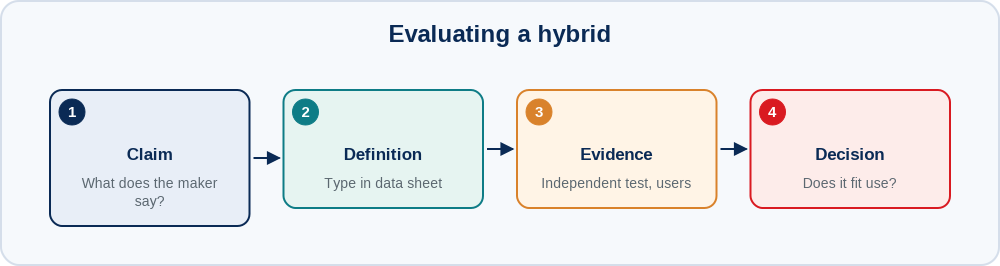
- Write down the maker’s “hybrid” claim and find the definition in the data sheet.
- Define your use pattern (speed, mooring, haul-out).
- Look for independent tests or many user experiences; do not lean on one forum comment.
- Confirm compatibility with the existing antifouling system with the maker.
- Check your region’s biocide regulation.
- Follow the data sheet for coat count and thickness.
- Record observations at season end.
5. Cost and expectation#
The cost of hybrids varies by product; some sellers argue that thanks to low build-up removal cost will fall in the long run. That calculation depends on your boat’s use, application frequency and local labour and no amounts are given in this article. Keep expectations realistic: no antifouling works trouble-free in all conditions; water temperature, fouling pressure and boat movement govern performance.
When trying a new product, testing on a small area or with your own observation in the first season is more sensible than risking the whole hull; some users use hard paint on frequently scrubbed areas such as the waterline and an eroding type on the rest of the hull. That is a single magazine’s practical tip and depends on product compatibility.
6. Common mistakes#
- Mistaking the “hybrid” label for a technical definition.
- Accepting a seller claim as independent evidence.
- Trusting a single forum comment.
- Not verifying compatibility with the old layer.
- Underestimating coat count and thickness.
- Dry-sanding antifouling.
- Not keeping end-of-season observations and records.
7. Checklist#
8. Conclusion#
Hybrid or semi-eroding antifoulings are said to combine the durability of a hard type with the slow wear of an eroding type and to build up less; but most of these claims are seller and manufacturer statements. “Hybrid” is not technically a standard definition and the terms have blurred. The decision depends on use pattern, water type, existing system, regulation and the product data sheet. This article is general information and recommends no product.
Frequently asked questions#
What is hybrid antifouling?
Products positioned between hard and eroding types, usually described as semi-eroding. Powerboat magazine describes them as products splitting the difference between hard and soft.
What is the advantage of a hybrid?
According to seller claims it combines the durability of a hard type with the slow wear of an eroding type and builds up less than a hard type. Those claims need not be independently verified.
Is a hybrid right for every boat?
No. Suitability depends on speed, use pattern, water and existing system; rely on the data sheet and the maker.
Can I trust the “hybrid” label?
Not on its own. According to Yachting Magazine the terms have blurred; look at the data-sheet definition and independent tests instead of the label.
Does a hybrid need maintenance?
Yes; the cleaning method depends on the product. As a general rule antifouling is not dry-sanded; see the maker’s instruction.
Was this guide helpful?
Thank you! Your feedback has been saved.
Guide content is for general information; in practice, the current technical data sheet of the product applies.
Keep reading
Related guides
Boat Colour Selection and Solar Reflectance: Effect of Heat Absorption on Surfaces
A study of the effect of boat paint colour on solar reflectance and surface temperature.
2 min read Paint and CoatingsCauses and Diagnosis of Paint Blistering
A study of the sources, types and diagnostic approach to blistering on boat paints.
2 min read Paint and CoatingsNumber of Coats in Epoxy Coating Systems
A study of the effect of the number of coats in epoxy coating systems on protective performance and thickness.
2 min read