
Paint and Coatings
Biocide Regulations and Antifouling Legislation
Because antifouling paints contain toxic active substances they are tightly regulated in many countries. This article summarises the logic of the EU Biocidal Products Regulation, the approval status of copper compounds and regional differences using general sources; it is not legal advice.
Short answer
In the EU antifouling paints are regulated under product type 21 of the Biocidal Products Regulation (BPR, 528/2012): first active substances, then products require approval. The Commission has approved some copper compounds such as dicopper oxide and coated copper flakes for product type 21; product authorisation is granted by member-state authorities based on environmental risk assessment and efficacy criteria. Regional restrictions on copper and use differ: for example Sweden allows reduced-copper products for most craft on the Baltic and prohibits biocide use on inland waters. Rules change over time and by region; this article is not legal advice, consult the current source and the competent authority.
Key points
- In the EU antifouling paints fall under BPR (528/2012) product type 21; active-substance approval comes first, then product approval.
- Some copper compounds such as dicopper oxide, copper thiocyanate and coated copper flakes are approved for product type 21; products still need authorisation.
- Product authorisation includes environmental risk assessment and efficacy criteria; the release-rate method can affect the outcome.
- Regional restrictions differ: Sweden allows reduced-copper products on the Baltic and prohibits biocide use on inland waters.
- Regulation changes; this article is not legal advice, check the local authority and product label.
1. Why is antifouling regulated?#
Antifouling paints release biocide deliberately to stop marine organisms attaching to the hull. That property is both the function itself and the source of environmental concern: paint enters the water over time and pollution can also arise during application and removal. The RYA notes that antifouling paint can enter the water through wear or during application or removal and can be ingested by marine life, affecting the food chain. So many regions treat antifouling under biocide regulation. This article is a general summary; it is not legal advice and does not guarantee the rules are current. For the current rule consult the competent authority and the product label.
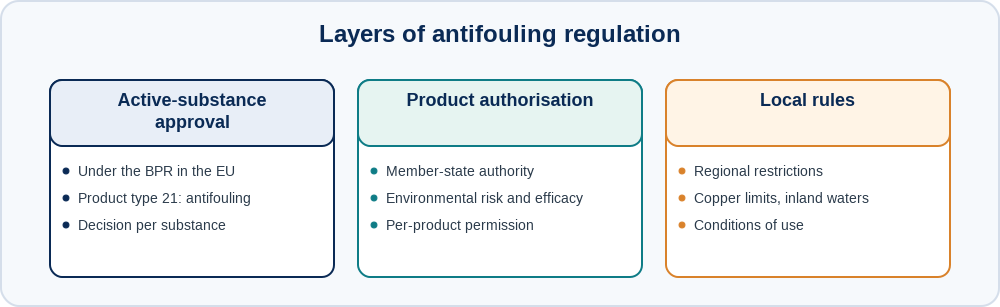
Regulation is structured around three questions: is the active substance in the paint permitted, is the product authorised in the region and do regional restrictions limit its use? The EU system is described below as an example; other regions work differently.
2. The Biocidal Products Regulation in the EU#
In the EU the making available on the market and use of biocidal products is governed by Regulation (EU) No 528/2012 of 22 May 2012 (BPR). Antifouling products fall under “product type 21”. The system has two tiers: active substances are first evaluated and approved at EU level, then products containing them are authorised. The German Environment Agency states that biocidal antifouling products are subject to authorisation in Germany. A study from Chalmers University says the harmonised product approval process under the BPR requires antifouling paints to pass an environmental risk assessment and also to meet certain efficacy criteria and that the choice of release-rate method can affect the approval outcome.
A manufacturer quoted by METSTRADE says that in Europe paints and coatings must comply with REACH and antifouling products must be registered under the BPR, and that every country has its own authority that evaluates and approves products through national approval boards. So active-substance approval is at EU level but product authorisation is at national level. For this reason do not assume the same product can be sold on the same terms in all countries.
| Tier | Who decides? | For what? |
|---|---|---|
| Active-substance approval | EU (ECHA opinion, Commission) | Use of the substance in product type 21 |
| Product authorisation | Member-state authority | Product suitability on environmental risk and efficacy |
| Regional restrictions | National and local authorities | Copper limits, water type, boat type |
| Application rules | Label and safety data sheet | Correct use, PPE, waste |
3. Copper compounds and other active substances#
Copper is the most common biocide in antifouling paints. According to an industry news report the ECHA Biocidal Products Committee concluded that dicopper oxide, copper thiocyanate and coated copper flake could be approved as active substances in commercial and yacht (leisure craft) antifouling products for both professional and non-professional users; the report also says these compounds were the only copper compounds to have received approval to that date. Commission Implementing Regulations 2016/1088 (copper flakes coated with aliphatic acid) and 2016/1089 (dicopper oxide) approve these substances for product type 21 subject to certain specifications and conditions; Regulation 2015/984 does the same for copper pyrithione. The committee also has an opinion on tralopyril under product type 21. This list is not exhaustive or current; for the current position see ECHA and Commission sources.
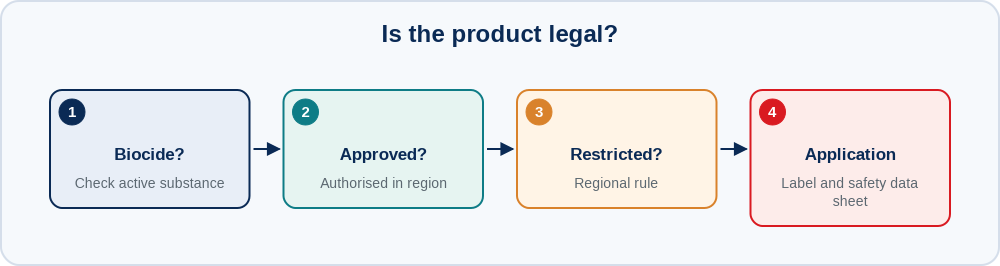
Approval of an active substance does not make a product legal; the product must also be authorised. So “copper is approved in the EU” does not mean “this copper product can be used freely in my region”. Approval decisions also carry conditions and periods; this article gives no dates.
4. Regional restrictions#
Regional rules differ markedly. The German Environment Agency notes that regional differentiation is difficult under EU BPR product approval and gives Scandinavian examples: Sweden allows only products with reduced copper content for most craft on the Baltic Sea and prohibits all use of biocidal agents in antifouling on inland waters. The same source relays that in 2016 around 19 percent of the total copper loads in German surface waters were estimated to come from biocidal coatings on pleasure craft. A Danish environmental agency fact sheet describes restrictions that vary with boat type and water type and their exceptions (for example exceptions for wooden boats in certain conditions and pleasure boats in certain harbours). In the US, Washington State enacted legislation targeting copper-based antifouling paints in 2011 and the state’s ecology department has published reports assessing alternatives in later years (including a 2024 update).
These examples show how different rules can be by region and that they change over time; none should be treated as binding information for your region. What you as boat owner and applicator need to do is verify the current rules of the harbour, marina and national authority in your area.
- Find out the active substance from the data sheet.
- Confirm the product is authorised in your region.
- Check your region’s copper limits and restrictions by water type.
- Ask marina, harbour and yard rules.
- Follow the application, PPE and waste conditions in the safety data sheet.
- Dispose of sanding dust and waste per local rules.
- Keep the documents (label, sheet, invoice).
5. Responsibility of applicator and owner#
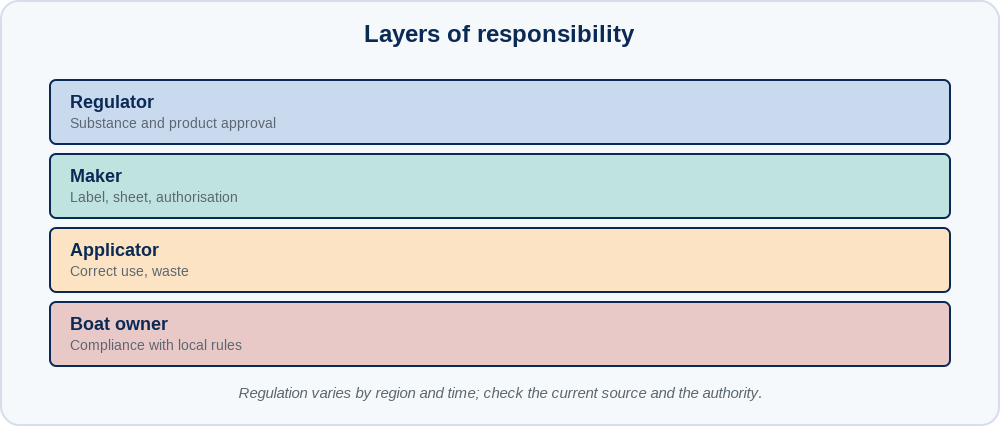
Regulation covers not only the product but its use. The label and safety data sheet define the application method, personal protective equipment and waste management. Sanding dust and antifouling residue must be collected and disposed of per local rules; entry into water and soil during removal and sanding must be prevented. For protection from toxic dust see the related article.
Marinas and yards may impose extra rules: for example that washdown areas collect their effluent or that certain products are restricted. If a professional does the application, ask in writing for the product name, active substance and authorisation status and keep records. This article is not legal or professional advice.
6. Common mistakes#
- Confusing “active substance approved” with “product legal in my region”.
- Not checking regional restrictions (copper limit, inland waters).
- Relying on out-of-date rule information.
- Not reading the label and safety data sheet.
- Not disposing of sanding dust and waste per local rules.
- Not asking for product and authorisation information in professional application.
- Applying another country’s rule to your region.
7. Checklist#
8. Conclusion#
In the EU antifouling paints are regulated under BPR product type 21: first active substances then products need approval and product authorisation is national. Some copper compounds are approved but that does not mean every product can be used freely in every region; regional restrictions differ markedly and change over time. For the current rule consult the competent authority and the product label. This article is general information and is not legal advice.
Frequently asked questions#
How is antifouling regulated in the EU?
Under the Biocidal Products Regulation (BPR, 528/2012) as product type 21; active substances are approved first, then products, and product authorisation is granted by member states.
Is copper antifouling banned?
Generally no: some copper compounds are approved in the EU for product type 21. But regional restrictions and product authorisation conditions apply; in some regions copper is limited or biocide use is prohibited.
How do I find out which rules apply?
See the product label, the safety data sheet and your region’s competent authority; rules change over time and by region.
Can antifouling be used on inland waters?
It depends on the region. The German Environment Agency relays that in Sweden all use of biocidal agents in antifouling is prohibited on inland waters; check your own region’s rule.
Is this article legal advice?
No. It is general information only; for legal questions consult the competent authority or a lawyer.
Was this guide helpful?
Thank you! Your feedback has been saved.
Guide content is for general information; in practice, the current technical data sheet of the product applies.
Keep reading
Related guides
Boat Colour Selection and Solar Reflectance: Effect of Heat Absorption on Surfaces
A study of the effect of boat paint colour on solar reflectance and surface temperature.
2 min read Paint and CoatingsCauses and Diagnosis of Paint Blistering
A study of the sources, types and diagnostic approach to blistering on boat paints.
2 min read Paint and CoatingsNumber of Coats in Epoxy Coating Systems
A study of the effect of the number of coats in epoxy coating systems on protective performance and thickness.
2 min read