
Paint and Coatings
Tent and Protection Arrangement for Outdoor Boat Painting
The way to paint without depending on the weather is to bring the boat under cover. This article summarises why a tent and protection arrangement works, how it can be built and what to watch, using general sources.
Short answer
A tent, tarp or shrink-film cover makes it easier to control painting conditions by cutting rain, dew, wind, direct sun and dust. A set-up needs a sturdy scaffold, a tightly tied cover and adequate ventilation; moisture and solvent vapour can build up in a sealed structure. Temperature, relative humidity and dew point must still be measured inside the structure. For fire, explosion and respiratory risks the product safety data sheet and local regulation govern. This article is general information; product and application conditions should be judged against the data sheet.
Key points
- A protective structure makes it easier to control painting conditions by cutting rain, dew, wind, sun and dust.
- A sturdy scaffold, a tightly tied cover and an air allowance are the base of the set-up.
- In a fully sealed structure moisture and solvent vapour can build up; plan intake and exhaust ventilation.
- Still measure temperature, relative humidity and dew point inside the structure.
- Follow the safety data sheet and local regulation for fire, respiration and waste.
1. Why a protective structure?#
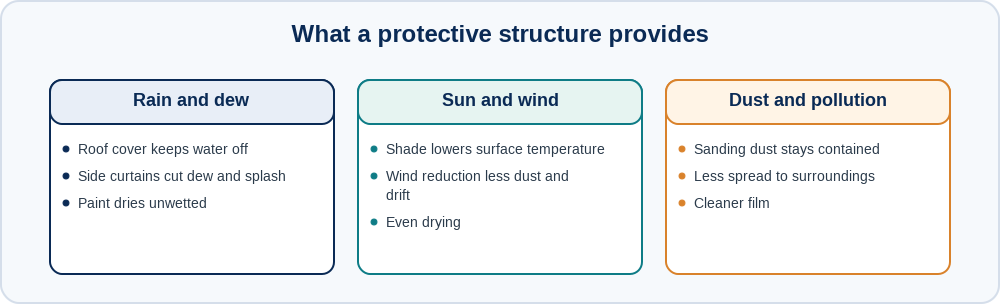
The biggest problem of outdoor painting is that weather cannot be controlled. Rain, dew, wind, direct sun and dust can spoil drying time, gloss and adhesion. Many of these factors, covered in related articles, can be eased by bringing the boat under a tent, tarp or shrink-film cover. This article summarises in a general frame why a structure works, how to set it up and what to watch; it recommends no time or temperature value for a product.
The main function of a protective structure is to make conditions predictable on painting day and through the drying period. But a structure does not provide climate control; inside, temperature, humidity and dew point must still be measured and managed.
2. Options: tent, tarp and shrink film#
Common options fall into three groups. Light framed tents can be erected quickly for small boats but are sensitive to wind. Tarp covers are reusable and cheap; but because they sit loose they can flap in wind and risk rubbing the paint surface. Shrink film is a heat-tightened, snug, long-lasting, rain-resistant cover, usually applied over a scaffold. Which method to choose depends on boat size, duration, budget and wind conditions. As a general application note the cover must not touch the painted surface and must be tied tightly.
| Option | Advantage | Watch |
|---|---|---|
| Light tent | Quick to erect | Wind-sensitive; small boats |
| Tarp | Cheap, reusable | Loose; flapping and rubbing risk |
| Shrink film | Snug, durable, enclosed | Cost; needs ventilation |
| Scaffold + cover | Sturdy, working space | Set-up time and cost |
3. Scaffold and working space#
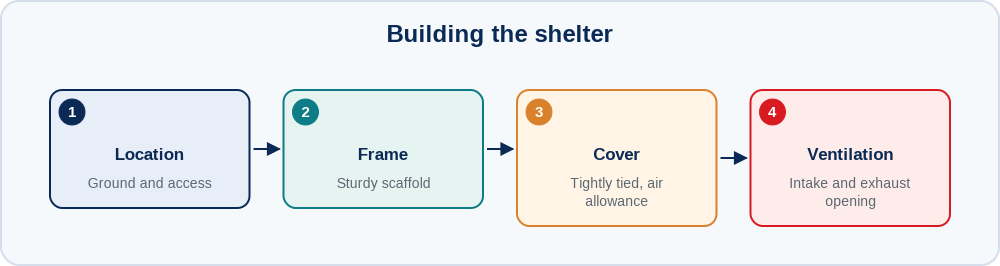
The foundation of a protective structure is a sturdy scaffold. The scaffold should form a frame that wraps the boat and leaves enough room to work; there should be no contact between cover and painted surface and the worker must move freely. The ground should be level and firm and the boat stands and scaffold must withstand wind load. Follow local occupational safety regulation for working height; this article gives no engineering calculation. If you will use heaters or lighting, assess separately the ignition risk of the cover and electrical safety.
Design access points (a door, zip or removable panel); material in and out should be easy. Plan waste management to reduce spread of sanding dust outside the structure and to comply with environmental regulation; for this see the article “Paint Remover Safety and Waste”.
4. Ventilation, humidity and dew#
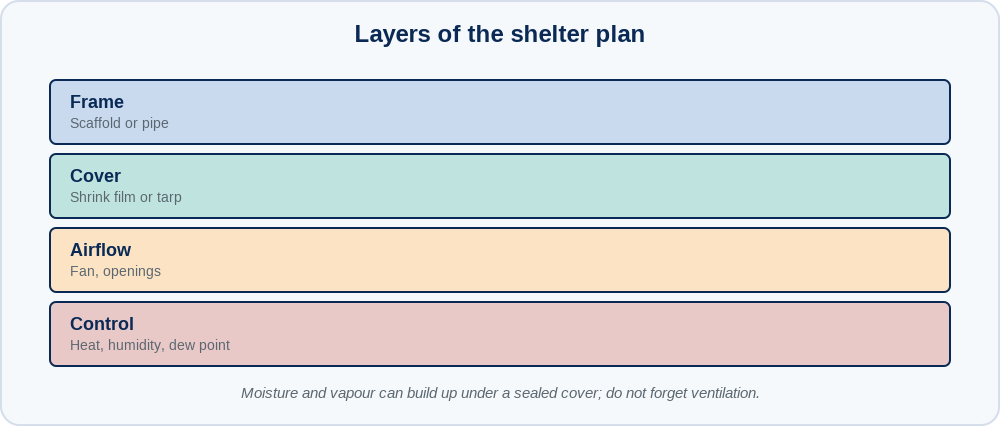
A fully enclosed structure protects paint from outside conditions but can accumulate moisture and solvent vapour inside. Without adequate ventilation solvent vapour concentrates, drying slows and fire and respiratory risk rises. Plan intake and exhaust openings; where possible use an exhaust fan and a filtered intake. Air movement should not strike the surface directly and strongly or kick up dust. For detail see the article “Enclosed Yard Paint Booth and Ventilation”.
Inside the structure temperature and humidity can differ from outside air; under a cover warming by day and cooling at night can occur. Measure dew point and surface temperature inside; the surface should be at least 3 °C above dew point. If humidity is high a dehumidifier or heating may be needed, but open-flame or exhaust-venting heaters are dangerous when solvent vapour is present; follow the safety data sheet and regulation. If you use a heater see the maker’s instruction.
- Assess location and ground suitability.
- Erect a sturdy scaffold and working space.
- Tie the cover tightly; keep it off the painted surface.
- Plan intake and exhaust ventilation.
- Measure temperature, humidity and dew point inside.
- Take fire and respiratory precautions; plan waste.
- Record the conditions.
5. Safety and waste#
In enclosed or semi-enclosed spaces solvent vapour accumulates; there is fire, explosion and respiratory risk. Follow the product safety data sheet and local occupational safety and environmental regulation; use suitable respiratory protection and control sources of fire, spark and static. This article is not legal or safety advice. Make a disposal plan in line with local rules for the cover material and for waste paint, solvent and sanding dust.
5b. Managing wind, sun and the structure#
A protective structure can behave like a sail under wind load; large flat cover surfaces carry a risk of toppling the structure or straining the scaffold. So check attachment points and tension lines regularly and plan to open or lower the cover partly when a storm is forecast. Local conditions may need an engineering assessment; this article gives no calculation.
Under a cover the effect of the sun is reduced but not removed: transparent or light-coloured covers can create a greenhouse effect inside and raise surface and air temperature. Surface temperature should be measured inside the structure too and compared with the data-sheet range. For the effects of the sun on paint see the article “Why Does Painting in Direct Sun Cause Problems?”. Repeat the measurement through the day; the difference between morning and afternoon can be large.
5c. Planning, cost and dismantling#
A protective structure is a cost item: material, labour, set-up time and disposal after dismantling. When deciding look not only at the price of the cover but also at the cost of postponements and rework. For a short simple job a structure may be unnecessary; for a multi-coat system lasting several days in a changeable climate a structure often protects the budget. This judgement varies by boat and region; no firm ratio or time is given.
Before dismantling the structure complete the drying and cure conditions in the paint’s data sheet; a cover removed too early re-exposes fresh paint to rain, dew and dust. Dismantle in calm weather and do not let cover or scaffold touch the painted surface. Sort used cover and waste material according to local rules and record what happened in the structure; it becomes valuable data for the next job.
6. Common mistakes#
- Leaving the cover loose so it rubs the painted surface.
- Building a fully enclosed structure with no ventilation.
- Not measuring temperature and dew point inside.
- Weak scaffold or ignoring wind load.
- Using open-flame or exhaust-venting heaters.
- Forgetting waste and dust management.
- Not recording conditions.
7. Checklist#
8. Conclusion#
A tent, tarp or shrink-film cover makes it easier to control painting conditions by cutting rain, dew, wind, sun and dust. A sturdy scaffold, a tightly tied cover and adequate ventilation are needed; temperature, humidity and dew point must still be measured inside. Follow the safety data sheet and local regulation. This article is general information; your product’s data sheet and the maker’s instruction govern.
Frequently asked questions#
Is a tent really necessary for painting?
It is not mandatory but makes it easier to control rain, dew, wind and sun. In regions with frequently changing weather it may reduce postponements.
What is the difference between shrink film and a tarp?
Shrink film is a heat-tightened, snug and usually single-use cover; a tarp is reusable but sits looser. The choice depends on budget, duration and structure.
Is a fully enclosed structure a problem?
It can be: moisture and solvent vapour can build up and a dew point problem can arise. Plan intake and exhaust ventilation.
Do I need to measure inside the structure?
Yes. Being enclosed does not mean conditions are suitable; measure temperature, relative humidity and dew point inside.
What should I watch for safety?
Solvent vapour can carry fire and explosion risk. See the product safety data sheet and local regulation; respiratory protection and control of ignition sources are needed.
Was this guide helpful?
Thank you! Your feedback has been saved.
Guide content is for general information; in practice, the current technical data sheet of the product applies.
Keep reading
Related guides
Boat Colour Selection and Solar Reflectance: Effect of Heat Absorption on Surfaces
A study of the effect of boat paint colour on solar reflectance and surface temperature.
2 min read Paint and CoatingsCauses and Diagnosis of Paint Blistering
A study of the sources, types and diagnostic approach to blistering on boat paints.
2 min read Paint and CoatingsNumber of Coats in Epoxy Coating Systems
A study of the effect of the number of coats in epoxy coating systems on protective performance and thickness.
2 min read